04 October 2006

Belated wishes
[cross-posted at 400 Windmills]
Last Friday was Cervantes' 459th birthday, but it's taken me this long to do something about it. Better late than never!
"Sueña Alonso Quijano"
El hombre se despierta de un incierto
sueño de alfanjes y de campo llano
y se toca la barba con la mano
y se pregunta si está herido o muerto.
¿No lo perseguirán los hechiceros
que han jurado su mal bajo la luna?
Nada. Apenas el frío. Apenas una
dolencia de sus años postrímeros.
El hidalgo fue un sueño de Cervantes
y don Quijote un sueño del hidalgo.
El doble sueño los confunde y algo
está pasando que pasó mucho antes.
Quijano duerme y sueña. Una batalla:
los mares de Lepanto y la metralla.
~ Jorge Luis Borges, Cervantes y el Quijote
["Alonso Quijano Dreams"
The man awakes in an uncertain
dream of sabers and flat fields
and he strokes his beard with his hand
and he asks whether he's wounded or dead.
Don't the sorcerers pursue him
that have sworn to his ill under the moon?
Nothing. Barely the cold. Barely an
illness of his recent years.
The hidalgo was a dream of Cervantes'
and Don Quixote a dream of the hidalgo.
The double dream confuses them and something
is happening that happened a long time ago.
Quijano sleeps and dreams. A battle:
the seas of Lepanto and the shrapnel.]
Last Friday was Cervantes' 459th birthday, but it's taken me this long to do something about it. Better late than never!
"Sueña Alonso Quijano"
El hombre se despierta de un incierto
sueño de alfanjes y de campo llano
y se toca la barba con la mano
y se pregunta si está herido o muerto.
¿No lo perseguirán los hechiceros
que han jurado su mal bajo la luna?
Nada. Apenas el frío. Apenas una
dolencia de sus años postrímeros.
El hidalgo fue un sueño de Cervantes
y don Quijote un sueño del hidalgo.
El doble sueño los confunde y algo
está pasando que pasó mucho antes.
Quijano duerme y sueña. Una batalla:
los mares de Lepanto y la metralla.
~ Jorge Luis Borges, Cervantes y el Quijote
["Alonso Quijano Dreams"
The man awakes in an uncertain
dream of sabers and flat fields
and he strokes his beard with his hand
and he asks whether he's wounded or dead.
Don't the sorcerers pursue him
that have sworn to his ill under the moon?
Nothing. Barely the cold. Barely an
illness of his recent years.
The hidalgo was a dream of Cervantes'
and Don Quixote a dream of the hidalgo.
The double dream confuses them and something
is happening that happened a long time ago.
Quijano sleeps and dreams. A battle:
the seas of Lepanto and the shrapnel.]
03 October 2006
Kids' recommendations
Last week, Bogotá's Biblioteca Luis Ángel Arango unveiled Los libros que leo, a site devoted to 1200 book recommendations and illustrations received by the children of Colombia (organized by region). Topping the list of the ten favorites? Antoine de Saint-Exupéry's The Little Prince. (Even if you don't read Spanish, the illustrations alone are worth the click.)
Back to life
Amid the flurry of visits of the past month, my sister brought books (!), including the one I hated to leave behind, Plowing the Dark. After what feels like years, I was able to do nothing but sit in a café tonight and lose myself in words...
"You see? You see? If we can make these...scratch lines come to life, then life is not just some outside thing that happens to us. It's something we come into and make."(Read about Powers' recent novel in Bookforum.)
Dalkey Archive Press moves...
...to the University of Rochester:
UPDATE 14 November...Scratch that. Not happening.
The Dalkey Archive Press, a prestigious independent publisher specializing in international literature and translations, will move to the University of Rochester in January 2007. A nonprofit publisher currently located in Normal, Ill., Dalkey releases 30 titles a year that are carried in 2,000 bookstores and libraries in the United States and Canada.(via Inside Higher Ed)
"We are delighted that Dalkey Archive Press, the premier press in literary translation, has chosen to join us at the University of Rochester," said Peter Lennie, the Robert L. and Mary L. Sproull Dean of the Faculty of Arts, Sciences, and Engineering. "Its presence on campus will help energize exciting new programs and will offer rich opportunities—particularly those focused on literary translation—to connect scholarship and professional experience."
UPDATE 14 November...Scratch that. Not happening.
02 October 2006
Medellín's poetry
According to the Poetry International Network,
The Medellín International Poetry Festival shares this year's Swedish Right Livelihood Award with Indian rights activist, Ruth Manorama and Daniel Ellsberg, the former US Defence Department official who leaked secret Pentagon documents during the Vietnam war.The latest edition of Prometeo, the journal of the Medellín festival, includes work by over 60 poets from five different regions of the world.
The prize committee cited the "The Festival Internacional de Poesía de Medellín" for promoting peace in what it called one of the most violent cities in the world. The Right Livelihood Award for justice, peace and truth-building, often referred to as "the alternative Nobel Prize", was founded in 1980 to honour work ignored by the prestigious Nobel prizes.
18 September 2006
Coffee Break
Like Stuart Murdoch of Belle and Sebastian, Patti Smith has started an online diary (although the entries don't appear to be archived). Free verse poetry to go with your morning brew.
12 September 2006
My thoughts exactly
Once again, Dan Green nails it:
In my opinion, to value fiction (or film) primarily for its ability to "make sense" through story is to move it even farther away from poetry (itself the fountainhead of all literature) and to align it with--even make it subservient to--all those other areas of inquiry where "understanding" reigns, however intuitive or partial such understanding might be where literature is concerned.This makes me want to get back to my James Longenbach reading... (And all my other reading for that matter!)
07 September 2006
Ever been had?
Libby Purves explains why the Betjeman hoax is such a good thing for "the whole trade of popular literary biography":
Sometimes it seems from the book pages that modern British readers are far keener to read clever-dick analysis and Hello!-style gossip about great writers than we are to approach their actual works, laying ourselves innocently and humbly open to what they have to say to us. It is good for publishers’ profits but less good for our souls. I was lucky enough years ago to study literature under tutors who demanded that we acquire only the most basic historical context and sketchy personal information about the masters, but who insisted that we knew each text and judged it by its intended meaning, its truth and the skill of its execution.(via Bookninja)
However good a biography, you still get closer to a writer’s heart and spirit by going back to the works themselves. It really is not necessary to know whether Jane Austen was a virgin, or which of T. S. Eliot’s wives it was who slept with Bertrand Russell. Interesting, but not essential. In youth I learnt much formative wisdom from Howards End before I ever found out that E. M. Forster was gay, or indeed a bloke at all; I read Evelyn Waugh at 12 in an equal state of uncertainty about the author’s gender, and nonetheless revelled in the acid beauty of the prose.
Later, in long university months of studying Paradise Lost, I dutifully checked up on the politics and religion of the time but felt only a passing interest in the fact that the blind poet dictated it to his daughters (and that interest was mainly because my tutorial partner and I had a theory that the damn thing was meant to be six times as long, only the duty daughter sometimes got bored and sneaked out of the room for a nap leaving Milton orating to the cat).
01 September 2006
Sound advice
Wislawa Szymborska counsels would-be poets:
(via The Page)
- “Your existential pains come a trifle too easily. We’ve had enough despair and gloomy depths. ‘Deep thoughts,’ dear Thomas says (Mann, of course, who else), ‘should make us smile.’ Reading your own poem ‘Ocean,’ we found ourselves floundering in a shallow pond. You should think of your life as a remarkable adventure that’s happened to you. That is our only advice at present.”
- “We have a principle that all poems about spring are automatically disqualified. This topic no longer exists in poetry. It continues to thrive in life itself, of course. But these are two separate matters.”
- “Rilke warned young poets against large sweeping topics, since those are the most difficult and demand great artistic maturity. He counseled them to write about what they see around them, how they live each day, what’s been lost, what’s been found. He encouraged them to bring the things that surround us into their art, images from dreams, remembered objects. ‘If daily life seems impoverished to you,’ he wrote, ‘don’t blame life. You yourself are to blame. You’re just not enough of a poet to perceive its wealth.’ This advice may seem mundane and dim-witted to you. This is why we called to our defense one of the most esoteric poets in world literature—and just see how he praised so-called ordinary things!”
- “A definition of poetry in one sentence--well. We know at least five hundred definitions, but none of them strikes us as both precise and capacious enough. Each expresses the taste of its own age. Inborn skepticism keeps us from trying our hand at our own. But we remember Carl Sandburg’s lovely aphorism: ‘Poetry is a diary kept by a sea creature who lives on land and wishes he could fly.’ Maybe he’ll actually make it one of these days?”
- “In school no time is spent, alas, on the aesthetic analysis of literary works. Central themes are stressed along with their historical context. Such knowledge is of course crucial, but it will not suffice for anyone wishing to become a good, independent reader, let alone for someone with creative ambitions. Our young correspondents are often shocked that their poem about rebuilding postwar Warsaw or the tragedy of Vietnam might not be good. They’re convinced that honorable intentions preempt form. But if you want to become a decent cobbler, it’s not enough to enthuse over human feet. You have to know your leather, your tools, pick the right pattern, and so forth. . . . It holds true for artistic creation too.”
- “Perhaps you could learn to love in prose.”
More on the state of things
Frank Kermode on English studies:
Looking back over the field he has dominated for half a century, Kermode's words are unminced. Universities, he says, "are being driven by madmen". And education in general "is being run by lunatics".(via The Page)
The recent A-level and GCSE statistics, I point out, would indicate that at one level, at least, his subject is increasingly popular. "Well," he replies, "I don't know what they call 'English' now. I can understand the attractiveness of it. But I don't hold the view that reading English is a soft option, or at least it shouldn't be. It should be a severe option, restricted to those people who are qualified to do it. I've been out of touch with student life for a long time. But I don't believe that many people nowadays get many visible benefits from studying English. It doesn't do them any harm, of course."
Is he suggesting that English should be re-engineered to be more in line with currently unpopular "hard" subjects - like physics? "Yes. I discovered just today, for example, that it's no longer compulsory at GCSE to take a foreign language. This seems to me to be a monstrous decision." [...]
"Looking back at the study of English in universities over the years the first thing that occurs to me is how very important the subject once seemed. In America the New Criticism - a school led by Cleanth Brooks and Robert Penn Warren - argued that the close study of poetry was a supremely valuable thing. This was a view that was then accepted generally. And the leading academic literary critics were, in those days, very famous people.
"Think, for example, of Northrop Frye. Frye's is now a name that you never hear mentioned but which was then everywhere. CS Lewis, who is now famous for fairy stories, was then famous for being a scholar. Tolkien too was famous for being a scholar, not for elves and so on. There is no prestige associated any longer with being a good critic. There are people writing now who seem to me likely to be as good as those critics I've been mentioning but they won't be as famous nor as influential. There's some very good scholarship in the subject still going on. There's also an immense amount of rubbish."
25 August 2006
An absurd command
From "In Sickness and in Health":
Beloved, we are always in the wrong,~ W.H. Auden
Handling so clumsily our stupid lives,
Suffering too little or too long,
Too careful even in our selfish loves:
The decorative manias we obey
Die in grimaces round us every day,
Yet through their tohu-bohu comes a voice
Which utters an absurd command--Rejoice.
Sacrifice
Spurious again, with more vibrant words:
And isn't this the oldest definition of inspiration: breath, received from outside? Divine exhalation? Breathed into the nostrils of the creator, who always creates with, and not alone. Whence figures of inspiration: muses, gods, goddesses, intermediary beings like angels or daemons - a whole bestiary, a whole angelology, a pantheon.
Breathed - or whispered, or sang - or written. Written with, so that writing is active and passive, both at once. What perfomer does not know this? What writer? And that, further, it can never be a question of self-expression.
Easier to see with fiction. The line is crossed. Easier to see with singing. The performance begins. But understand performance everywhere, a priori, from the first. Not your performance, understand. Or that outperforms what you perform, that lets you become actor or dummy. And isn't there a writing that writes with you as you write? Writes with you, but sets itself back from you; it is not in your power.
It is the angel who writes. It is your forebears. It is your race that sings inside me; your people: all this a figuration of what sets itself into a past that cannot be lived and sets itself into a future, which is why a people is always to come, even as its prototype existed in the murky past.
It is why God is waiting for what you write even as he launched you on the path of writing. And isn't the devil waiting, too? A host of angels and a crowd of Muses? To see what you write? In a sense. To see what is written by you, and by way of you.
There is writing, there is blogging - but what does that mean? In the past you did not live and the future that is ever to come. Time displaced, time out of phase: write from what does not meet itself in your present. Write from the present disjoined. No narcissism where what is written will not return. No fort-da where what is lost will not come back to you. [...]
To write is to die, always. To be sacrificed - to live, now, only as figure, as silhouette. You are not preserved. No fame - nothing lasts. No one will speak of you. Or you are the object of rumour, of a gossip that dispenses with its object, passing the word along. Torn apart, now like Orpheus, it is not your song that sings from your disembodied head. Drowned like Narcissus, but it is not you who drowns.
24 August 2006
Excitement
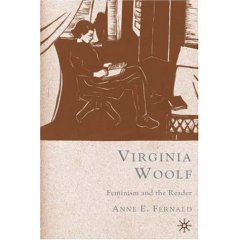 Anne's book on Virginia Woolf is now available!
 According to Amazon,
"This study argues that Virginia Woolf taught herself how to be a feminist artist and public intellectual through her revisionary reading. Fernald gives a clear view of Woolf's tremendous body of knowledge and her constant references to past literary periods."Congrats, Anne! What an amazing year this has been for you!
23 August 2006
Another one for the wish list
I love finding good reading recommendations. Here's ReadySteadyBlog again, citing an article listing the top five books written about the Bible. This one sounds fascinating:
(Incidentally, I would've added René Girard to that "top five" list. I've only read The Scapegoat, but I find his literary analysis of the Bible to be deeply engaging.)
The Book of God is an imaginative overview, sensitive to narrative detail and to stylistic nuance, of both Testaments. Josipovici sees how the Bible constitutes a unique kind of literature--a book, as he says, meant to change your sense of reality--which is nevertheless linked with certain later writers. He proposes surprising comparisons with Proust, Kafka and other modernists. Some biblical passages, he observes, "bring us face to face with characters who can be neither interpreted nor deconstructed. They are emblems of the limits of comprehension."I have yet to read any Josipovici (through lack of availability in this part of the hemisphere), but have already added three of his books to my TBR list. Hm...must do something about this the next time I head north.
(Incidentally, I would've added René Girard to that "top five" list. I've only read The Scapegoat, but I find his literary analysis of the Bible to be deeply engaging.)
Consideration
Mark Thwaite and Dan Green offer measured responses to the Günter Grass controversy--better responses than anything I've yet read from the mainstream media.
Thwaite also offers thoughts on the situation of Aharon Appelfeld, which I believe apply to that of Grass as well:
Thwaite also offers thoughts on the situation of Aharon Appelfeld, which I believe apply to that of Grass as well:
Condemning Appelfeld for his silence, which has been rendered into support for Israeli violence, seems as easy as shooting fish in a barrel. Perhaps it is useful to point out the partiality of his understanding of the "human condition", about which he has written so wonderfully well, and right to condemn his silence and the politics it suggests. But this only confirms that Appelfeld's novels are better than the man, a paradox one should remember as we read his best novels and ignore (what we imagine to be) his politics. Knowing that Appelfeld has perhaps failed to understand the full import of his own enigmatic writing makes me wish he was as good a reader as he is a writer. But good readers are as rare as good writers. And good men rarer still.
21 August 2006
Still glaring
Two weeks later and Salon has *still* neglected my continent--but for Chile. Perhaps in another month one more country might merit their notice?
Sheesh, guys. It's ok to have a work in progress, but have the decency to keep it under wraps until it's actually ready for public scrutiny. You really don't need to give people another reason to roll their eyes at the silly gringos.
Sheesh, guys. It's ok to have a work in progress, but have the decency to keep it under wraps until it's actually ready for public scrutiny. You really don't need to give people another reason to roll their eyes at the silly gringos.
20 August 2006
Advice for the forlorn
"There is no mystery in art. Do the things you can see, they will show you what you cannot see."
~ Isak Dinesen
(via Javier Marías)
~ Isak Dinesen
(via Javier Marías)
Housekeeping
Thanks to Pandora and my better half, I've added a slew of new names to the music in my head (the southwest corner of this little blog). Most of them I'm just getting to know, but after a long, silent drought, it all sounds good to me.
19 August 2006
Daily bread
In Written Lives, Javier Marías quotes from a letter James Joyce wrote to his brother Stanislaus:
Don't you think there is a certain resemblance between the mystery of the Mass and what I am trying to do? I mean that I am trying in my poems to give people some kind of intellectual pleasure or spiritual enjoyment by converting the bread of daily life into something that has a permanent artistic life of its own...for their mental, moral, and spiritual uplift.I've read opinions on this view of Joyce's that range anywhere from "blasphemous" to "arrogant," but to me, these ideas are self-evident. It may be my background, it may be my love, it may be my curse, but I will never be able to believe otherwise of the vitality of words.
03 August 2006
Doing the Snoopy dance
 Pitchfork spreads the joy:
On November 14, the Ys descend. Yes, that's the release date and title of harpist/pianist/woodland creature Joanna Newsom's much-anticipated new album, due out on Drag City. It features arrangements scored and conducted by legendary Beach Boys collaborator Van Dyke Parks, and from what we've been hearing, the record contains some looong songs.Pure bliss.
(via Ed)
01 August 2006
Pet peeve
Okay. I know I've hashed this out before, but as I continue to see this crop up in many well-meaning litblogs, I'll climb up onto my soapbox for a little litblog public service announcement...
If Gabriel García Márquez had been born in the United States, everyone would be referring to him as "García" NOT "Márquez." His first last name is García, his mother's maiden name was Márquez. This is the common practice of Latin America and Spain--the mother's maiden name is retained as the second last name. Hence Vargas Llosa, García Lorca, Pardo Bazán, Cabrera Infante, Eustasio Rivera, Cervantes Saavedra, etc.
As the redoubtable Teaching Assistant has noted,
If Gabriel García Márquez had been born in the United States, everyone would be referring to him as "García" NOT "Márquez." His first last name is García, his mother's maiden name was Márquez. This is the common practice of Latin America and Spain--the mother's maiden name is retained as the second last name. Hence Vargas Llosa, García Lorca, Pardo Bazán, Cabrera Infante, Eustasio Rivera, Cervantes Saavedra, etc.
As the redoubtable Teaching Assistant has noted,
Another extremely perverse thing is that when I'm in a bookstore, I can never find authors like Gabriel García Márquez or Federico García Lorca or Emilia Pardo Bazán where they are should be located according to proper alphabetization by last name. I've always got to resort to looking under Márquez, Lorca, and Bazán, even in the foreign language section of my university's official bookstore. I never know where I'll end up finding Lope de Vega or Sor Juana Inés de la Cruz, either... This doesn't change whether I look for the works of these authors in Spanish or in translation.Let the bookstores learn from the litbloggers, as we continue to develop the excellence of this necessary medium.
31 July 2006
Redux
I completely agree with the Little Professor, who notes:
Apparently, there's yet another TV adaptation of Jane Eyre in the works, as if the world needed yet another adaptation of Jane Eyre. (Incidentally, isn't Francesca Annis a little over-qualified for a two-bit character like Lady Ingram?) Even more so than many Victorian novels told in the first person--or, for that matter, many Victorian novels with strong narrative voices--JE is not at all suited to cinematic realism. It's not just that the novel's literary effects depend on JE's very distinctive, complex POV, but also that its events themselves often seem bizarre or bathetic when rendered in "objective" form. The "Red Room," the symbolic lightning bolt (when it's included), Rochester's "telepathic" connection to Jane, and so forth frequently appear uncomfortably comical--especially when, as is usually the case, the filmmaker strips the narrative of its theological underpinnings and turns it into a straightforward twentieth- or twenty-first century romance. That being said, I think that in JE's case an overtly stylized or even surreal aesthetic might work in an adaptation's favor.Exactly. There isn't an adaptation out there that hasn't come off as clumsy or melodramatic in parts--and the final act is invariably botched (or passed over altogether), completely missing the point of how the force of Jane's convictions fuel her strength of will. (And I liked Toby Stephens and Tara Fitzgerald in The Tennant of Wildfell Hall...but Stephens as Rochester? Doubtful.)
27 July 2006
Thin soup
Poet Scott Cairns on the perils of putting the words "Christian" and "poetry" in the same sentence:
My sense is that 20th Century American Christianity–its most vocal elements, anyway–has been a largely anti-intellectual endeavor, largely suspicious of art in general, and pretty much dumbed down in comparison to earlier epochs, making what usually passes for "Christian poetry" to be pretty thin soup. Moreover, the apophatic, parabolic, essentially poetic character of traditional theological discourse itself has been eclipsed in the most visible Christian communities by a reductive literalism, and by a disposition that has substituted arrogance for mysteries, substituted allegory for metaphor, substituted zeal for love, substituted earnestness for joy. As if that weren't trouble enough, I also sense that poetry in general has undergone a similar diminishment, wherein the poem has come to be understood as a document of experience, rather than a scene of revelation, retrospective rather than prospective.(via The Page)
Beauty as interconnection
From a 1981 interview with William Gass:
There is a view that some ideas are so obnoxious that they can't be put into a form that would be rather beautiful. Some believe there is a conflict between, for example, moral value and aesthetic value, such that viciousness can't be beautiful. I claim it can. One way of doing that is to demonstrate it. It is perfectly possible, it seems to me, for there to be a beautiful anti-Semitic speech. My present work requires me to do just that. So some of it is the challenge of creating something out of garbage, and there's a philosophical point there if you can make it. But also, the words are nothing by themselves until they're placed in relationships. For me, there are no bad words; there are just ill-written things. So the idea is to find contexts so integrated and interconnected that they have the beauty some mathematicians speak of. Everything fits. Everything's functioning fully. You have a complete system. It's sometimes a challenge to make that system out of things people find rather awful or objectionable. It's careless to associate what the characters say with what the author thinks. I frequently don't agree with what mine say. The challenge is, to me, to be able to say it as well as I can and represent and fit it into the larger scheme. It doesn't matter whether what I'm saying is nice or true.(via wood s lot)
26 July 2006
Thinking twice
In the Contemporary Poetry Review, Daniel Bosch expresses his ambivalence about the now-infamous collection of Elizabeth Bishop's leavings:
I am determined, shamefacedly, to overcome my own reticence in writing reviews and comments. The opening paragraphs here—whatever their other faults—now seem to me gutless throat-clearing. How delighted I was, in March, to present my own muddling through of the incorrigible situation created by the publication of Edgar Allan Poe & the Juke Box. There I go, pottering about, careful to acknowledge, on the one hand, the potential usefulness of some of the writing in this volume, and yet careful to deplore the commodification of Bishop’s unpublished works and the contravention of so many years of her artistic practice.
I read Helen Vendler’s review of Edgar Allan Poe & the Juke Box in The New Republic of April 3 with self-recognition and a bit of horror. I am not Helen Vendler, nor was meant to be. Vendler writes from power:Students eagerly wanting to buy ‘the new book by Elizabeth Bishop’ should be told to go back and buy the old one, where the poet represents herself as she wished to be known....In the long run, these newly published materials will be relegated to what Robert Lowell called ‘the back stacks,’ and this imperfect volume will be forgotten, except by scholars. The real poems will outlast these, their maimed and stunted siblings.Unlike [Meghan] O’Rourke, or [Peter] Campion, or even [Charles] Simic, she need not make nice with an Alice Quinn or a Farrar Straus & Giroux. Vendler’s lack of reticence, her ability to step up and to stake her claim, clearly and vigorously, exposed for me the vapidity of my own earnestness. What exactly was my interest in presenting a persona who would promise not to follow through on the moral objections he was just about to raise? What else but the creation of some slack space in which to enjoy the prospect of a guilty pleasure. Not every reticence is powerful.
21 July 2006
Another way
This article confirms all of my cynical suspicions about graduate school ("To succeed as a Ph.D. in English, you have to give up all of the things that attracted you to the subject in the first place"). More and more I feel I made the right decision in avoiding it--at least in the U.S.
But in the meantime, litblogs are the perfect place for misplaced former English majors to continue their exploration of and contribution to the world of books. Something inside of me is deeply satisfied by the times when I more rigorously examine works and ideas in this little corner of cyberspace.
(via The Reading Experience)
The problem is you can't get to where I am now without going through a decade or more of immersion in a highly politicized and anti-literary academic culture. You have to spend so many years conforming that, by the time freedom presents itself, you don't know why you became an English major in the first place. You might even have contempt for your seemingly naïve students, who represent the self that you had to repress in order to be a professional.It seems that "idealistic" people such as myself have to find alternate routes to express this insatiable love of literature and are compelled to delve deeper into modes of personal study (which isn't a bad thing). Yet somehow, I still harbor the small hope that more will come of this passion. I especially wonder how Mr. Benton's observations would apply to literature departments in other countries. How widespread is this political disease?
But in the meantime, litblogs are the perfect place for misplaced former English majors to continue their exploration of and contribution to the world of books. Something inside of me is deeply satisfied by the times when I more rigorously examine works and ideas in this little corner of cyberspace.
(via The Reading Experience)
18 July 2006
Cruelly parted
Am currently feeling the brunt of my separation from two marvelous books I wasn't able to finish before leaving the country again: Richard Powers' Plowing the Dark and the newly-reissued collection of essays by Wendell Berry, Standing by Words. It's horrible. Perhaps my frequent silences here are due to the fact that I feel these sorts of things so keenly I'd rather *not* know what I'm missing.
All the same, I was able to find several gems in my used-bookstore hunts (Galatea 2.2 being one of them), so I plan to focus on the upside of things and share a bit more of what I do have.
Yesterday, I finally started James Longenbach's The Resistance to Poetry (which took over four months to reach me via airmail!). Already I'm seeing an interesting tension between his preface and Berry's essay, "The Specialization of Poetry." But I don't think they necessarily disagree...
More soon.
All the same, I was able to find several gems in my used-bookstore hunts (Galatea 2.2 being one of them), so I plan to focus on the upside of things and share a bit more of what I do have.
Yesterday, I finally started James Longenbach's The Resistance to Poetry (which took over four months to reach me via airmail!). Already I'm seeing an interesting tension between his preface and Berry's essay, "The Specialization of Poetry." But I don't think they necessarily disagree...
More soon.
03 July 2006
Translators needed
Here's a (possibly ignorant) question. Much has been made (and rightly so) of the lack of attention given in various quarters to literature in translation. It's important that awareness of global literature increases for English-speaking readers. But what about books originally written in English and translated into other languages?
I have searched in vain for Spanish translations of Ellison's Invisible Man, or anything by Walker Percy or Annie Dillard. Joan Didion, David Markson, Stephen Dixon, and Wendell Berry are similarly absent, although Nabokov, Pynchon, and Vonnegut seem to be pretty-well represented (thankfully).
William Gass' In the Heart of the Heart of the Country is translated, but unavailable. There is a Spanish version of Richard Powers' In the Time of Our Singing, but these two seem to be the only translated works of the above authors.
Flannery O'Connor's stories (as well as Wise Blood) are translated into Spanish, but not Mystery and Manners.
Are these decisions entirely market-based? Is it up to each publisher to decide whether a work is "worthy" of translation into a second language (Spanish in this case)? Granted, all I did was look up certain authors on Amazon. Is there another resource I should be using instead, a better way to discover which works have been translated? (I find it very difficult to believe that Ellison hasn't been translated into Spanish.)
I am sure there are many possible explanations and responses to the issue (I'd love to hear them! Perhaps I just need to learn more about how publishing works?). But is there a way for the average Spanish-speaking reader to obtain copies of items not found in a general web search? Or is it true that these authors simply have not yet been translated into Spanish?
I have searched in vain for Spanish translations of Ellison's Invisible Man, or anything by Walker Percy or Annie Dillard. Joan Didion, David Markson, Stephen Dixon, and Wendell Berry are similarly absent, although Nabokov, Pynchon, and Vonnegut seem to be pretty-well represented (thankfully).
William Gass' In the Heart of the Heart of the Country is translated, but unavailable. There is a Spanish version of Richard Powers' In the Time of Our Singing, but these two seem to be the only translated works of the above authors.
Flannery O'Connor's stories (as well as Wise Blood) are translated into Spanish, but not Mystery and Manners.
Are these decisions entirely market-based? Is it up to each publisher to decide whether a work is "worthy" of translation into a second language (Spanish in this case)? Granted, all I did was look up certain authors on Amazon. Is there another resource I should be using instead, a better way to discover which works have been translated? (I find it very difficult to believe that Ellison hasn't been translated into Spanish.)
I am sure there are many possible explanations and responses to the issue (I'd love to hear them! Perhaps I just need to learn more about how publishing works?). But is there a way for the average Spanish-speaking reader to obtain copies of items not found in a general web search? Or is it true that these authors simply have not yet been translated into Spanish?
Sonata para que amanezca
Estoy en el fondo de un barco roto
Estoy en el medio de un mar agrietado
Estoy en la orilla de un cielo horadado.
Estoy horadada en el medio de un barco
Estoy agrietada en el fondo de un cielo
Estoy rota en la orilla de un mar.
Estoy en el cielo de un fondo roto
Estoy en el barco de un miedo horadado
Estoy en el mar de una orilla agrietada.
Pronto veré la luz.
~ María Clemencia Sánchez
(English translation)
Estoy en el medio de un mar agrietado
Estoy en la orilla de un cielo horadado.
Estoy horadada en el medio de un barco
Estoy agrietada en el fondo de un cielo
Estoy rota en la orilla de un mar.
Estoy en el cielo de un fondo roto
Estoy en el barco de un miedo horadado
Estoy en el mar de una orilla agrietada.
Pronto veré la luz.
~ María Clemencia Sánchez
(English translation)
27 June 2006
Vargas Llosa on Faulkner
Mario Vargas Llosa on the creation of context:
"I consider writing a kind of adventure," he says. "I don't want to repeat myself, doing things that I have already done. No, because that would impoverish something for me that is very fresh, very new always. And that's why my books are very different, one from the other ... Even the writing is different because it depends very much on what you want to tell ... You have to find the way it is with each story." [...](via The Literary Saloon)
When asked how he discovers how each story must be told, he invokes another writer he invariably cites (along with Sartre and Flaubert) as a seminal influence.
"There was the way in which [William] Faulkner transformed stories that otherwise would have been unacceptable, no?" he says, going on to describe a scene from "The Hamlet," a novel Faulkner published in 1940.
"If I tell you, 'well, I know a man who became in love with a cow.' So you smile. That's a stupid story! But when you read Faulkner, this story becomes something so tragic, so tragic. It's not the story. It's the way in which the story's presented, the way in which he creates a context that can transform this stupid thing into something very tragic in which the human condition is expressed.
"That is something that I learned reading Faulkner, that anything can become the most important, the most deep human experience, if you have the ability to reach this story or this situation, linking it with the human condition in general."
26 June 2006
Priorities
I've had a vague sense of panic for the past few days now, and it's only increasing. Vacation time is severely limited and I have yet to finish reading one book since I've been north. Bookstores to visit, books to buy, and the growing stack of library volumes by my bed are all clamoring for my attention, distracting me from settling down long enough to finish anything.
Then there's the personal writing I'm doing, long talks with family, the chipmunks in the backyard, and an impending trip to Boston. I'm in the process of realistically judging which books I should read first--the ones I will kick myself for not getting to. I've been scouring used bookstores for things to take back down, and even bought my first full-price book in a very long time: David Markson's Reader's Block. Granted, it's a nice sort of problem to have, but I'm finding that going from scarcity to overabundance and back again is severely nerve-racking.
So back to the books! Specifically, this one:
Then there's the personal writing I'm doing, long talks with family, the chipmunks in the backyard, and an impending trip to Boston. I'm in the process of realistically judging which books I should read first--the ones I will kick myself for not getting to. I've been scouring used bookstores for things to take back down, and even bought my first full-price book in a very long time: David Markson's Reader's Block. Granted, it's a nice sort of problem to have, but I'm finding that going from scarcity to overabundance and back again is severely nerve-racking.
So back to the books! Specifically, this one:
Carson listened in fascination to Wystan's pronouncement that detective stories were virtually the only type of novel that he cared to read. Most other kinds, particularly American novels, lacked interest in his opinion. He disliked Steinbeck's work, for example, since he did not believe that novels could successfully deal "with inarticulates or with failures." Moreover, he was struck by the utter loneliness of American literature. Emerson, Hawthorne, Melville, James--American literature was "one extraordinary literature of lonely people." That was not necessarily a criticism. It was the destiny of all Western nations, as the machine age developed, to lose their traditions, their connections, their allegiances. America was just ahead of the rest of the world in highlighting man's aloneness, his real condition. [...] Carson, far from being offended by his lack of interest in novels, drank in his remarks about American literature and thought a great deal about them, both at the dinner table and later in her room. [...] Contrary to Auden's opinion, Carson felt that, in a sense, inarticulates and failures may be the only people worth writing novels about. But she also knew that their inability to formulate feelings made it difficult to portray them.
McCullers' meals
Finally getting to read Sherill Tippins' February House and am loving every page...
Most alarming to Auden, meals turned out to be equally casual. Carson enjoyed playing chef, but her menus were limited to such dishes as meat patties, canned green pea soup with wienies, and a concoction she called "Spuds Carson"--mashed potatoes mixed with onions, cheese, or whatever she found in the larder. Even these were often burnt to the consistency of charcoal, since Carson tended to wander off and forget that she was cooking.
16 June 2006
Hearing color, tasting music
Dan Green notes this wonderful article on Kandinsky's synesthesia:
All composers should write music with crayons.
Kandinsky undoubtedly led the European revival in synaesthesia but there are many other examples of sonic influence in modern art, from Munch's The Scream and Whistler's Nocturnes and Harmonies to Ezra Pound's cantos and T S Eliot's quartets. Yet Kandinsky's curious gift of colour-hearing, which he successfully translated onto canvas as "visual music", to use the term coined by the art critic Roger Fry in 1912, gave the world another way of appreciating art that would be inherited by many more poets, abstract artists and psychedelic rockers throughout the rest of the disharmonic 20th century. Here then are Kandinsky's guidelines so that you can. . .experience synaesthesia for yourself: "Lend your ears to music, open your eyes to painting, and… stop thinking! Just ask yourself whether the work has enabled you to 'walk about' into a hitherto unknown world. If the answer is yes, what more do you want?"This reminds of me of Stephen Mitchelmore's comments on Wallace Stevens, Vladimir Nabokov, and Jeffrey Ford. I had never read "Signs and Symbols" before last month (thank God for such blogs as This Space!). It altered my mood for the rest of the day. Nabokov knows exactly how to "catch the heart off guard and blow it open" (as Seamus Heaney writes). Ford's story, "The Empire of Ice Cream," was also very interesting--less poignant and elliptical, but a really nice piece of work.
All composers should write music with crayons.
14 June 2006
Disclosure
Leave it to Ed to give us Twenty-One More Reasons Why Litbloggers Are Evil & Unethical. I nearly fell out of my chair with laughter. Beats rolling my eyes at alarmist mainstream types. (And for anyone remotely curious, the Amazon links are for informational purposes only. For all you know, people--such as my shameless self--are using the info to check books out of the library.)
Also:
Happiness is putting 15 books on hold in a library in another country, and having them ready for you by the time you arrive in said country.
Thus the madness begins...
Also:
Happiness is putting 15 books on hold in a library in another country, and having them ready for you by the time you arrive in said country.
Thus the madness begins...
"is" and "was"
Just some simple last thoughts on As I Lay Dying that I've dusted off for this little lit corner...
Darl seems to be closer to his mother in ideology than any of the others, although he is the one she has rejected. In his mind, because she does not live, she does not exist, and so her body should not exist either (thus his attempts to destroy her corpse). Darl follows his mother’s example in his use of anti-language and the questioning of being:
I also just have to say how much I love Vardaman.
Darl seems to be closer to his mother in ideology than any of the others, although he is the one she has rejected. In his mind, because she does not live, she does not exist, and so her body should not exist either (thus his attempts to destroy her corpse). Darl follows his mother’s example in his use of anti-language and the questioning of being:
In a strange room you must empty yourself for sleep. And before you are emptied for sleep, what are you. And when you are emptied for sleep, you are not. And when you are filled with sleep, you never were. I dont know what I am. I dont know if I am or not. Jewel knows he is, because he does not know that he does not know whether he is or not. He cannot empty himself for sleep because he is not what he is and he is what he is not. [...] And since sleep is is-not and rain and wind are was, it is not. Yet the wagon is, because when the wagon is was, Addie Bundren will not be. And Jewel is, so Addie Bundren must be.This bears a sharp contrast to Jewel, who has transferred his fierce love for his mother to his horse, maintaining being (and the existence of his love) at any cost. But as Darl plainly states, "I cannot love my mother because I have no mother." This idea also causes Vardaman to observe:
“Jewel’s mother is a horse,” Darl said.Vardaman then says, “But you are, Darl,” and Darl responds, “I know it [...] That’s why I am not is. Are is too many for one woman to foal.” Interestingly, he accepts his brother's idea of her being a horse, but cannot accept being her son or the validity of his own existence (the negation they share).
“Then mine can be a fish, cant it, Darl?” I said.
Jewel is my brother.
“Then mine will have to be a horse, too,” I said.
“Why?” Darl said. “If pa is your pa, why does your ma have to be a horse just because Jewel’s is?”
“Why does it?” I said. “Why does it, Darl?”
Darl is my brother.
“Then what is your ma, Darl?” I said.
“I haven’t got ere one,” Darl said. “Because if I had one, it is was. And if it is was, it cant be is. Can it?”
I also just have to say how much I love Vardaman.
13 June 2006
A Shrug of the Shoulders
A slip from The Book of Disquiet, courtesy ArtSEENsoHo:
We generally give to our ideas about the unknown the color of our notions about what we do know: If we call death a sleep it's because it has the appearance of sleep; if we call death a new life, it's because it seems different from life. We build our beliefs and hopes out of these small misunderstandings with reality and live off husks of bread we call cakes, the way poor children play at being happy.~ Fernando Pessoa, born on this day in 1888
But that's how all life is; at least that's how the particular way of life generally known as civilization is. Civilization consists in giving an innapropriate [sic] name to something and then dreaming what results from that. And in fact the false name and the true dream do create a new reality. The object really does become other, because we have made it so. We manufacture realities. We use the raw materials we always used but the form lent it by art effectively prevents it from remaining the same. A table made out of pinewood is a pinetree but it is also a table. We sit down at the table not at the pinetree. ...
12 June 2006
Faulkner's games play games
As Dan Green notes, "Faulkner at his best is full of game-playing." But the linguistic games get nasty sometimes, too.
Looking back at some old writing I did on As I Lay Dying, I see Faulkner up to his old tricks in the character of Addie, who bends words back on themselves. In her solitary section, she proclaims the futility of language: "[W]ords are no good [...] words dont ever fit even what they are trying to say at." She goes on to discuss her husband Anse:
Not only does Faulkner play games with words, his own characters do as well, creating a fascinating tension between the words that comprise (or create) each character and the words they themselves use to undo (unmake) each other. I think this is one reason why Dan Green can emphasize how Faulkner's "fiction always forces awareness of the way these images are produced, and it's hard to believe he didn't know this. Such self-awareness makes him a quintesstial modernist."
(Still more on this soon.)
Looking back at some old writing I did on As I Lay Dying, I see Faulkner up to his old tricks in the character of Addie, who bends words back on themselves. In her solitary section, she proclaims the futility of language: "[W]ords are no good [...] words dont ever fit even what they are trying to say at." She goes on to discuss her husband Anse:
He had a word, too. Love, he called it. But I had been used to words for a long time. I knew that that word was like the others: just a shape to fill a lack; that when the right time came, you wouldn’t need a word for that anymore than pride or fear.Taking this even further, she coins words of negation, denying the inherent being of language. She confesses that the one thing her husband could have given her was "not-Anse." By surrendering to the fact that this would not happen, she fulfills her "duty" to him:
I would be I; I would let him be the shape and echo of his word. That was more than he asked, because he could not have asked for that and been Anse, using himself so with a word.This negation of language extends into her rejection of conventional spirituality, according to Cleanth Brooks (in William Faulkner: First Encounters):
One might call her basic philosophy a kind of transcendental materialism, for she has simply inverted the Christian doctrine. Since the soul is nothing, the body itself must be everything, and so, transcendentally important, for only the tangible is truly real.With this perspective, she channels her remaining affection into her illegitimate son, Jewel. By placing sole importance on physical reality, Addie sees her salvation (or vindication) as a corporeal thing: "Addie tells Cora that 'he' will save her from the fire and the flood. The conventionally pious Cora thinks at first that Addie is referring to Christ," yet she soon "realizes that Addie is referring to her son Jewel, who in the course of the journey actually does save her decomposing body from both perils" (Brooks 83). Addie’s identity and selfhood impinge upon those of her entire family, particularly Darl and Jewel, directly affecting their individual fates. By effectually giving being to Jewel (through her love), and denying it to Darl (through unreasonable withdrawal), Addie dictates the being and non-being of each son...with words.
Not only does Faulkner play games with words, his own characters do as well, creating a fascinating tension between the words that comprise (or create) each character and the words they themselves use to undo (unmake) each other. I think this is one reason why Dan Green can emphasize how Faulkner's "fiction always forces awareness of the way these images are produced, and it's hard to believe he didn't know this. Such self-awareness makes him a quintesstial modernist."
(Still more on this soon.)
Incompatible with modernism?
Dan Green spots yet another example of the type of misunderstanding that unwittingly maligns the modernists:
That Faulkner conveys a worldview incorporating "classical" qualities must certainly be true, but I don't see why this feature of his work makes it incompatible with modernism. Does this mean T.S. Eliot, a self-confessed classicist, was also no modernist? Has our definition of "modernist" evolved to the stage where it simply means "chaotic"? No work that moves through apparent disorder to achieve a different kind of order need apply to the "timeless" club? With modernists, nothing matters?I'll have more on this later (when I have a bit more time). Suffice it to say that it's good to see muddied ideas sorted out. In discussions concerning modernism and postmodernism, there is a tendency towards sloppy generalizations that blur essential issues of how a work functions in the first place, leaving us with nothing more than rote stereotypes that lead to facile judgments. This robs us of literary understanding rather than adding to it. Better to confess ignorance than to make unwarranted assumptions.
11 June 2006
Impossible gift
We careen towards the end of the semester; exhaustion is palpable. Again, I find my unspoken thoughts in the words of another. Spurious:
You have fallen; the world knows you as blessed. You are a saint of chance.(And it continues....)
The face of God is worn out. You do not pray. Or prayer is thought, the whole of thought, as it is present in you. Come with me. Follow me there, to where we will fall together. There where thought needs our weakness to come to itself. Where thought desires only to hold itself, to touch itself as I would touch you. But thought will not be kept. Thought keeps us. It would keep us, the exhausted ones, who have fallen from everything but thinking.
'I would like to learn how to fall.' - 'But you cannot learn.' - 'I would like to fall.' - 'But falling must be what you do not want.'
We are exhausted, the sacred ones. Thought crowns us. Thought is joined to itself in our exhaustion, and there it unjoins the world. For that is what thought demands, impossible gift: you will think as no one; nothing will think in your place.
08 June 2006
World Cup reading
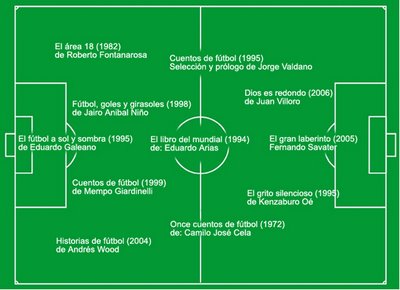
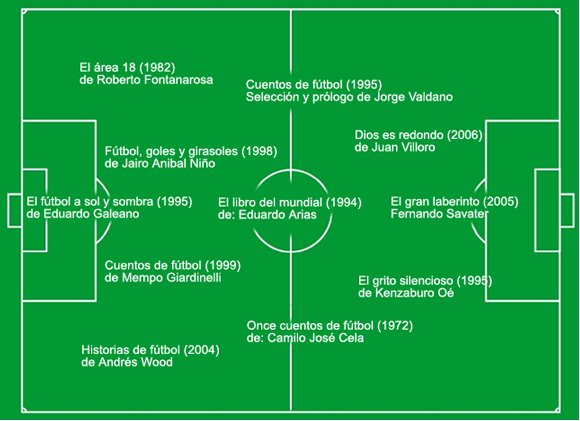
Courtesy of Bogotá's Biblioteca Luis Ángel Arango (and their marvelous e-newsletter), here's a list of "What to Read During the World Cup":
ARCO
1. El fútbol a sol y sombra, 1995. Eduardo Galeano [Soccer in Sun and Shadow]
En este libro, considerado un clásico dentro de las publicaciones futbolísticas, el escritor uruguayo Eduardo Galeano le hace un homenaje a este deporte y cuenta su historia a partir de anécdotas, datos y análisis llenos de humor e ironía. Para la muestra un botón: ¿En qué se parece el fútbol a Dios? En la devoción que le tienen muchos creyentes y en la desconfianza que le tienen muchos intelectuales.
LÍNEA DEFENSIVA
2. El área 18, 1982. Roberto Fontanarrosa
El escritor y caricaturista argentino, famoso por Boogie el aceitoso, recrea el mundo del fútbol a través de una novela que cuenta la historia de Congodia, un pequeño país africano, que logra su independencia y desarrollo gracias a su equipo nacional de fútbol hasta el momento invicto. Dada la estratégica localización del país y las poderosas apuestas que genera el equipo una poderosa corporación multinacional decide armar un conjunto capaz de derrotarlos.
3. Fútbol, goles y girasoles, 1998. Jairo Aníbal Niño
4. Cuentos de fútbol, 1999. Mempo Giardinelli, selección de Federico Díaz Granados.
5. Historias de fútbol, 2004. Andrés Wood
Esta película hace una mirada a la historia social de Chile a través de tres historias que giran alrededor del fútbol.
MEDIOCAMPO
6. Cuentos de fútbol, 1995. Selección y prólogo de Jorge Valdano
24 historias de fútbol realizadas por destacados escritores, entre los que se encuentran Fontanarrosa, Alfredo Bryce Echenique, Julio Ramón Ribeyro y Benedetti.
7. El libro del mundial, 1994. Eduardo Arias
8. Once cuentos de fútbol, 1972. Camilo José Cela
Estampas sobre futbolistas sacados de contexto, desarraigados de geografía o época y satirizados en sus máximas figuras son las que presenta en este libro el Nobel español.
DELANTEROS
9. Dios es redondo, 2006. Juan Villoro
El escritor mexicano, enviado especial a los mundiales de fútbol de Italia 90 y Francia 98, profundiza en los ritos y mitos del fútbol e indaga en la pasión que despierta este deporte. Así mismo le rinde un homenaje al que según él es el más grande jugador de todos los tiempos: Maradona.
10. El gran laberinto, 2005. Fernando Savater
Esta novela dirigida a jóvenes lectores se desarrolla en un estadio donde la gente lleva varias semanas sin poder salir y a merced de gigantescos monstruos. Unos niños serán los encargados de solucionar este problema.
11. El grito silencioso, 1995. Kenzaburo Oé [The Silent Cry]
El Nobel japonés narra la historia de cuatro hermanos que viajan de regreso a su tierra natal en la isla de Shikoku. El segundo tratará de emular la revolución del primer año de Mannen (1861), animando a los aldeanos a levantarse contra el "Emperador de los Supermercados", empresario coreano de gran poder e influencia en la región, bajo el pretexto de "entrenar un equipo de fútbol".
ÁRBITRO
Revista El gráfico
Esta revista argentina de circulación semanal creada en 1919 se ha consolidado como una de las más importantes de su género en el mundo.
ARCO
1. El fútbol a sol y sombra, 1995. Eduardo Galeano [Soccer in Sun and Shadow]
En este libro, considerado un clásico dentro de las publicaciones futbolísticas, el escritor uruguayo Eduardo Galeano le hace un homenaje a este deporte y cuenta su historia a partir de anécdotas, datos y análisis llenos de humor e ironía. Para la muestra un botón: ¿En qué se parece el fútbol a Dios? En la devoción que le tienen muchos creyentes y en la desconfianza que le tienen muchos intelectuales.
LÍNEA DEFENSIVA
2. El área 18, 1982. Roberto Fontanarrosa
El escritor y caricaturista argentino, famoso por Boogie el aceitoso, recrea el mundo del fútbol a través de una novela que cuenta la historia de Congodia, un pequeño país africano, que logra su independencia y desarrollo gracias a su equipo nacional de fútbol hasta el momento invicto. Dada la estratégica localización del país y las poderosas apuestas que genera el equipo una poderosa corporación multinacional decide armar un conjunto capaz de derrotarlos.
3. Fútbol, goles y girasoles, 1998. Jairo Aníbal Niño
4. Cuentos de fútbol, 1999. Mempo Giardinelli, selección de Federico Díaz Granados.
5. Historias de fútbol, 2004. Andrés Wood
Esta película hace una mirada a la historia social de Chile a través de tres historias que giran alrededor del fútbol.
MEDIOCAMPO
6. Cuentos de fútbol, 1995. Selección y prólogo de Jorge Valdano
24 historias de fútbol realizadas por destacados escritores, entre los que se encuentran Fontanarrosa, Alfredo Bryce Echenique, Julio Ramón Ribeyro y Benedetti.
7. El libro del mundial, 1994. Eduardo Arias
8. Once cuentos de fútbol, 1972. Camilo José Cela
Estampas sobre futbolistas sacados de contexto, desarraigados de geografía o época y satirizados en sus máximas figuras son las que presenta en este libro el Nobel español.
DELANTEROS
9. Dios es redondo, 2006. Juan Villoro
El escritor mexicano, enviado especial a los mundiales de fútbol de Italia 90 y Francia 98, profundiza en los ritos y mitos del fútbol e indaga en la pasión que despierta este deporte. Así mismo le rinde un homenaje al que según él es el más grande jugador de todos los tiempos: Maradona.
10. El gran laberinto, 2005. Fernando Savater
Esta novela dirigida a jóvenes lectores se desarrolla en un estadio donde la gente lleva varias semanas sin poder salir y a merced de gigantescos monstruos. Unos niños serán los encargados de solucionar este problema.
11. El grito silencioso, 1995. Kenzaburo Oé [The Silent Cry]
El Nobel japonés narra la historia de cuatro hermanos que viajan de regreso a su tierra natal en la isla de Shikoku. El segundo tratará de emular la revolución del primer año de Mannen (1861), animando a los aldeanos a levantarse contra el "Emperador de los Supermercados", empresario coreano de gran poder e influencia en la región, bajo el pretexto de "entrenar un equipo de fútbol".
ÁRBITRO
Revista El gráfico
Esta revista argentina de circulación semanal creada en 1919 se ha consolidado como una de las más importantes de su género en el mundo.

02 June 2006
Álvarez on poetry
From Robert Birnbaum's chat with Julia Álvarez:
JA: When I go to Breadloaf, I like to go to the poetry lectures. I am much more interested in what the poets have to say. They are the ones at the cutting edge where language meets the ineffable, the silence. Seamus Heaney gave a reading a few years back at Middlebury and he said poetry is about [she opens her mouth as if to say something]. He just stood there, his mouth hanging open, as if dumbfounded, like he couldn't find the words.
RB: [laughs]
JA: His point, I think, was that poetry tries to put into words what can't be put into words! That is what poets do. I think of them as the hot lava pushing out. They are the scouts, traveling out into the unknown where language has not gone before. They are doing interesting things with language, thinking about ways of using syntax. They talk about line breaks, about the breath as opposed to the visual cutting off of language. Storytellers, we're the settlers, we come in later, we need schools and a post office and homes and day care centers—but I am more interested in poets. I learn more from them. I don't know why.
01 June 2006
My long-standing grudge
Realizing anew that it isn't time that's the problem, but our manner of measuring it...
Historias de cronopios y de famas
¿Qué más quiere, qué más quiere? Átelo pronto a su muñeca, déjelo latir en libertad, imítelo anhelante. El miedo herrumbra las áncoras, cada cosa que pudo alcanzarse y fue olvidada va corroyendo las venas del reloj, gangrenando la fría sangre de sus pequeños rubíes. Y allá en el fonda está la muerte si no corremos y llegamos antes y comprendemos que ya no importa.~ Julio Cortázar, "Instrucciones para dar cuerda al reloj,"
Historias de cronopios y de famas
On the verge of summer
Day before yesterday I nailed down my flights north. After the flurry of exams...grading over the weekend...report card deadlines...and the last couple weeks of school...I will migrate back to that other native land. Because my last vacation was filled with planning and work and responsibility, I'm particularly looking forward to this one. I plan to go barefoot every day and...
It is truly a luxury to love such simple things: books, ink, paper, coffee, ideas. I feel like the wealthiest girl in the world...learning how to dream all over again.
- pack light
- drive long, open roads
- gaze at summer fields and evening fireflies
- spend hours in bookstores and coffee shops
- write dozens of letters to a certain someone
- laugh with my brothers
- collect books and bookends to bring back
- get caught up on my neglected reading
- laugh with my sisters
- explore long-lost places
- wander this waking dream
It is truly a luxury to love such simple things: books, ink, paper, coffee, ideas. I feel like the wealthiest girl in the world...learning how to dream all over again.
Subscribe to:
Posts (Atom)


