When they ran their hair lay back from their broad foreheads. Her feet were small, her brown hands were small. She left imprints in the sand of a street runner, a climber of dark stairs; her track was a flight from the terrors of alleys and the terrible crash of ashcans. She had relieved herself in wooden outhouses behind the tenements. The tails of rodents had curled about her ankles. She knew how to sew with a machine and had observed dogs mating, whores taking on customers in hallways, drunks peeing through the wooden spokes of pushcart wheels. He had never gone without a meal. He had never been cold at night. He ran with his mind. He ran toward something. He was unencumbered by fear and did not know there were beings in the world less curious about it than he. He saw through things and noted the colors people produced and was never surprised by a coincidence. A blue and green planet rolled through his eyes.
Showing posts with label notes. Show all posts
Showing posts with label notes. Show all posts
27 October 2010
Two of us
From E.L. Doctorow's Ragtime:

28 November 2009
Switching gears
After trying to figure out what to do with this site for over a year now, I've decided to focus my efforts on a new endeavor: Reading the Bogotá 39.
I've lived past my year of academic coursework, found a comfortable corner for my books, and have finally renewed my library card at the local branch of el Banco de la República. I'm ready to get back into my reading and learn what I can about what's been happening in Latin American literature lately. There are enormous amounts of catching up to do, but I'm looking forward to exploring new books and authors, and finding out more about what's been happening on the translation front.
I've lived past my year of academic coursework, found a comfortable corner for my books, and have finally renewed my library card at the local branch of el Banco de la República. I'm ready to get back into my reading and learn what I can about what's been happening in Latin American literature lately. There are enormous amounts of catching up to do, but I'm looking forward to exploring new books and authors, and finding out more about what's been happening on the translation front.
20 August 2009
Venturing out
 In the past few weeks I've submitted a dissertation, moved back to Colombia, and stepped in to replace a third-grade teacher. One more week will find me in a new apartment with the dust (hopefully) settling around me.
Happily, I'm back to my book-buying ways and hope to begin writing more about the Colombian literature I'm reading. I don't want to jinx myself by saying too much, but I think it's safe to say that things will resume in the next week or so.
In the meantime, I'm hugely relieved to be back home in my tierra querida.
31 January 2009
Homesick
 On Thursday, another post of mine went up at the Words Without Borders Blog. Somehow, I was able to begin to articulate the strangeness of my situation. But just now, I'm irremediably homesick. I think posting a few things that have occupied my thoughts lately will help.
 Nearly two weeks ago I found out about Gina Parody's resignation from the Senate. As the youngest person to be elected to Congress in Colombia, she is also the most direct and clear-spoken--and is undeniably brilliant. In the interview she gave with RCN (the video follows this letter to her supporters), she expressed the reasons why she could no longer represent her (former) party. Her integrity and clear belief in her principles is awe-inspiring. At 35, she's closed this chapter of her political career, but continues to explore other ways to fight for change. (At this point, she sees education as a main avenue.)
Between January and July of 1861, Colombia had a black president. Juan José Nieto, governor of Bolívar, served as interim president while Mosquera arrived to Bogotá. History had forgotten, his tomb is falling apart. But memory is returning...
The Hay Festival is in full swing! I'll be checking this year's blog all weekend. (I love looking at last year's too.) A., his sister, and another dear friend are in Cartagena right now! I look forward to hearing all about it.
Junot Díaz talks about how his two great loves--books and the Caribbean--were brought together for the first time in his life when he first attended the Hay Festival in Cartagena: "Cartagena fue la primera vez en mi vida en la que mis disparatados yos se sintieron como uno solo."
 And because I can't help it... Two "Bettyadictas" from Mexico and Spain visit Colombia for the first time, thanks to one of the greatest shows ever: Yo soy Betty, la fea. (Yes, I may as well join la Asociación de Bettyadictas Anónimas too!) Originally a Colombian "telenovela" that ran between 1999 and 2001, it has since been adapted by 18 other countries around the world. It's brilliant--hysterically funny and deeply moving at once. (They've been running it again in Colombia and I had to leave before it finished. Luckily, I was able to see the rest of it on YouTube.)
15 January 2009
Briefly
Another dispatch of mine went up at the Words Without Borders Blog on 4 January. I returned from Colombia on Sunday night and I'm slowly but surely getting back into the swing of things. Hope to have more to offer soon!
29 December 2008
More love for Hay
 Having attended the Hay Festival in Cartagena for the past two years, I can decidedly say that this literary event has become an established and well-loved tradition for us. Sadly, I'll be back at university before things kick off on 29 January...and I nearly passed out when I saw who's coming this year--two writers I was hoping to see at the two prior fests I've attended: Laura Restrepo and Junot Díaz (!!!). But we've already reserved A.'s tickets so I have the consolation of knowing that at least I'll be able to experience it vicariously. The other huge event will be Fernando Vallejo--I predict a VERY lively evening for that one!
 Many congratulations to the organizers of the Hay Festival in Cartagena for another spectacular line-up: Laura Restrepo, Junot Díaz, Fernando Vallejo, Alberto Manguel, Gerald Martin, Alan Pauls, Daniel Samper Pizano, Juan Gossaín, Eduardo Lago, Ricardo Silva, Salman Rushdie, and Martin Amis, among many others. May you continue for centuries to come!
14 December 2008
Goings and comings
It has been a crazy week, but I'm finally finishing up my last essay to hand in tomorrow (on how form and content should not be separated in the translation of novels, particularly Latin American novels that share intertextual similarities with the modernists).
This week also brought a great honor. Bud Parr, who is the new editor of the Words Without Borders Blog, had asked if I would contribute a few thoughts on my translation studies now and again, and my first post went up on Wednesday. I travel back to Colombia on Tuesday, but hope that over the break I'll have more to share. Part of my vacation will be dedicated to working on the translation of some poems for my dissertation, so perhaps some of my experiences will find their way there (especially as I live in the region where the poet was born!).
Incidentally, there is also a marvelous article by Alexander Cuadros on the plight of the displaced in Bogotá on the main site. Well worth your time.
This week also brought a great honor. Bud Parr, who is the new editor of the Words Without Borders Blog, had asked if I would contribute a few thoughts on my translation studies now and again, and my first post went up on Wednesday. I travel back to Colombia on Tuesday, but hope that over the break I'll have more to share. Part of my vacation will be dedicated to working on the translation of some poems for my dissertation, so perhaps some of my experiences will find their way there (especially as I live in the region where the poet was born!).
Incidentally, there is also a marvelous article by Alexander Cuadros on the plight of the displaced in Bogotá on the main site. Well worth your time.
23 November 2008
Waving, not drowning
With two major essays and a presentation due within the next three weeks, I haven't had much time at all for peeking through this window. But I can't complain as my time revolves around analyzing translations of work by Pablo Neruda and Laura Restrepo... I hope to be able to offer more on this in the next couple of weeks as there have been some surprising discoveries.
In the meantime, here is something I would love to see (although it's old news)... You Are Free, the Joseph Arthur documentary by Bryan Johnson.
The Innocence Mission have also been busy: Street Map is available for pre-order. It sounds lovely.
In the meantime, here is something I would love to see (although it's old news)... You Are Free, the Joseph Arthur documentary by Bryan Johnson.
The Innocence Mission have also been busy: Street Map is available for pre-order. It sounds lovely.
17 October 2008
Going concerns
There are many things I should probably be writing about here, having attended readings by David Lodge and Geraldine Brooks, a literary translation workshop by Nick Caistor, and a literature faculty seminar on the aforementioned Falling Man. (The latter was quite a surreal experience: I found myself in the same room as a professor whose students have expressed derision for blogs, e-books, and other aspects of modern reality, and an internationally known author who has been interviewed by Bat Segundo, appeared on Daniel Menaker's show, and praised by various and sundry litblogs. Quite a disconnect.)
And then, of course, there's the window Thomas Gray practically fell out of.
I've taken notes on everything, but with my current (very wonderful and very satisfying) coursework, I spend most of my free time reading (surprise!). Lots of fun with B.S. Johnson, Paul Auster, Stieg Larsson, Agatha Christie, J.M. Coetzee, Per Petterson, Anne Carson, and David Leavitt. I have a lengthy (mushrooming) list of books I want to get to and have researched their locations in either the university's library or the one downtown. So there's that too.
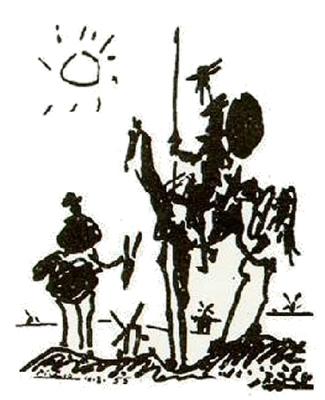
Perhaps some things will slip out during Christmas vacation? Possibly. I fully admit to being a bad blogger and correspondent, but take comfort in the print of Picasso's Don Quixote tacked up over my desk. Onward without regrets!
And then, of course, there's the window Thomas Gray practically fell out of.
I've taken notes on everything, but with my current (very wonderful and very satisfying) coursework, I spend most of my free time reading (surprise!). Lots of fun with B.S. Johnson, Paul Auster, Stieg Larsson, Agatha Christie, J.M. Coetzee, Per Petterson, Anne Carson, and David Leavitt. I have a lengthy (mushrooming) list of books I want to get to and have researched their locations in either the university's library or the one downtown. So there's that too.
Perhaps some things will slip out during Christmas vacation? Possibly. I fully admit to being a bad blogger and correspondent, but take comfort in the print of Picasso's Don Quixote tacked up over my desk. Onward without regrets!
13 October 2008
A process of discovery
I was delighted to read this interview with literary translator Charlotte Mandell--not only because she outs herself as a translator who does not read the entire text before beginning the work (I love her explanation), but because she reminds me of all of the reasons I ventured into this field in the first place:
(via The Literary Saloon)
You’ve also mentioned having "no need to write"—would you think that your loyalty to translation may hinder your own will to write, if you would also contemplate writing, starting from a blank page, without an original text or language as a cross-reference or interpretation? Creation versus re-creation, would you also like to write?When I was in fourth grade, I started copying out a Nancy Drew novel by hand on lined binder paper. I knew it didn't make any logical sense to do this, but for some reason it felt immensely satisfying to see those words in my own carefully penciled printing. I stopped after two chapters (having made the mistake of confessing this to my teacher), but a few years after that, I began filling journal after journal with passages, lines, and verses from other things I read. It's really only since I've intentionally set out to explore translation (and complete my own) that I've been able to fully understand the why of these formative habits. As a dear friend pointed out to me recently, I'm more a scribe than a scholar. There was something that was deeply satisfying about copying out the beloved words of others...and now I'm doing it again, but in a whole new creative context.
But my point is that translation is also a form of creation. It’s not just recreating what’s already been written—it’s creating the text anew, in my language. That’s why I don’t feel the need to write my own work; I feel fulfilled writing in many different voices, the voices of the authors I translate. It's interesting that classical musicians aren't usually asked if they also compose, but they're a lot like translators, in that they play many different styles of music, and the interpretations can vary hugely from one performer to the next.
I think all writing starts from a blank page, originals and translations alike. For me, all writing is creative. A poet writing about the sunset and the trees is translating his/her thoughts and impressions into words. All writing is translation, in a way.
(via The Literary Saloon)
03 October 2008
USian
In the comments to her post on the recent Nobel dust-up, Gwenda Bond used the term "USian"--something I've been saying myself but have never seen anywhere else. Until yesterday, of course:
Still, I want to see fisticuffs! Effete fisticuffs! And I'm (relatively) proud that our USian champions have attempted to bring the affronted heat.I applaud her for avoiding the rather ethnocentric word "American" when referring to people from the United States. As I mentioned three years ago,
In Spanish the word is estadounidense--literally, "United Statesian." Is there no word like that in English? The word "American" is taken for granted as meaning "a citizen of the U.S.," although it's only third in Merriam-Webster's list of definitions. (Yes, Virginia, people from Central and South America are "Americans" too.)I know this may sound like PC posturing, but it was great to see someone else making the appropriate distinction. Maybe it will catch on?
22 September 2008
Shifting gears
Things have been pretty silent around here lately due to a transcontinental move and the commencement of a taught MA (and the present lack of internet access in my room). Hopefully, this is about to change (both the silence *and* the state of my online access).
I've thought a lot about the direction I'd like this humble litblog to take, and I think the most helpful (and least dangerous) thing would be to focus on interesting things I come across during my studies. I've barely begun my reading, but already have a few things I'd like to post about. And since I am my primary audience, I look forward to keeping track of where my thoughts go in this exhilarating, complex field.
To begin with, there's this loaded little footnote in Translation Studies by Susan Bassnett that I found particularly relevant:
After all, it isn't just the "Americans" (or rather, "U.S.ians") who need certain attitude adjustments when it comes to literature from other countries.
I've thought a lot about the direction I'd like this humble litblog to take, and I think the most helpful (and least dangerous) thing would be to focus on interesting things I come across during my studies. I've barely begun my reading, but already have a few things I'd like to post about. And since I am my primary audience, I look forward to keeping track of where my thoughts go in this exhilarating, complex field.
To begin with, there's this loaded little footnote in Translation Studies by Susan Bassnett that I found particularly relevant:
In his article, 'Translation in the United States', Babel VII, (2), 1968, pp. 119-24 Henry Fischbach points out that the United States has a shorter history of translation than almost any other industrialized nation of the world, and attributes this deficiency to four basic points:I was reminded of John O'Brien's infamous diatribe. He has quite a lot of righteous indignation to back his complaints about translation "hype." But from where I'm sitting, as much noise should be made as possible--even if it annoys those who go about this business the "right" way.
(a) The political and commercial isolationism of nineteenth-century America.
(b) The traditional cultural allegiance to the English-speaking community.
(c) The American complacent self-sufficiency in technology.
(d) The strength of the myth of the Land of Promise for emigrants and their subsequent desire to integrate.
Fischbach's theory is interesting in that it would seem to show correspondences with the English attitude towards translation linked to British colonial expansion.
After all, it isn't just the "Americans" (or rather, "U.S.ians") who need certain attitude adjustments when it comes to literature from other countries.
10 June 2008
Don't do anything
 (photo by Autumn de Wilde)
Grades, progress reports, translations, proofreading, loans, letters, photocopies, housing contracts, financial aid forms, visa applications, passport photos, fees, airline tickets, considerations, plans, methods, means, hours, days, waiting, breathing...
It's been a little busy in this particular corner of the universe lately.
Thankfully, I've discovered some very good news. Sam Phillips is back with a new album and some spare words for a new site:
I was born in east Hollywood. I just found out that Charles Bukowski worked at the post office right around the corner from my grandmother’s house. I might have even sold him some lemonade when I was a kid, though I hear that wasn’t his drink. The excesses of Hollywood go down the wrong side of the tracks and up the right side. The religious and experimental/alternative lifestyles have always thrived here because so many people come to Hollywood with dreams that get broken (or come true) and need to be replaced. I’d rather make art than make my dreams come true. I’d rather be interested and inspired. [...]And so I go back and try to make room for the things I love, and not let duty wear me too thin. I need to stop and listen a little more.
When I was eight years old, I was given my first Bible at Hollywood Presbyterian Church by a minister who looked like a football star/leading man. Around the same time my beloved dance teacher gave me a small bottle of perfume, which I loved too much to use. After reading the story of Mary pouring her best perfume oil on Jesus’ feet, I decided to pour my whole bottle of perfume on the Bible. Since that perfume was my only treasure at the time, it was an extravagant expression of faith. That smelly Bible was one of my first attempts to make art.
In one of the most important election years in the history of our United States, I am bringing out a record called “Don’t Do Anything”. This is not a political statement. The line of the song it’s taken from is “I love you when you don’t do anything”. I might have written this to my child, a lover, a friend, a dead person, or all of these. Maybe I wanted someone to write it to me. Maybe an extravagant expression of faith is the last thing we need this year. Maybe it’s the first. There is a lot to do in between.
22 May 2008
Thursday links
- The London Review of Books hosts a literary contest that asks entrants to list as many literary allusions as they can find in Adrian McKinty's thriller The Bloomsday Dead (to be published in June).
- Michelle of in the Lourve discovers George MacDonald's fairy tales.
- Ed is back to his old posting habits. He officially made my day. (And I must once again say how much I love the ever-fascinating Bat Segundo.)
- I'm watching John Berger's Ways of Seeing right now, which leaves me in debt to both Marks.
- I also enjoyed the fifth episode of Titlepage.tv in between classes this morning. So many great books to get to!
- Garrick Davis of the Contemporary Poetry Review has edited Praising It New: The Best of the New Criticism, the "first anthology of New Criticism to be printed in fifty years."
- Meanwhile, I'm nearing p. 950 of Against the Day (plan on finishing it during the three-day weekend) and am feeling positively nostalgic about leaving it behind. I can barely remember a time when I wasn't reading this book...
15 May 2008
Teaching oneself
Another excellent point about litblogs from Dan Green:
This ties in to what Darby wrote about "the notion of overpopularity." If you love something, why shut up about it simply because others already love it too? It isn't the topic or work that should be accepted or rejected, only the way in which we write about it. There can never be enough "specific analysis" of a text's merits.
The question is not whether another "opinion" is needed but whether that opinion is linked to a specific analysis of the book--pointing out specific attributes of form, style, or theme through quotation or extended description--that might reveal to other readers some angle of understanding or interpetation they haven't previously considered.In addition, I think writing one's thoughts down in this medium can be a way of teaching oneself. I know that I can have many ideas and impressions about a text, but it isn't until I flesh them out in black and white that I can fully comprehend the nuances and implications of these thoughts--which sometimes extend into even more illumination and ultimately lead to a better understanding of the text itself.
This ties in to what Darby wrote about "the notion of overpopularity." If you love something, why shut up about it simply because others already love it too? It isn't the topic or work that should be accepted or rejected, only the way in which we write about it. There can never be enough "specific analysis" of a text's merits.
13 May 2008
Present concerns
- A new free international e-mail list co-hosted by the Universities of East Anglia, Warwick and London Metropolitan has just been launched. STRAP - Stage Translation Research Adaptation and Practice - aims to promote collaboration and discussion between academics and practitioners working in the field of stage translation and adaptation. It is intended that this facility will help subscribers create networks and further the discipline of stage translation and adaptation.
- García Márquez's Of Love and Other Demons has become an opera.
- Bud Parr has a few things to say about John O'Brien's recent screed, "Scamming in Translation: The Philistines Have Arrived." As a fledgling translator about to begin an MA program in the fall, my immediate reaction was a sad disappointment and confusion. How did it come to this?
- Darby has spoken:
I hereby propose that we banish the notion of overpopularity from the litblogosphere. Surely it's an idea that can do well on its without further help from us.
Hear hear!
- A friend introduced me to Better World Books--an "online bookstore with a soul." Definitely worth your time.
09 May 2008
Erickson's Soledad
I've been busy with freelance work, during the completion of which I discovered a few interesting things about Christopher Lee and his fidelity to Bram Stoker (in his opinion, a faithful adaptation has yet to be made). I also had to do some fact-checking and was surprised to see the name of Soledad Miranda in a film they did together.
So I discovered something that I probably should have already known: Soledad Miranda seems to have provided the inspiration for the character of Soledad Palladin in Steve Erickson's Zeroville. I haven't seen anyone ask him about this in the few interviews I've read. (Then again, I haven't seen anyone ask him about the Van Gogh connection, either.) It would be interesting to hear more about this connection, especially since Soledad's character is the mother of Zazi. Vikar's reactions to Soledad mirror his internal evolution (and not only because "soledad" is Spanish for "loneliness" or "solitude"), but it is Zazi who is the lynchpin of the novel.
So I discovered something that I probably should have already known: Soledad Miranda seems to have provided the inspiration for the character of Soledad Palladin in Steve Erickson's Zeroville. I haven't seen anyone ask him about this in the few interviews I've read. (Then again, I haven't seen anyone ask him about the Van Gogh connection, either.) It would be interesting to hear more about this connection, especially since Soledad's character is the mother of Zazi. Vikar's reactions to Soledad mirror his internal evolution (and not only because "soledad" is Spanish for "loneliness" or "solitude"), but it is Zazi who is the lynchpin of the novel.
09 April 2008
A handful of links
- Inside Higher Ed discusses the "Next Chapter for E-books"--affordable text access for university students. Although I loved the legitimate "excuse" for buying expensive Norton Anthologies and other lit texts, this sure could've come in handy for Psych 101!
- Mark Thwaite mentions Yale's exciting move of putting certain Open Courses online. Sit in on intro classes in Astronomy, English, Philosophy, Physics, Political Science, Psychology, and Religious Studies. This reminds me that a while back I found out about Harvard@Home--a similar idea. (My favorite is Helen Vendler's lecture on Yeats.)
- The Literary Saloon announces that Reading the World 2008 has gone live. Many wonderful books will finally be getting the attention they deserve.
- They also mention that the new issue of Poetry magazine is devoted to translated works. (I do miss being able to read the original Spanish, though. They should consider putting them up on the website, if nothing else--like the Poetry International Web does. But adding the translators' notes is a very nice touch.)
28 March 2008
Best news of the week
 Sancho's Panza is back--in a very big, vibrant, and true way:
We need Oiticica and Frida Kahlo, Jorge Luis Borges and Gabriel García Márquez, Juan Luis Guerra and Juana Molina, etc. etc. Not Macondo or McOndo. But Más Hondo, deep, deep enough to contain everything, and more, y siempre, algo más. Admit it, the baroque always was a congenital thing in Latin America, a baroque built around the depth of the culture's carrying sack, which has no breaking point, just eternal inordinate strain. One thing is marketing exoticism, another is indulging in it because it's in your bones; one thing is marketing a universalist's sophistication and dominion of forms being trafficked in Paris-New York-London-Berlin-Rome, another is actually having that sophistication, effortlessly. And being secure enough in your possession of it to not require the upturned nose when in range of a Frida's or a Gabo's flowers.Yes, yes, yes.
Here's hoping he never goes away again.
15 March 2008
Semana Santa
 Café del Parque, Santa Marta
Holy Week, vacation time. The house has been cleaned, books organized. Family members arrive tomorrow. We'll revisit beaches we haven't seen in a while, go camping, read in the shade, and hope to get some rest amid the traveling. Will check back soon.
Subscribe to:
Posts (Atom)