25 October 2008

Perhaps

Your result for What Your Taste in Art Says About You Test...

Balanced, Secure, and Realistic.

19 Impressionist, 13 Islamic, -1 Ukiyo-e, -14 Cubist, -17 Abstract and -1 Renaissance!


Impressionism is a movement in French painting, sometimes called optical realism because of its almost scientific interest in the actual visual experience and effect of light and movement on appearance of objects. Impressionist paintings are balanced, use colored shadows, use pure color, broken brushstrokes, thick paint, and scenes from everyday life or nature.


People that like Impressionist paintings may not alway be what is deemed socially acceptable. They tend to move on their own path without always worrying that it may be offensive to others. They value friendships but because they also value honesty tend to have a few really good friends. They do not, however, like people that are rude and do not appreciate the ideas of others. They are secure enough in themselves that they can listen to the ideas of other people without it affecting their own final decisions. The world for them is not black and white but more in shades of grey and muted colors. They like things to be aestically pleasing, not stark and sharp. There are many ways to view things, and the impresssionist personality views the world from many different aspects. They enjoy life and try to keep a realistic viewpoint of things, but are not very open to new experiences. If they are content in their live they will be more than likely pleased to keep things just the way they are.

Take What Your Taste in Art Says About You Test at HelloQuizzy

(via Shaken & Stirred)

22 October 2008

Call her "Em'ly" at your own risk

[This is my first contribution to the Emily of New Moon discussion over at Blogging Anne of Green Gables]

I first read the Emily books as a teenager living in Colombia and was struck by the subtle sense of danger that's threaded through them. I've mentioned that although I've always considered Anne a friend, I personally identify more with Emily--not because she seems more "human" or has more faults (which certainly is an argument that could be made), but because the world in which she lives is more hazardous; hence, real. We never really fear for Anne in the various environments and "scrapes" in which she finds herself, but Emily's situation is much more precarious. The physical setting of New Moon and the fragile condition of her internal state deepen the reader's concern. Plus, Emily's world is simply darker... By the time you hit Emily's Quest, you wonder whether Montgomery was influenced by Villette in evoking the novel's tone. (In her journals, she mentions not being able to forgive Charlotte for the ending--but it would be interesting to compare the dates to see if this was before or after the last Emily book was published.)

I'm reading this one more slowly and am only at Chapter 7 (it's hard for me to slow down once I start rereading these books!). I don't think I'll list the literary allusions in the same way I did with Anne, but I do plan on mentioning them. Aside from the clear references to The Pilgrim's Progress and the Song of Solomon (her comments about the former always make me smile because they're so true!), I also suspect that George MacDonald's At the Back of the North Wind may have inspired the "Wind Woman." (I easily imagine Emily flying away with her like Diamond did.)

I was also reminded of Jane Eyre (which I am almost positive influenced these novels). It begins with this exchange with Ellen Greene:
"I don't think I want Aunt Ruth to take me," said Emily deliberately, after a moment's reflection.

"Well, you won't have the choosing likely. You ought to be thankful to get a home anywhere. Remember you're not of much importance."

"I am important to myself," cried Emily proudly.
I was immediately reminded of one of Jane's famous lines to Rochester:
"I care for myself. The more solitary, the more friendless, the more unsustained I am, the more I will respect myself."
I have some thoughts about "the flash" as well, but I'll save them for another post. I look forward to reading other thoughts on this brilliant little book.

Thomas Gray's window


The story goes that Thomas Gray had mortal fear of fire and installed a metal bar outside his window at Peterhouse in case he would one day have to climb out. He was said to be a lazy professor while at Cambridge and would often not show up to his classes. To get even, some of his students decided to play a practical joke on him. One night, they stood outside his window with a tub of water and began shouting "Fire!!" Gray panicked, tied his sheets to the bar, and let himself down. But the sheets weren't long enough for him to reach the ground, and so he had to let himself drop...drenching himself in the process. I don't know if this actually improved his attendance, though.

19 October 2008

Continually

Just as the order of numbers in a sum makes no difference, just as there is no special sequence to towns on a map, the mind and the masterpiece may pass back and forth between thoughts as often and as easily as trains between Detroit, Duluth, and Denver, and chapter headings are, in fact, only the names of places. Oral literature had to be sequential (like music before tape), but type made possible a reading which began at the rear, which repeated preferred passages, which skipped. As in an atlas, the order was one of convenience, and everything was flat. A geographical history rolls time out like that. Of course, there are stories still; an evening's entertainment, that's all human nature asks for; but masterpieces have to bear repeating and repeating. There are no surprises, no suspense, no tears, no worries in them. We know what will happen to Ahab. Duncan's dead, and Anna's under her train. I can tell you the page. The Wings of the Dove lies spread before us now as openly as Iowa. Literature in the eyes of the human mind is like land seen from a plane. And so is Gertrude Stein when we find her. Macbeth shall murder sleep again, Tom Jones receive a beating, Heathcliff . . . ah, well . . . "Oblige me," she says, "by not beginning." Netherfield Park is let at last. Mr. Gradgrind is still proceeding on the principle that two and two are four, and nothing over. Bloom is carrying a piece of soap about. The next century is approaching like a distant train. John Barth has just written Chimera, Beckett has brought out The Lost Ones, Nabokov a book called Transparent Things. And they are reissuing The Geographical History of America almost a hundred years from the author's birthday. Oblige me, she says, "Also by not ending."
~ William Gass, "Gertrude Stein and the Geography of the Sentence," The World Within the Word

18 October 2008

Constraint, creativity, and Nabokov

Reading notes on The Practices of Literary Translation: Constraints and Creativity, ed. by Jean Boase-Beier and Michael Holman

~ p. 3: MH & JBB: "If the original is seen as something whose authority is in doubt, then equivalence to the original needs to be examined from the point of view of multiple potential equivalences."

~ p. 3: "Both Chaucer and Shakespeare, as Hughes remarks, borrowed freely from Ovid, often translating, transforming or adapting what Ovid had earlier adapted. Hughes himself produced a translation of the Metamophorses so compellingly Hughes-like that it won the Whitbread Award, not normally given for translations. Nevertheless, we tend to view Hughes' version of Ovid's Pyramus and Thisbe as a translation, but not Shakespeare's in A Midsummer Night's Dream. We might well ask who were the translators here and what is the distinction between translation and writing?"

~ p. 10: "There will always be compromise between faithfulness and freedom, between the need to be true to one's own and the author's voice."

~ p. 13: "In a purely additive sense, therefore, it is quite clear that the burden of constraint is bound to be greater in translation than in original writing. Yet just as constraint moulded and gave rise to the creative impulse in the original, so in translation this added burden of constraint can force a translator into new ways of overcoming it and thus into new creativity."

~ p. 14: "A translator, therefore, is a rewriter who determines the implied meanings of the TL text, and who also, in the act of rewriting, redetermines the meaning of the original (Álvarez and Vidal 1996:4). Translation as radical rewriting can thus be seen as a way of rescuing the original from unwanted constraint."

~ pp. 16-17: "Translation, then, can act as an agent for change, altering and stretching perceptions, knowledge and language in the target culture, and threatening the status quo (see Hewson 1997:49), as it presents a challenge to the indigenous culture. What the papers in this book show is that it is the very fact that translation is so highly constrained which gives it the power to effect such change."

~ p. 24: Emily Salines examines how Baudelaire combined lines from Longfellow's "A Psalm of Life" and Gray's "Elegy Written in a Country Church-Yard" to create a completely new poem ("Le Guignon") that altered the initial meanings of the originals.

~ p. 96: Jenefer Coates on Nabokov's translation of Pushkin's Eugene Onegin:
Behind this approach lay his belief in the specificity of experience and its transmutation into art. His withdrawal from advocating conventionally domesticated translation was prompted by realization that the specificity of the original would thus be represented by an alien imitation, and that the smooth and elegant Anglo-American versions encouraged by publishers and critics preferred the false voice of an "impersonator" to the original artist's, whose authenticity had got lost. Translation thus became a form of resistance to cultural appropriation.
~ p. 97: "Nabokov showed, he did not tell. Constructing complex narratives that only make sense at the deepest level, for example, he urges the careless or confused reader, through ludic and adversarial asides (such as addressing "the re-reader of this passage" in Ada), to follow the convolutions of text, mis-trust appearances, be wary of deception or observe the minutiae of details--all borrowings from the detective genre so frequently parodied, and all ideal prescriptions for the reading of a difficult translation."

~ p. 98: Coates again referring to Nabokov's Onegin:
It was also continuous with his own style, which similarly eschewed smoothness in favour of defamiliarization, inviting the reader to participate by decoding an intricately wrought text. Many of his stylistic effects compare with strategies that translators regularly deploy: paraphrasing particulars, reinventing proper nouns, prising open cliches, rendering the familiar strange, and the strange familiar, employing archaic and non-standard terms that strain towards their source, or leaving traces of source languages visible. Not only was Nabokov a resistant translator, he was probably the most resistant English prose stylist of this century.
(I realize again all of the reasons I love him.)

~ p. 105: "As his trust in conventional translation waned, belief in another kind of cultural proliferation gained strength: the idea of spirality and synthesis, which Nabokov began to embody in his novels by means of intertextual references and verbal mirroring and patterning."

17 October 2008

Going concerns

There are many things I should probably be writing about here, having attended readings by David Lodge and Geraldine Brooks, a literary translation workshop by Nick Caistor, and a literature faculty seminar on the aforementioned Falling Man. (The latter was quite a surreal experience: I found myself in the same room as a professor whose students have expressed derision for blogs, e-books, and other aspects of modern reality, and an internationally known author who has been interviewed by Bat Segundo, appeared on Daniel Menaker's show, and praised by various and sundry litblogs. Quite a disconnect.)

And then, of course, there's the window Thomas Gray practically fell out of.

I've taken notes on everything, but with my current (very wonderful and very satisfying) coursework, I spend most of my free time reading (surprise!). Lots of fun with B.S. Johnson, Paul Auster, Stieg Larsson, Agatha Christie, J.M. Coetzee, Per Petterson, Anne Carson, and David Leavitt. I have a lengthy (mushrooming) list of books I want to get to and have researched their locations in either the university's library or the one downtown. So there's that too.

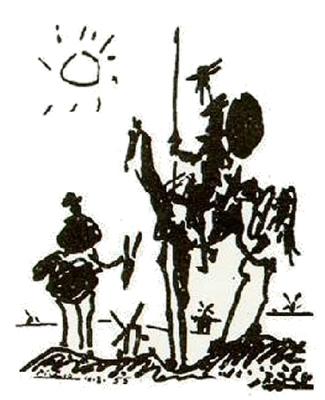
Perhaps some things will slip out during Christmas vacation? Possibly. I fully admit to being a bad blogger and correspondent, but take comfort in the print of Picasso's Don Quixote tacked up over my desk. Onward without regrets!

15 October 2008

After turning the last page

Paul Auster's Leviathan was published in 1992 and dedicated to Don DeLillo. Its events seem to eerily prefigure Falling Man... I'll be attending a lecture on this latter work today and it will be interesting to see if the subject comes up.

13 October 2008

Le Clézio with the Embera

One of the more interesting articles I've seen in response to Le Clézio's Nobel Prize win recounts his visit to Colombia in the 1970's and the time he spent with the Embera tribe of el Chocó (which he discussed in his book La fête chantée et autres essais de thème amérindien):
De sus experiencias con las culturas indígenas de México, Panamá y Colombia, el Premio Nobel destacó en alguna oportunidad: "Esa experiencia cambió toda mi vida, mis ideas sobre el mundo del arte, mi manera de ser con los otros, de andar, de comer, de dormir, de amar y hasta de soñar".

No en vano, su amor por la naturaleza le ha deparado a Le Clézio ser llamado también "escritor nómada", "indio en la ciudad" o "panteísta magnífico".
Colombian author Édgar Bastidas Urresty was his translator at the time and has also written an interesting account of the experience (published in 2002).

(With thanks to A.)

Elsewhere, The Literary Saloon gives an excellent sense of the international reaction to Le Clézio's win.

Cambridge graffiti

The secrets of the universe revealed:


A process of discovery

I was delighted to read this interview with literary translator Charlotte Mandell--not only because she outs herself as a translator who does not read the entire text before beginning the work (I love her explanation), but because she reminds me of all of the reasons I ventured into this field in the first place:
You’ve also mentioned having "no need to write"—would you think that your loyalty to translation may hinder your own will to write, if you would also contemplate writing, starting from a blank page, without an original text or language as a cross-reference or interpretation? Creation versus re-creation, would you also like to write?

But my point is that translation is also a form of creation. It’s not just recreating what’s already been written—it’s creating the text anew, in my language. That’s why I don’t feel the need to write my own work; I feel fulfilled writing in many different voices, the voices of the authors I translate. It's interesting that classical musicians aren't usually asked if they also compose, but they're a lot like translators, in that they play many different styles of music, and the interpretations can vary hugely from one performer to the next.

I think all writing starts from a blank page, originals and translations alike. For me, all writing is creative. A poet writing about the sunset and the trees is translating his/her thoughts and impressions into words. All writing is translation, in a way.
When I was in fourth grade, I started copying out a Nancy Drew novel by hand on lined binder paper. I knew it didn't make any logical sense to do this, but for some reason it felt immensely satisfying to see those words in my own carefully penciled printing. I stopped after two chapters (having made the mistake of confessing this to my teacher), but a few years after that, I began filling journal after journal with passages, lines, and verses from other things I read. It's really only since I've intentionally set out to explore translation (and complete my own) that I've been able to fully understand the why of these formative habits. As a dear friend pointed out to me recently, I'm more a scribe than a scholar. There was something that was deeply satisfying about copying out the beloved words of others...and now I'm doing it again, but in a whole new creative context.

(via The Literary Saloon)

10 October 2008

Misreading Coetzee

At Matilda, Perry Middlemiss has posted a couple of reactions to J.M. Coetzee's Diary of a Bad Year. In my opinion, the NewsBlaze review completely misses the point and even misidentifies the author with the narrator:
First of all, the desultoriness with which the author hops from one topic to another - thematically unrelated - topic destroys the book's coherence. Few of the topics are developed to a thought-arousing level and the author's person continues to overshadow his views.
"First of all," the reviewer seems to be unaware of the quite obvious Nabokov reference. The character "C" is writing brief mini-essays for a collection entitled Strong Opinions. It's too obvious, but I'll say it anyway: they're "thematically related" in that they are all "strong opinions." Also, the novel's coherence is located in the parallel narratives and the interplay between C's "opinions" and what takes place in the story's action. The plot and the essay portions of the text are inextricably intertwined.
That also holds for the story in which the characters feel like 'voice generators' for communicating the author's mind and not as palpable human figures. There is no climax and the book remains as plain at the end as at the very beginning.
I probably shouldn't even be wasting my time in addressing such an egregious oversight. There is most definitely a "climax" and for the reviewer to have turned such a blind eye to the evolution of the two principal characters makes this "review" completely baseless and causes its writer to come off as sounding callous. On the contrary, the eloquent compassion with which Coetzee writes is quite moving.
Labeling the book as 'fiction' is another point that leaves the book at a loss. There is no 'true' fiction in the book. Of course, a critic should be pointing to the publisher, and not the author, for erroneous categorization of the book.
Aside from the fact that I don't know what "'true' fiction" is supposed to mean, the misidentification of the author with his narrator is unforgivable in a piece of writing that purports to be a literary "review" in a news publication.
Then there is the format of the book - three different modes of speech on the same page - that seriously interferes with the reader's struggle to connect coherently to the content.
But the reader can choose how he or she reads it, which lends strength to Coetzee's structural device. I was delighted at how, for nearly the entire first half of the novel, Coetzee has each segment come to a full stop on each page. This made it easy for me to read it one page at a time. But by the time the central crisis emerges, the sections are no longer self-contained. The text of each section spills over into subsequent pages, prompting a reconsideration of the reading strategy and enabling the reader to confront the shift in the action. It's cleverly done and mirrors the urgent pace at which events occur and the manner in which C begins to lose control of the rigidity of his thoughts and becomes more open to "softer" views.

Reviewers don't have to love the books they write about. But they should (at the very least!) understand what it is the author is attempting and discuss the work on those terms.

The saving grace of the dark and cold

Grateful for Richard Wirick's memorable reflection on Solzhenitsyn:
After his nonfiction forays, and while setting about his Red Wheel cycle of novels, Solzhenitsyn made fair mockery of our expectations of him. If we were going to invite him to give commencement addresses, we were going to be reminded, once again, of the special spiritual advantages of privation. We weren’t going to hear praise of our excesses, our shallowness, our engulfing vacuity. [Appropriately, I read his famous, scolding Harvard commencement address through a newspaper vending box in the Las Vegas bus station, the red lights of slot machines blinking on his face.] His message was no different than the prophet Isaiah’s: without the rudder and keel of discipline, and perhaps faith, freedom leads to its own paradoxical imprisonment: a torpor, a hollowness, a Selbstmord as real as the clang of a prison door. He wanted to put some of the dark and cold back into our brain-dissolving American sunshine.

09 October 2008

Previous pronouncements

Reading notes on Translation/History/Culture: A Sourcebook, ed. by André Lefevere

~ p. 1: "Let us not forget that translations are made by people who do not need them for people who cannot read the originals."

~ p. 2: "It may be a sobering thought that some of the masterpieces of world literature, such as Cervantes' Don Quixote, profess to be translations of lost originals, i.e. that they refer to non-existent texts in order to derive some kind of legitimacy which, it is felt, would otherwise not be present to the same extent."

~ p. 13: Anne Dacier (from the intro to her translation of the Iliad, pub. 1699):
Bad translations render the letter without the spirit in a low and servile imitation. Good translations keep the spirit without moving away from the letter. They are free and noble imitations that turn the familiar into something new.
~ p. 17: Anne Louise Germaine de Staël:
The most eminent service one can render to literature is to transport the masterpieces of the human spirit from one language into another.
~ p. 25: Goethe:
That is how we should look upon every translator: he is a man who tries to be a mediator in this general spiritual commerce and who has chosen it as his calling to advance the interchange. Whatever you may say about the deficiencies of translation, it is and remains one of the most important and dignified enterprises in the general commerce of the world. The Qur'an says: "God has given every nation a prophet in its own language." Every translator is a prophet among his own poeple.
~ p. 34: Ulrich von Willamowitz-Moellendorff:
True translation is metempsychosis.
~ p. 36: Nicolas Perrot d'Ablancourt (his translations were the first to be called "belles infidèles"):
Consequently, I do not always stick to the author's words, nor even to his thoughts. I keep the effect he wanted to produce in mind, and then I arrange the material after the fashion of our time.
~ p. 37: Jacques Delille:
I have always thought of translation as a way to enrich a language. If you write an original work in a particular language you are likely to exhaust that language's own resources, if I may say so. If you translate, you import the riches contained in foreign languages into your own, by means of a felicitous commerce.
~ p. 56: Shelley (from "A Defence of Poetry"):
Sounds as well as thoughts have relation both beween each other and towards that which they represent, and a perception of the order of these relations has always been found connected with a perception of the order of the relations of thought.
~ p. 64: Pope (from the preface to his translation of the Iliad, pub. 1715):
I know no Liberties one ought to take, but those which are necessary for transfusing the Spirit of the Original, and Supporting the Poetical Style of the Translation: and I will venture to say, there have not been more Men misled in former times by a servile dull Adherence to the Letter, than have been deluded in ours by a chimerical insolent Hope of raising and improving their Author.
~ p. 78: Goethe:
There are two maxims in translation: one requires that the author of a foreign nation be brought across to us in such a way that we can look on him as ours. The other requires that we ourselves should cross over into what is foreign and adapt ourselves to its conditions, its peculiarities, and its use of language.
~ p. 79: Schlegel:
Literalness is a long way from fidelity. Fidelity means that the same or similar impressions are produced, for these are the heart of the matter.
~ p. 171: Ulrich von Willamowitz-Moellendorff (from the preface to his translation of Euripides' Hippolytus, pub. 1925):
This is how it is: whoever wants to translate a poem must understand it.

06 October 2008

Navigating the labyrinth

Reading notes on Translating Poetry: The Double Labyrinth, ed. by Daniel Weissbort

~ p. x: "Yet, as Ezra Pound remarked, translation is also a form of criticism, the highest in his view, since it represents a fusion of the creative and the critical."

~ p. xi: "Translation, as a specialised branch of practical criticism, of concentrated reading, is well worth exploring."

~ p. 10: János Csokits' discussion of how Ted Hughes translated János Pilinszky's work without knowing a word of Hungarian. (Csokits supplied word-for-word translations, plus notes.)

~ p. 18: Ted Hughes:
But even more exciting, for me, was the knack [Csokits] had of projecting a raw, fresh sense of the strange original--the particular and to me alien uniqueness of the original. I know from experience with quite a few translators that this is a very rare ability. Most translators, inevitably, translate the strangeness of the original work into the standard of their own sensibility--and the best one can hope for is that their sensibility can adapt itself interestingly. But again and again János Csokits transmitted the characters of several quite different poets, while introducing me to modern Hungarian poetry.
p. 36: John Felstiner on translating Celan: "A translator, I think, needs to become the reader par excellence--or perhaps I should say par exigence. Here I would borrow from Kafka's Trial, where Joseph K., trying to interpret the parable 'Before the Law', is told by a priest: 'The Scripture is unalterable and its interpretations often merely betray bewilderment at this.'"

~ p. 107: Weissbort interviews Stanley Kunitz on his collaboration with Max Hayward in his translations of Anna Akhmatova's poetry. (A similar procedure to that of Hughes and Csokits.)

~ p. 108: Kunitz: "During our sessions together he would read the poems aloud to me in Russian. This was of the utmost importance, for the soul of a poem, I have always felt, is in its sound. When I read my versions back to him, above all I wanted them to sound right."

~ p. 110: Kunitz: "What is most readily translatable is the matter of a poem, its substantive ground, which there is no excuse for betraying, even in the absence of equivalents. All the rest--its music, its spirit, its complex verbal and psychic tissue--one tries to suggest as best as one can."

~ p. 126: Rika Lesser on translating Sonnevi's poetry: "Perhaps it is because he is alive and still very productive and therefore I cannot devour and digest his works in my usual fashion; his next book may cast more light on an earlier book or books, which could make me read them and translate poems from them in a different way. Perhaps it is simply because there is so much more uncertainty about every aspect of a massive new undertaking, so much more inertia to overcome."

~ p. 139: W.S. Merwin (!): "I continue in the belief, you know, that I don't know how to translate, and that nobody does. It is an impossible but necessary process, there is no perfect way to do it, and much of it must be found for each particular poem, as we go."

~ p. 202: William Jay Smith: "Poets must translate poets; even if they know little of the other's language, something of the fine frenzy of the original will somehow work its way through."

~ p. 220: William Jay Smith: "Translating the poems of Andrei Voznesensky over the past twenty years has brought me closer to him, to his country and to his language. 'Form isn't what counts,' he has said; 'form must be clear, unfathomable, disquieting, like the sky in which only radar can sense the presence of a plane.' In my translations I have tried to keep the form--that clear, unfathomable sky--in which his lines may remain airborne as those of a poet of his talent and courage deserve to be."

~ p. 232: Paul Auster to Richard Wilbur on the latter's translation of Apollinaire's "Le Pont Mirabeau": "What strikes most about it is the thickness of the language, a feeling of texture...you've tackled the work as a whole, not just as a series of isolated lines, and the result is something that hangs together."

Sound familiar?

Was everyone nowadays thirled to a formula? Authors today wrote so much to a pattern that their public expected it. The public talked about 'a new Silas Weekley' or 'a new Lavinia Fitch' exactly as they talked about 'a new brick' or 'a new hair-brush'. They never said 'a new book by' whoever it might be. Their interest was not in the book but in its newness. They knew quite well what the book would be like.
from The Daughter of Time by Josephine Tey, published in 1951

03 October 2008

The wonders of home

I'm in the middle of translating an excerpt from Zanahorias voladoras (Flying Carrots) by Antonio Ungar (one of the Bogotá 39), and happened across an interview that made me a little homesick:
"Creo que el placer más grande del mundo es montarse a un carro o a un bus y salir a cualquier destino lejano en Colombia. Absolutamente cualquier cosa puede pasar. Y esa incertidumbre permanente, ese mundo frágil pero también muy vital y muy creativo que hemos construido en una geografía hermosísima, hacen de Colombia uno de los mejores sitios para vivir del mundo y el mejor para viajar (a pesar de sus miles de muertos y sus injusticias inmensas)", afirma el escritor.
Ay, sí.

["I think that the greatest pleasure in the world is to get in a car or a bus and leave for any far away destination in Colombia. Absolutely anything can happen. And that permanent uncertainty, that fragile yet very vital and very creative world that we've constructed in a gorgeous geography, makes Colombia one of the world's best places to live and the best to travel (in spite of its thousands of deaths and immense injustices)," affirms the writer.]

USian

In the comments to her post on the recent Nobel dust-up, Gwenda Bond used the term "USian"--something I've been saying myself but have never seen anywhere else. Until yesterday, of course:
Still, I want to see fisticuffs! Effete fisticuffs! And I'm (relatively) proud that our USian champions have attempted to bring the affronted heat.
I applaud her for avoiding the rather ethnocentric word "American" when referring to people from the United States. As I mentioned three years ago,
In Spanish the word is estadounidense--literally, "United Statesian." Is there no word like that in English? The word "American" is taken for granted as meaning "a citizen of the U.S.," although it's only third in Merriam-Webster's list of definitions. (Yes, Virginia, people from Central and South America are "Americans" too.)
I know this may sound like PC posturing, but it was great to see someone else making the appropriate distinction. Maybe it will catch on?

The Prayer of Van Gogh

Humbling defeat in the fields.
The air held by invaders.
Birds, the sun, and again birds.
By night what will be left of me?

At night only the row of lamps
the yellow wall of dry mud
and from the bottom of the garden, through trees,
like a row of candles, the windows,

where I too, dwelt and do not dwell,
the house where I lived and do not live,
the roof which tucked me in safely.
Ah God, then you covered me up safely.
~ János Pilinszky, translated by János Csokits and Ted Hughes
from Translating Poetry: The Double Labyrinth, edited by Daniel Weissbort

01 October 2008

Nuts and bolts

Reading notes on Clifford Landers' Literary Translation: A Practical Guide. (He currently has a Machado de Assis story up at Words Without Borders and his translation of Rubem Fonseca's The Taker and Other Stories will be released by Open Letter next month.)

~ p. 30: He quotes Terrance--"the literary translator believes that 'nothing human is foreign to me.' In its good and its evil, its most elevated flights of beauty and its basest profanities, humanity is both subject and object, and the translator's role is to capture its often contradictory impulses as first given voice in another language."

~ p. 31: Embarrassing to admit, but this was a huge lightbulb moment:
Beginners often ask me, 'Do I have to get permission to translate X?' The surprising answer is that anyone can translate anything. If you decide to do a retranslation of the complete short stories of Jorge Luis Borges, mazel tov.
Of course, "the problem comes in trying to publish it."

~ p. 38: This entire book is supremely helpful and I loved reading his section on "A day in the life of a literary translator." He goes through a typical day and the issues he encounters in translating a work of Rubem Fonseca's.

~ p. 45: The "eight stages" of his translation process are also incredibly useful.

~ p. 50: His "author-translator-reader" triangle (with the author at the top) reminds me of Walker Percy's "Delta factor."

~ p. 53: He tangles with Venuti's concept of "resistance" in practical terms:
Did Pushkin, Baudelaire, or Ibsen sound strange in the original? Lofty, certainly; inspired, absolutely; but not odd. A literal rendering of any world-class writer invariably makes that individual sound tongue-tied, as if he or she were speaking a foreign language, and poorly at that. 'Resistance' of this kind, I contend, often places cultural and academic considerations so far ahead of literary and aesthetic concerns as to distort the TL reader's perception of the author. Why bother with a masterpiece from another language if it reads like a trot?
~ p. 82: After recounting a particularly chilling story of Mordecai Richler's pointed disdain for one of his translators, he shares something a bit more heartwarming:
There are authors like Kurt Vonnegut, Jr., who display a commendable awareness of the formidable tasks inherent in literary translation and have only good things to say about those who labor to reproduce their works in other languages. (In fact, he argues, 'Translators should be paid the same royalties as authors.') In Vonnegut's words, 'All I require of a translator is that he or she be a more gifted writer than I am, and in at least two languages, one of them mine.'
~ p. 83: "Writing is a profession tailor-made for engendering self-doubt."

~ p. 100: "Any translation should--make that must--be read aloud for sonority. Sound is paramount to poets, and more than one translator has been told by the SL poet, 'When it's impossible to preserve both meaning and sound, go with the sound.' Although not all poems (both translations and originals) that sound good are good, it's a pretty safe bet that a translation that sounds bad is, well, bad."

~ p. 194: "For those treading the unfamiliar terrain of contracts, I strongly recommend visiting the web site of PEN American Center (www.pen.org) and downloading the translator's Model Contract found there. It addresses many of the doubts facing translators at all levels of experience."

~ p. 196: I'm photocopying this page and pinning it to the wall above my desk: Peter Theroux's flowchart on "One Way of Translating a Book," which points out how the translator can approach the author and publisher of a book worthy of translation.

~ p. 201: The bibliography is also very helpfully broken down by subject matter. There are three titles listed under "Getting Started":
ALTA Guides to Literary Translation. Breaking into Print. American Literary Translators Association, 2000.

Gertrud Graubart Champe, 'Letter to a Young Translator.' ATA Chronicle, August 1996.

Keith Goldsmith, 'How Badly Do You Want to Be a Literary Translator?' ATA Chronicle, January 1994.
Landers has done a fantastic job providing the right balance of practical advice and measured enthusiasm. Now I just need to buy my own copy...

29 September 2008

Inner workings

Reading notes on Translation Studies by Susan Bassnett:

~ p. 7: "To divorce the theory from the practice, to set the scholar against the practitioner as has happened in other disciplines, would be tragic indeed."

~ p. 9: "the arrogant way in which critics will define a translation as good or bad from a purely monolingual position again indicates the peculiar position occupied by translation vis-à-vis another type of metatext (a work derived from, or containing another existing text), literary criticism itself."

~ p. 9: "It is pointless, therefore, to argue for a definitive translation, since translation is intimately tied up with the context in which it is made."

~ p. 13: Translation "belongs most properly to semiotics".

~ p. 14: "In the same way that the surgeon, operating on the heart, cannot neglect the body that surrounds it, so the translator treats the text in isolation from the culture at his peril."

~ p. 16: Translation as an act of decoding and recoding... Maybe I could compare Percy's triadic theory of meaning to translation?

~ p. 32: examining both linguistic and cultural untranslatability (words vs. concepts)

~ p. 37: "The purpose of tranlsation theory, then, is to reach an understanding of the processes undertaken in the act of translation and, not, as is so commonly misunderstood, to provide a set of norms for effecting the perfect translation. In the same way, literary criticism does not seek to provide a set of instructions for producing the ultimate poem or novel, but rather to understand the internal and external structures operating within and around a work of art." (Well, that's the idea anyway...)

~ p. 38: Bassnett quoting from a translated edition of Octavio Paz's Traducción: literatura y literalidad:
Every text is unique and, at the same time, it is the translation of another text. No text is entirely original because language itself, in its essence, is already a translation: firstly, of the non-verbal world and secondly, since every sign and every phrase is the translation of another sign and another phrase. However, this argument can be turned around without losing any of its validity: all texts are original because every translation is distinctive. Every translation, up to a certain point, is an invention and as such it constitutes a unique text.
~ pp. 43-44: "Both Horace and Cicero, in their remarks on translation, make an important distinction between word for word translation and sense for sense (or figure for figure) translation. The underlying principle of enriching their native language and literature through translation leads to a stress on the aesthetic criteria of the TL product rather than on more rigid notions of 'fidelity'."

~ p. 52: "Translation acquired an additional dimension, as writers used their abilities to translate as a means of increasing the status of their own vernacular. Thus the Roman model of enrichment through translation developed in a new form."

~ p. 56: begins to examine translations of Petrarch by Wyatt and Surrey

~ p. 66: "If poetry is perceived as a separate entity from language, how can it be translated unless it is assumed that the translator is able to read between the words of the original and hence reproduce the text-behind-the-text; what Mallarmé would later elaborate as the text of silence and spaces?"

~ p. 79: "The reader, then, translates or decodes the text according to a different set of systems and the idea of the one 'correct' reading is dissolved. At the same time, Kristeva's notion of intertextuality, that sees all texts linked to all other texts because no text can ever be completely free of those texts that precede and surround it, is also profoundly significant for the student of translation."

~ p. 83: "Pound defined his Homage as something other than a translation; his purpose in writing the poem, he claimed, was to bring a dead man to life. It was, in short, a kind of literary resurrection."

~ p. 98: Bassnett does a fascinating parallel analysis of translations by Ezra Pound and Charles Kennedy of The Seafarer.

~ p. 110: In discussing how some treat the translation of novels differently from that of poetry, she says that "a different concept of the imaginary distinction between form and content prevails when the text to be considered is a novel. It seems to be easier for the (careless) prose translator to consider content as separable from form"--when, of course, this is not really the case.

~ pp. 115-16: "Again and again translators of novels take pains to create readable TL texts, avoiding the stilted effect that can follow from adhering too closely to SL syntactical structures, but fail to consider the way in which individual sentences form part of the total structure." She judges this "a deficiency in reading" and suggests that this is "a whole area of translation that needs to be looked at more closely."

~ p. 116-17: Hilaire Belloc's "six general rules for the translator of prose texts" are listed and explained.

~ p. 118: "Every prime text is made up of a series of interlocking systems, each of which has a determinable function in relation to the whole, and it is the task of the translator to apprehend these functions."

~ p. 119: "What the translator must do, therefore, is to first determine the function of the SL system and then to find a TL system that will adequately render that function."

28 September 2008

In search of reality

From Anne Carson's Glass and God:
ON THE RULES OF PERSPECTIVE

A bad trick. Mistake. Dishonesty. These are the view [sic] of Braque. Why? Braque rejected perspective. Why? Someone who spends his life drawing profiles will end up believing that man has one eye, Braque felt. Braque wanted to take full possession of objects. He has said as much in published interviews. Watching the small shiny planes of the landscape recede out of his grasp filled Braque with loss so he smashed them. Nature morte, said Braque.

26 September 2008

Where theory and practice meet

Reading notes on Can Theory Help Translators?: A Dialogue Between the Ivory Tower and the Wordface by Andrew Chesterman and Emma Wagner:

~ p. 2: "[W]e theorists should seek to be descriptive, to describe, explain and understand what translators do actually do, not stipulate what they ought to do. From this descriptive point of view, it is the translators that are 'up there', performing an incredibly complex activity, and the theorists are 'down here', trying to understand how on earth the translators manage. These theorists see themselves as studying translators, not instructing them." (AC)

~ p. 8: Transposition: "This means changing the word class." (AC)

~ p. 9: Deverbalization: "It means simply that a translator or interpreter has to get away from the surface structure of the source text, to arrive at the intended meaning, and then express this intended meaning in the target language." (AC)

~ p. 10: "Roughly speaking, iconicity is the matching of form and meaning, so that the form reflects the meaning or the experience that is being described." (AC) A unification of form and content?

~ p. 15: AC: "Reverence for the source text, and the consequent insistence on literal translation, is also evident in the ideas of some modern literary translators. Nabokov is a good example."

EW: "With all due respect to Nabokov, this reminds me of the 'reverence' (or lack of confidence) we see in newly recruited translators who are overawed by the subject matter. Too scared to admit that they don't really understand a text, they translate it literally in the hope that the Real Experts will be able to make something out of it."

I'm reminded of a former post of mine from two years ago--"When fidelity is treasonous".

~ p. 16: St. Jerome as "the patron saint of translators": "When criticized for his translations by St Augustine, because they changed traditional wordings in places, he is said to have replied that 'God is on the side of the scholar'." (AC)

~ p. 20: The translator as victim of divided loyalties: "It is not always possible to be loyal to both the original writer and the readers. Sometimes it has to be one or the other." (EW)

~ p. 57: Dividing translation strategies into three groups: "Search," "Creativity," and "Textual". (AC)

~ p. 68: "Distancing is something all translators, and indeed most other creative people, know about. It means stepping back mentally from what you are creating to get a better perspective on it." (EW)

~ p. 79: Two of the best motivational strategies for translators: "Respect and variety". (EW)

~ pp. 81-82: "It reminds me of Anthony Pym's definition of translation competence (in Pym 1992b: 175ff.), which goes roughly like this: a translator needs two abilities (apart from obvious language skills, etc.). One is the ability to come up with several possibilities, several potential equivalents. The second is the ability to select the best one, for the purpose in hand. The first skill needs divergent intelligence, imagination, creativity; the second needs convergent intelligence, the ability to criticize, analyze, compare, assess." (AC)

~ p. 86: "Yes, 'Never translate alone!' is an excellent guideline." (EW)

~ p. 100: "Once we had started the job, however, some of the translators suggested that one useful theoretical concept that we could use was Christiane Nord's distinction between documentary and instrumental translation (see Chapter 4), where documentary translation 'shows what the original says' and instrumental translation 'does what the original tries to do'." (EW)

~ p. 114: Eurodicautom--a "Large multilingual term bank" (EW)

~ p. 121: It's funny that it's the academic in this discussion that tends to argue for machine translations...

~ p. 127: CELEX--a "database containing all language versions of EU Regulations, Directives, Recommendations and so on." (EW)

~ p. 131: Fire Ant and Worker Bee--an "on-line problem page" for translators.

~ p. 134: the European Society for Translation Studies

24 September 2008

On Steiner

(Continuing with the idea of using this space to keep track of my reading...)

Cursory reading notes on George Steiner's After Babel: Aspects of Language and Translation, Chapter Four: "The Claims of Theory":

~ p. 250: Novalis has a part in the idea that "all communication is translation". I wonder how this links to German romanticism and, by extension, George MacDonald?

~ p. 251: These readings of I Corinthians 14 and II Corinthians 12:4 are specious at best. I see no prohibition against translation here.

~ p. 253: "Traditionally, the weight of the argument bears on poetry. Here the welding of matter and form is so close that no dissociation is admissible." I'm reminded of Eliot's essay, "The Metaphysical Poets"...and what Massimo Bacigalupo had to say on the matter:
"I find that the more unambitious the approach the better. Quasi-poets should not use translation as a means of expressing their poetic souls. The closer you look into an original the more poetry you find — even in a translation."
(This is shortly to become my MO... And hey! I could probably find this issue of The Paris Review at the university library.)

~ p. 256: Translation as an act of redemption: "As the Fall may be understood to contain the coming of the Redeemer, so the scattering of tongues at Babel has in it, in a condition of urgent moral and practical potentiality, the return to linguistic unity, the movement towards and beyond Pentecost."

~ p. 257: "It underlies the subtle exaltation in Walter Benjamin's view of the translator as the one who elicits, who conjures up by virtue of unplanned echo a language nearer to the primal unity of speech than is either the original text or the tongue into which he is translating."

~ p. 261: Translation as a unifying force: "Moreover, it established a logic of relation between past and present, and between different tongues and traditions which were splitting apart under stress of nationalism and religious conflict."

~ p. 262: Goethe to Carlyle:
"Say what one will of the inadequacy of translation, it remains one of the most important and valuable concerns in the whole of world affairs."
p. 262: "And speaking out of the isolation of the Russian condition, Pushkin defined the translator as the courier of the human spirit."

~ p. 263: "The argument against translatability is, therefore, often no more than an argument based on local, temporary myopia. Logically, moreover, the attack on translation is only a weak form of an attack on language itself."

~ p. 264: Translation transcends logic: "The defence of translation has the immense advantage of abundant, vulgar fact. [...] Translation is 'impossible' concedes Ortega y Gasset in his Miseria y esplendor de la traducción. But so is all absolute concordance between thought and speech. Somehow the 'impossible' is overcome at every moment in human affairs."

~ p. 264: "The argument from perfection which, essentially, is that of Du Bellay, Dr. Johnson, Nabokov, and so many others, is facile. No human product can be perfect. No duplication, even of materials which are conventionally labelled as identical, will turn out a total facsimile." Of course, Borges explored this idea thoroughly in "Pierre Menard, autor del Quijote" (in English as "Pierre Menard, Author of the Quixote"). Somehow I think he had his tongue firmly planted in his cheek as he wrote it.

~ p. 291: "The translator seeks to exhibit 'what is already there'."

~ p. 308: "Poets can even smell words."

~ p. 309: "We know next to nothing of the organization and storage of different languages when they coexist in the same mind. How then can there be, in any rigorous sense of the term, a 'theory of translation'?"

~ p. 311: "An error, a misreading initiates the modern history of our subject. Romance languages derive their terms for 'translation' from traducere because Leonardo Bruni misinterpreted a sentence in the Noctes Atticae of Aulus Gellius in which the Latin actually signifies 'to derive from, to lead into'. The point is trivial but symbolic. Often, in the records of translation, a fortunate misreading is the source of new life. [...] The logic comes after the fact. What we are dealing with is not a science, but an exact art."

Thou and thou

Between buildings and meetings and appointments, I've been reading Glass and God by Anne Carson (which "conflates all but two of the pieces from Glass, Irony and God with the full text of Short Talks"). I will have to agree with Michael Ondaatje when he says, "Her long poem 'The Glass Essay' is one of the best of our time." In it, she reads Emily Brontë's poetry while on a visit to her mother in the aftermath of a five-year relationship's end.

One of the remarkable things about it is how she explicates Emily's poetry within her own poem. After quoting "I'll come when thou art saddest" in its entirety (but for the last line of the first stanza, "From evening's chilly gloom"), Carson muses,
Very hard to read, the messages that pass
between Thou and Emily.
In this poem she reverses their roles,

speaking not as the victim but to the victim.
It is chilling to watch Thou move upon thou,
who lies alone in the dark waiting to be mastered.

It is a shock to realise that this low, slow collusion
of master and victim within one voice
is a rationale

for the most awful loneliness of the poet's hour.
Her discussion of Charlotte's comments on her sister's work adds yet another layer to the poem's multidimensionality. She walks along the moors, lies awake at night, thinks of her suffering parents, and tries to process the internal fragments of a dead relationship. It's harrowing reading, but one of the most satisfying poems I've ever experienced.

Against realism

From an enlightening interview with Marilynne Robinson:
Like all her novels, Housekeeping doesn’t seem to have been written at all; the sentences seem to have been there for ever, waiting to be discovered. This effect goes to the heart of her greatness as a writer. She rejects the realist conventions of the novel.

“The assumptions of realism as it has been practised are simply wrong. People bring a great deal of memory and also a sense of present experience to everything that they do. If you see someone doing a simple action like hanging sheets on a line, there is absolutely no reason in that person’s perception that there is anything simple about it at all. I have all the respect in the world for reality, but I think the general assumptions about it are wrong.”

She thinks in metaphors because everything is a metaphor. This is her faith - the world, not as a factual cul-de-sac, but as an unfolding revelation.
(via Maud)

22 September 2008

Shifting gears

Things have been pretty silent around here lately due to a transcontinental move and the commencement of a taught MA (and the present lack of internet access in my room). Hopefully, this is about to change (both the silence *and* the state of my online access).

I've thought a lot about the direction I'd like this humble litblog to take, and I think the most helpful (and least dangerous) thing would be to focus on interesting things I come across during my studies. I've barely begun my reading, but already have a few things I'd like to post about. And since I am my primary audience, I look forward to keeping track of where my thoughts go in this exhilarating, complex field.

To begin with, there's this loaded little footnote in Translation Studies by Susan Bassnett that I found particularly relevant:
In his article, 'Translation in the United States', Babel VII, (2), 1968, pp. 119-24 Henry Fischbach points out that the United States has a shorter history of translation than almost any other industrialized nation of the world, and attributes this deficiency to four basic points:

(a) The political and commercial isolationism of nineteenth-century America.
(b) The traditional cultural allegiance to the English-speaking community.
(c) The American complacent self-sufficiency in technology.
(d) The strength of the myth of the Land of Promise for emigrants and their subsequent desire to integrate.

Fischbach's theory is interesting in that it would seem to show correspondences with the English attitude towards translation linked to British colonial expansion.
I was reminded of John O'Brien's infamous diatribe. He has quite a lot of righteous indignation to back his complaints about translation "hype." But from where I'm sitting, as much noise should be made as possible--even if it annoys those who go about this business the "right" way.

After all, it isn't just the "Americans" (or rather, "U.S.ians") who need certain attitude adjustments when it comes to literature from other countries.

21 September 2008

Moving towards life

From a conversation between Jim Sheridan and Annette Insdorf, included at the back of In America: A Portrait of the Film:
JS: If I think of an idea, I usually try to put it up against the X-ray that is James Joyce. He was the only one with a good father, like Leopold Bloom in Ulysses.

AI: Of course.

JS: A Jewish man walking around Dublin was the only good father figure in Irish literature before 1980! And in Joyce’s stories, the women were always in love with dead people: The Dead is essentially about that estrangement from the husband. And Molly Bloom is about the estrangement from the husband through the dead child. So, there was a kind of refusal by the women to engage on a loving or sexual level because of a death, which I always thought was probably like a psychological dramatization of the famine. So, I just stole a little bit from Joyce, and added the husband in love with the dead child. The attempt was to move the stone from the mouth of the grave, you know. To kind of get out of the death culture.
(I've loved this film since it first came out in 2002, but Sheridan's audio commentary is really wonderful as well--very rich.)

The armor of a dead man

From director Jim Sheridan’s forward to In America: A Portrait of the Film:
When I was doing my own story, I thought a lot about Bloom and his dead son, and the resonance throughout Ulysses, of Shakespeare, and of Hamlet in particular. And when I wondered if it was right to do such a personal story and cannibalize my own life, I remembered that the great Shakespeare had a child called Hamnet and that three years after his son’s death, he took out an old play and rewrote it.

And not only did he rewrite it, he went in the lonely isolation of backstage, he put on the armor of a dead man, and he clunked out on stage as the ghost of Hamlet’s father. That idea has always struck me as profound. A live man in dead man’s clothes talking to his dead son, alive, in front of him, on stage and asking for revenge. Shakespeare must have been tough, I thought, to keep the deep baritone of the ghost intact.

01 September 2008

Translating Hugo

I spent a relaxing Sunday morning finishing up my last post on the literary allusions in Anne of Green Gables while listening to a fascinating conversation between Rick Kleffel and Julie Rose, translator of Les Misérables (dated 08-07-2008 down near the bottom in his archive).

Their talk included discussion of Les Misérables as an experimental novel, the fact that she had never read it before translating it, the literary crimes of two previous translators--Charles Wilbur and Norman Denny (and it's not the Victorian who gets the harshest criticism), how she lived during the three years (and three drafts) it took to complete, thoughts on the "force of nature" that was Victor Hugo, the importance of new translations due to the rapid evolution of the English language, the role of fundamentalism in the work, its political factors, Hugo's writing process, and the novel's enduring relevance. I was impressed by her sheer love of the text and her confession that for awhile she completed only a paragraph a day. (It was wonderfully affirming.)

31 August 2008

The only thing missing

Someone should start up an online library with thousands upon thousands of ebooks. For a small annual subscription fee, users would be able to "check out" books by receiving temporary passwords, which would "expire" when the time limit (of two weeks or so) is up. (This would probably mean that the ebooks would have to be kept on certain password protected websites and not be available for download.)

Does anyone know if anything like this exists yet? If not, I hope it's only a matter of time. Once it does, my life here will be complete. Imagine--a global lending library!

29 August 2008

Brief resurfacing

Today was my last in this little office, running an EFL program to support several small groups in the elementary school. On Monday, I'll cover for the resident librarian for two weeks before embarking on my postgraduate work in literary translation. Here are a few things I've been gathering in the meantime...

22 August 2008

Marvelously suggestive

James Pollock explores Anne Carson's Decreation at the Contemporary Poetry Review:
Carson has been for many years a professor of classics, she is a superb translator from ancient Greek, and in her own writing she returns again and again to the ancient roots, the classical and biblical origins of Western literature. These obsessions, self-consciously combined with her more fashionable interest in the new traditions of certain great innovators of the twentieth century like Paul Celan, Samuel Beckett, and Gertrude Stein, enable her, at her best, to be truly original. Merely to rank her with “the triumphant march of the avant-garde,” in Zbigniew Herbert’s sardonic phrase—cultural amnesiacs endlessly shooting at the easy target of novelty—is to miss completely much of what is most interesting and valuable in her work. In fact, Carson has always been a writer in the Romantic tradition of the sublime, a tradition stretching back through Longinus to Sappho, Homer, and the Bible. And never more so than in her recent book, Decreation: Poetry, Essays, Opera.

The book explores, from a wide variety of perspectives, the theme of the sublime annihilation or decreation of the self. Carson borrows the term “decreation” from the French philosopher and mystic Simone Weil, for whom the purpose of such an act was to get out of the way of God, to let God’s will prevail over one’s one. Any student of religions will recognize this as a very old idea. But one way of understanding Carson’s focus on this theme is to think of her place in literary history: as a self-consciously post-confessional poet, she is concerned with finding ways to displace the self from the centre of the work. Not, mind you, in order to replace it with the cold, inhuman babble of Language, but rather to make way for “spiritual matters”. And this, as I say, places her squarely in the Romantic tradition of the sublime. “Not I,” writes D.H. Lawrence, in his “Song of the Man Who Has Come Through”: “Not I, not I, but the wind that blows through me.” The main difference is that where English Romantics like Shelley and Lawrence speak of “wind,” Carson often speaks of the still more traditional “God.” [...]

Lest we forget that the sublime is a concept that was applied in the eighteenth century especially to certain aesthetic experiences of nature, Carson’s third essay, “Totality: The Colour of Eclipse,” considers the sublime experience of the total eclipse of the sun. She describes it as follows: “You are now inside the moon’s shadow, which is a hundred miles wide and moves at two thousand miles an hour. The sensation is stupendous.” Carson takes her literary examples this time from Archilochus, Pindar, Emily Dickinson, Virginia Woolf, and Annie Dillard. Surprisingly, she finds the experience is often associated in these writers with copulation, marriage, questions and doubts about marriage, and, less surprisingly, with a feeling of wrongness; in a metaphor borrowed from her own essay in praise of sleep, she compares seeing an eclipse to “waking from a dream in the wrong direction and finding yourself on the back side of your mind.” Taken by itself, this is the slightest of the four essays; however, when read together with the other three its images and ideas help to link all four in marvelously suggestive ways. For instance, although she never makes the link explicitly, the image of a total eclipse of the sun is perhaps her most powerful metaphor for her central notion of “decreation,” which may be understood as a kind of eclipse or annihilation of the self.
I also recently enjoyed listening to Michael Silverblatt's conversation with Carson (from January 2007) about her translations of Euripides.

20 August 2008

More on Solzhenitsyn

Linh Dinh at Detainees points to one of Solzhenitsyn's last interviews:
SPIEGEL: And your strength did not leave you even in moments of enormous desperation?

Solzhenitsyn: Yes. I would often think: Whatever the outcome is going to be, let it be. And then things would turn out all right. It looks like some good came out of it. [...]

SPIEGEL: In 1987 in your interview with SPIEGEL founder Rudolf Augstein you said it was really hard for you to speak about religion in public. What does faith mean for you?

Solzhenitsyn: For me faith is the foundation and support of one’s life.

SPIEGEL: Are you afraid of death?

Solzhenitsyn: No, I am not afraid of death any more. When I was young the early death of my father cast a shadow over me -- he died at the age of 27 -- and I was afraid to die before all my literary plans came true. But between 30 and 40 years of age my attitude to death became quite calm and balanced. I feel it is a natural, but no means the final, milestone of one’s existence.

SPIEGEL: Anyhow, we wish you many years of creative life.

Solzhenitsyn: No, no. Don’t. It’s enough.

15 August 2008

Confession

I just finished solving a fun little puzzle on the Lostpedia Blog. (Yes, I'm one of those people.)

I owe what cryptogram skills I have to Poe's "The Gold Bug" and Fours Crossing by Nancy Garden. Both stories had me solving the cryptograms in the local paper when I was a kid. (In the evenings after Jeopardy!, of course.)

Thanks to Lost for helping me relive a bit of my childhood...

By the way, their book club is currently reading Carrie (a live chat will happen on the 23rd, but this discussion thread is interesting). Lord of the Flies is September's selection.

13 August 2008

Remembering Solzhenitsyn

Too many deadlines, not enough time. It has taken me awhile to absorb the shock of this death and finally have something to offer. I reread an interview he gave in June 2005 (which discusses the challenge of democracy) and the interview his wife gave in April and feel a great sense of loss. He lived an amazing, full life--but such urgency, such purpose!
Solzhenitsyn's most recent years have been characterised by frantic activity - and an austere preoccupation with historical patterns rather than fleeting events, she added.
(One can only wonder if this pace had something to do with the October 2005 fire that destroyed many of his archives.)

A friend once recommended Daniel J. Mahoney's Aleksandr Solzhenitsyn: The Ascent from Ideology. I was fascinated by the complex ideas presented and the (yes) urgency of what Solzhenitsyn was trying to communicate. This book is an excellent exploration of the ramifications of his work (highly recommended).

So I was disappointed and troubled by the tone of many of the obituaries I read, as well as by Jane Smiley's personal response "article." She is honest (I'll give her that) and openly admits that
Russian novels are a treasure, and I have long treasured them. But, like most Americans, I, too, had a very shallow understanding of Solzhenitsyn. When he came to the US, took up residence in Vermont, and began criticizing the US and the modern world, I was surprised, put off, and then lost interest in what the old man had to say.
Yet she never confronts this loss of "interest" and simply winds up saying,
He didn't conform to anyone's program. No one could make an ally of Solzhenitsyn, at least for very long. He was prickly, he was opinionated, he was independent, he was peculiar. For this, and this alone, I thank him and honor him.
It is unfair to demand that she "understand" him, but it's unfortunate that there is no willingness to examine his criticisms. He is reduced to some type of curiosity.

This is precisely what must not happen to his work and his memory--especially now. We must be willing to analyze what he had to say and confront its implications.

More worthwhile responses can be found here:
A cold drizzle was falling, and as the translator rolled out one section at a time, it took a while for the listeners to take in how radical it was. “This is terrible!” a middle-aged woman near me finally burst out.

As for me, I didn’t agree with everyone Solzhenitsyn said, but it was bracing to hear him inveigh against Western complacency and materialism from the same platform where President Derek Bok had been proudly announcing how much money each Harvard class has donated to its alma mater.

Tolkien and Lewis illustrator Pauline Baynes

passed away last Friday at the age of 85. When I was 8, her illustrations for The Chronicles of Narnia taught me to "read" images. It seemed that every time I looked at her lovely pen drawings, I saw something new.

Brian Sibley writes,
There are certain illustrators whose work is so intimately interwoven with the author's text as to rank as the books' co-creators. Sir John Tenniel, for example, the first illustrator of Alice's Adventures in Wonderland and E H Shepard who, with A A Milne, led us into the world of Winnie-the-Pooh. Similarly, Pauline Baynes' pictures of country and denizens in C S Lewis' seven Chronicles of Narnia are still - despite the recent big-screen movie imagery - the definitive depiction of that extraordinary land beyond the wardrobe...
It is a lovely personal tribute that goes on to describe her achievements, her illustration of the lost chapter of Through the Looking Glass, and the stories behind how she met J.R.R. Tolkien and C.S. Lewis.
After producing illustrations for various books of fairy tales, Pauline Baynes' career was established when, in 1949, J R R Tolkien's publishers showed the author of The Hobbit a portfolio of her artwork. Tolkien had written Farmer Giles of Ham, a fanciful novella with a faux-medieval setting, and being dissatisfied with the pictures that had been produced for the book was looking for a new illustrator.

Pauline produced a series of witty line illustrations that perfectly caught the essence of Tolkien's story to an extent that he declared them to be "more than illustrations, they are a collateral theme." He also delighted in reporting that friends had said that the pictures had reduced his text to "a commentary on the drawings"!
Here is his full obituary in The Independent. It is very sad that she is gone, but what a beautiful life she led.

(via NarniaWeb via cleolinda)

11 August 2008

Life-changing books

El País recently surveyed 100 Spanish-language authors about the top ten books that changed their lives. (Here is a PDF of the complete list of the authors and their choices.)

A few interesting bits:
  • The top five authors turned out to be (from one to five) Cervantes, Proust, Homer, and Kafka (in both fourth and fifth place).
  • Jorge Luis Borges is number one of the Latin American authors mentioned.
  • Dostoevsky's The Brothers Karamozov is number one on Horacio Castellanos Moya's list.
  • Alberto Manguel's first pick was Alice's Adventures in Wonderland.
  • Javier Marías placed both Richard III and Macbeth at the top of his list.
  • Proust's In Search of Lost Time was at the top of Antonio Muñoz Molina's list.
  • Iván Thays has Ana Karenina at the top, with Pale Fire a close second.
  • Enrique Vila-Matas' number one is Kafka's Diaries.
(With thanks to A.)

08 August 2008

Beautiful mistakes

Earlier this week, Anne shared the whimsical discovery of a new word:
I was listening to “Proud Mary” and googled the lyrics to figure out the phrase “pumped a lot of tane.” The Tina Turner version is ‘tane, for octane, which makes sense as the kind of lousy, hard job someone might have in New Orleans, but wikipedia suggests, too, that the line may be a mondegreen, helpfully linking to an entry on the topic.

The coinage comes from a 1954 essay by Sylvia Wright in Harper’s:
When I was a child, my mother used to read aloud to me from Percy's Reliques, and one of my favorite poems began, as I remember:
Ye Highlands and ye Lowlands,
Oh, where hae ye been?
They hae slain the Earl Amurray, [sic]
And Lady Mondegreen.
The actual fourth line is "And laid him on the green." As Wright explained the need for a new term, "The point about what I shall hereafter call mondegreens, since no one else has thought up a word for them, is that they are better than the original."
I was immediately reminded of Walker Percy's essay "Metaphor as Mistake" (from The Message in the Bottle):
I remember hunting as a boy in south Alabama with my father and brother and a Negro guide. At the edge of some woods we saw a wonderful bird. He flew as swift and straight as an arrow, then all of a sudden folded his wings and dropped like a stone into the woods. I asked what the bird was. The guide said it was a blue-dollar hawk. Later my father told me the Negroes had got it wrong: It was really a blue darter hawk. I can still remember my disappointment at the correction. What was so impressive about the bird was its dazzling speed and the effect of alternation of its wings, as if it were flying by a kind of oaring motion.
Percy goes on to explore the implications of this sort of linguistic "error":
It might be useful to look into the workings of these accidental stumblings into poetic meaning, because they exhibit in a striking fashion that particular feature of metaphor which has most troubled philosophers: that it is "wrong"--it asserts of one thing that it is something else--and further, that its beauty often seems proportionate to its wrongness or outlandishness.
It's a fascinating essay that praises the lovely paradox of metaphor and the possibilities of poetic meaning:
That is to say, is it the function of metaphor merely to diminish tension, or is it a discoverer of being?