30 November 2005

Breathing room

After final exams, report cards, portfolio filing, closing ceremonies, goodbye hugs, mass cleanings, and a farewell lunch...yesterday was the last day of school...

...which means I actually survived my first year of teaching.

(Note: None is more surprised by this than I.)

Tomorrow I begin the happy work of library organization and inventory. The rumor is that we'll have more space next year...and more books! Thus, I shamelessly admit that I'm looking forward to a week of cataloging prior to a well-earned vacation, in which I hope to do a lot of reading, planning, and research for next year.

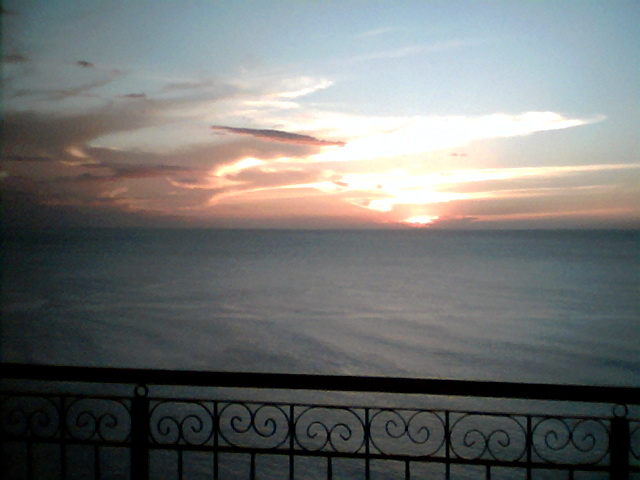
But for now, I'm relaxing with the MetaxuCafé, a beer, and the sunset view from my balcony.

Cheers!

29 November 2005

Forgetfulness

Forgetfulness is like a song
That, freed from beat and measure, wanders.
Forgetfulness is like a bird whose wings are reconciled,
Outspread and motionless,--
A bird that coasts the wind unwearyingly.

Forgetfulness is rain at night,
Or an old house in a forest,--or a child.
Forgetfulness is white,--white as a blasted tree,
And it may stun the sybil into prophecy,
Or bury the Gods.

I can remember much forgetfulness.
~ Hart Crane

The song goes on its way, meandering the halls of time, heedless of tempo or space. The bird could spend hours bathed in such timelessness--sea and sky might as well be one and the same. Water falls, aiding the dreams of the sleepers beneath roofs in the dark...perhaps in the woods where only the trees remember. Children have ephemeral soap-bubble emotions: grudges, tears, and laughter follow where old moons go. There is blankness on the face of it, or of the limbs bleached by the ceaseless, roaming wind. No ending or beginning, alive to nothing but itself. The sybil might blink and speak and forget to remember that eons have gone by with silence as the only answer. The Gods follow the opposite course--smothered by centuries, decades, years of disregard.

I write this to recall the blessings of oblivion.

28 November 2005

Visions

William Blake...mystic, pre-Romantic poet, engraver, printer, painter, visionary.

Born on this day in 1757.


'Tell me what is a thought, and of what substance is it made?
Tell me what is a joy, and in what gardens do joys grow?
And in what rivers swim the sorrows? And upon what mountains
Wave shadows of discontent? And in what houses dwell the wretched,
Drunken with woe, forgotten, and shut up from cold despair?

'Tell me where dwell the thoughts, forgotten till thou call them forth?
Tell me where dwell the joys of old, and where the ancient loves,
And when will they renew again, and the night of oblivion past,
That I might traverse times and spaces far remote, and bring
Comforts into a present sorrow and a night of pain?
Where goest thou, O thought? to what remote land is thy flight?
If thou returnest to the present moment of affliction,
Wilt thou bring comforts on thy wings, and dews and honey and balm,
Or poison from the desert wilds, from the eyes of the envier?'

~ from "Visions of the Daughters of Albion"

15 November 2005

A difficult paradox

Linda Leavell on "Marianne Moore, the James family, and the politics of celibacy":
Her mother explained one of the inspirations for ["Marriage"]: "One day when skating in Central Park, and coming to a statue of ... Daniel Webster, [Marianne] noted the words inscribed, ... Liberty and Union, now and forever,' and thought his notion was as appropriate to the family as to the state." (48) "Liberty and union" is the paradox of American democracy, and of family love, that Moore returns to again and again. It is significant that in "Marriage" she deletes the third phrase of Webster's famous quotation--"Liberty and union, now and forever, one and inseparable"--because it would upset the balance in favor of "union." [...]

Repeatedly her poetry resists categories, resists stereotypes, resists expectations, resists, in short, unions. To lean against the prevailing wind of erotic desire and of most lyric poetry demands "gusto" (Complete Prose 420-26) on Moore's part, if not "criminal ingenuity" (Complete Poems 62). And yet what she chooses ultimately is not the myth of the solitary artist or lone American pilgrim. Self-sufficiency can be as egotistical as "love in the mistaken sense of greed." Rather, her model of national and personal identity lies in the difficult paradox of "liberty and union," each impossible without the other.
(Via wood s lot)

from "Marriage"
Below the incandescent stars
below the incandescent fruit,
the strange experience of beauty;
its existence is too much;
it tears one to pieces
and each fresh wave of consciousness
is poison.
"See her, see her in this common world,"
the central flaw
in that first crystal-fine experiment,
this amalgamation which can never be more
than an interesting possibility,
describing it
as "that strange paradise
unlike flesh, gold, or stately buildings,
the choicest piece of my life:
the heart rising
in its estate of peace
as a boat rises
with the rising of the water;"
constrained in speaking of the serpent --
that shed snakeskin in the history of politeness
not to be returned to again --
that invaluable accident
exonerating Adam.
~ Marianne Moore, born on this day in 1887

14 November 2005

Removing context to preserve meaning?

Boris Fishman has written an excellent essay for Nextbook on what went wrong with Bee Season's adaptation to film, and poses some interesting questions about the possible implications:
Though screenwriter Naomi Foner Gyllenhaal and the directing team of Scott McGehee and David Siegel retain the book's enchantment with Jewish mysticism, they have leached it almost entirely of its context. "We didn't want the religious side of Judaism to overwhelm the spiritual side of the story," the directors told me before the film's release. In the film's production notes, they explain, "We wanted to explore a more universal and accessible vision of what an internal spiritual quest of any kind might be like." [...]

[I]n the book, Saul's stewardship of an ordinary congregation implicitly explained his obsession with mysticism; in the film, the avocation comes across as random and weird. These are certainly spiritual times in America, but it may be premature to assume that kabbalist aspirations require no more explanation than a gardening habit. A more specifically Jewish setting might have had a clarifying effect, making the material easier to relate to for non-Jews. Indeed, if Siegel and McGehee are right and Jews have become thoroughly integrated, non-Jews shouldn't find that backstory too difficult to absorb.

The film does pose an intriguing, if inadvertent, question absent from Goldberg's novel: Does anything indivisibly Jewish remain after the traditional markers of American "Jewishness"—the stock characters, the rituals of the shul—have been removed? Is there something uniquely Jewish about this story, or is the Jewish teaching it portrays so universally applicable because it's so unspecific? As American culture performs on Jewish tradition the loving evisceration to which it subjects other cultures before they can join its mainstream, what remains?
There's also an insightful audio interview with Myla Goldberg.

(Via MoorishGirl)

Unaware

I imagine...
the confident and euphoric Melville at his cigar-and-port dinner with Nathaniel Hawthorne on or about publication day, unaware that the British edition was out, or botched; the British reviews describing his novel "as so much trash belonging to the worst school of Bedlam literature" winging their way to Boston by boat that very minute; the U.S. papers about to quote and re-quote the British press, showing not just a similar lack of insight but that they had not read the book, as the American edition was different, and not botched. The long-term personal and professional impact could not have been greater: "Taken all in all," writes Parker of Nov. 14, "this was the happiest day of Melville's life."
For on this day in 1851, Moby-Dick was published.

(Via Today in Lit)

12 November 2005

Dolor


I have known the inexorable sadness of pencils,
Neat in their boxes, dolor of pad and paper-weight,
All the misery of manilla folders and mucilage,
Desolation in immaculate public places,
Lonely reception room, lavatory, switchboard,
The unalterable pathos of basin and pitcher,
Ritual of multigraph, paper-clip, comma,
Endless duplication of lives and objects.
And I have seen dust from the walls of institutions,
Finer than flour, alive, more dangerous than silica,
Sift, almost invisible, through long afternoons of tedium,
Dropping a fine film on nails and delicate eyebrows,
Glazing the pale hair, the duplicate gray standard faces.

~ Theodore Roethke

(With much gratitude to wood s lot. This has become a new favorite.)

And there was much rejoicing

Yesterday saw the completion of my in-class observation and now I am a certified TEFL grad! I was pleased to discover that it was much more rigorous than I had originally thought...and wonderfully practical. Plus, it was great to be a student again.

Next year will be a whole 'nother ballgame: five classes (25 teaching hours) devoted entirely to English and History. And the miracle is...I'm actually excited about it.

08 November 2005

The latest from my favorite FPLA

It has been an evil day filled with many gradations of malevolence--from finding out about the death of John Fowles to having to extract a wad of gum from the lovely black tresses of one of my students (the work of an infatuated seven-year-old boy).

So what do I do? Stay in and read the John Hodgman interview at One Story, of course (and offer thanks to The Elegant Variation).

Many moons ago when I was barely out of college, I stumbled upon Hodgman's "Ask a Former Professional Literary Agent" columns in McSweeney's. As this was before I discovered the marvelous universe of litblogs, I would email friends with the links so they, too, could bask in the seasoned wisdom of Mr. John K. Hodgman.

Later, I moved to Brookline, Massachusetts and became a proud patron of the Coolidge Corner Theatre myself. (Every word he has written about it is lovingly true.)

Now I discover he has just released a new book, The Areas of My Expertise. Or, as he so aptly explains,
Everything you need to know about my book is contained within its title: THE AREAS OF MY EXPERTISE. That is actually the shorthand title. The full title is:

"An Almanac of Complete World Knowledge Compiled With Instructive Annotation and Appranged in Useful Order by Me, JOHN HODGMAN, a professional writer, in THE AREAS OF MY EXPERTISE, Which Areas Include Matters Historical, Matters Literary, Matters Cryptozoological, Hobo Matters, Food, Drink, and Cheese (a Kind of Food), Squirrels & Lobsters & Eels, Haircuts, Utopia, What Will happen in the Future, and Most Other Subjects."

Which is to say that it is a handy desk reference and book of interesting trivia in the tradition of THE BOOK OF LISTS or THE PEOPLE'S ALMANAC, with the distinction that in MY book, all of the historical oddities and amazing true facts contained within it are entirely MADE UP, by me. This, paradoxically, allows it to be more true.
Of course it does.

So for old time's sake (and because I needed a laugh), here is a glimpse from The Best Column Ever (or in the immediate case below, "Ask A Brilliant But Eccentric Sleuth Who Is As Mysterious As The Many Legendary Crimes That He Has Solved, And Who Has Since Gone Into Hiding"):
Lisa L. F. asks: Marcel Duchamp once remarked that no book should be longer than 99 pages, but still most seem to be much longer. Why?
JKH, WOWAD: Because pages are printed in groupings of 16 or 32 (called "signatures"), the longest a book can actually be is 96 pages long. Most are much shorter: "One Hundred Years of Solitude," which many believe to be a very long novel, is actually only ten sentences long. There are two explanations for the phenomenon, called "page inflation," that you have observed. Wide margins are partly to blame. But more commonly the fault lies in the conjuring of an evil magician, as magicians are the sworn enemies of logic, literary brevity, and, of course, detectives. Electronic publishing will change all this.
And for good measure:
Monica S asks: Is it ethical for a writer to say that she has been published on the website of a literary journal, even if said writer has merely contrived to have a letter printed in that journal's Letters section?
JKH, FPLA: Oh, absolutely. This is common practice in publishing, just as it is entirely acceptable to say that your novel is "being seriously considered" by a publishing house so long as you have not yet opened the rejection letter.

05 November 2005

Giddy

True education flowers at the point when delight falls in love with responsibility. If you love something, you want to look after it.
~ Philip Pullman


On Thursday, I received a lovely brown package in the mail (hooray for parents and belated gifts!): Literature: A Portable Anthology. Since reading an article back in August on "How schools are destroying the joy of reading," I've wanted to get my hands on this book. It's exceeded my expectations. I got the same feeling as when I was in college and bought my Norton anthologies--beautiful tomes with Bible-thin pages full of friends old and unmet. This anthology by Bedford/St. Martin's is specifically for introductory lit classes (high school) and has wonderful bios and excellent supplementary info (not to mention the 35 stories, 250 poems, and 9 plays by everyone from Sir Philip Sidney to Sandra Cisneros). I plan to rely on it a lot this coming year. (I've been reading through it in my spare time--revisited "Bartleby, the Scrivner" and "A White Heron" yesterday.)

Most days I'm terrified of what lies ahead. But then there are days like last week when I needed to carry a volume of Dylan Thomas in my mochila and devour a few poems during breaktime. Like a schoolgirl with a crush, I wrote his lines all over the blank cover of my new journal: the words of a Welshman in handwritten black ink to serve as a talisman to ward off mediocre thoughts and banal forms of despair.

So for now I won't think about my lack of experience and the vastness of all I don't know. The weight of this new book in my hands reminds me of a time when I knew what I was doing and loved every minute of it.

miracle

I have just listened to this
symphony which Mozart dashed off
in one day
and it had enough wild and crazy
joy to last
forever,
whatever forever
is
Mozart came as close as
possible to
that.

~ Charles Bukowski

02 November 2005

Mi ratoncito favorito

"Speaking the Heritage," an anonymous column that appeared this week at Inside Higher Ed, exposes the tensions and complexities of Spanish-speaking communities in the U.S.:
For my students who are what has been called Heritage speakers of Spanish — those whose home language is Spanish, and speak it with varying degrees of proficiency — their relationship with the language is quite different from the one the non-Heritage speakers and the native speakers have. In these years I have worked close to la frontera, I have come to understand that, for many of the heritage speakers, Spanish is much more than just a language: it is a source of pain, no matter how well or how poorly they speak it. Some have come to tell me how they were ridiculed in elementary school for now [sic] knowing how to speak “proper” English. Others told me of other times when the newcomers from Mexico or other Spanish-speaking countries make fun of their Spanish and tell them that they do not speak any Spanish, even in the university!
The professor goes on to relate a particularly heinous experience with a university board. Ultimately, it is the students who suffer.

It is true that "there are all kinds of Hispanics, some of whom, unfortunately, do not recognize somebody who is an ally, and would rather have only people of one ethnic group teach any subject related to the interests of that ethnic group." I'm very familiar with the type of anxiety the author refers to. I think that's part of the reason I abandoned my plans for graduate school and hightailed it back to Colombia. I'm ashamed of what I don't know, of my merely adequate Spanish, of the crater-sized gaps in my knowledge of Latin America. My father knew no English when he arrived in northern California in the '70s, and although both English and Spanish are spoken at home (my Anglo mother is fully bilingual), inevitably, English predominates. (He speaks excellent English--I wish I could say the same for my Spanish!)

The longer I'm here, the more I learn about my father...and myself. (I feel more at home here in a lot of ways than I do in the States.)

As children, my brothers and sisters and I didn't have the tooth fairy. Instead, whenever we lost a tooth, we'd awake the next morning with a carefully folded note from "the Big Mouse" under the pillow. The Big Mouse always drew his self-portrait on his notes by way of signature (which included a cheeky Cheshire-like grin). These notes sent us off on "wild-goose chases" throughout the house--each clue sending us off in search of another until we found our small presents.

I'd always thought this tradition was invented by my dad--and certainly parts of it are. But last month (only last month!!) I found out about el Ratón Pérez--the mouse who replaces teeth with money under pillows all across Latin America and Spain. So I did a bit of digging...

Apparently, Sr. Pérez was partially the creation of Fr. Luis Coloma (a member of the Spanish Royal Academy) for the Spanish king Alfonso XIII when he was 8. In the story, the mouse lives in Madrid with his family in a big box of cookies in a candy store not far from the Palacio Real. The night he goes to take the tooth from underneath the prince's pillow, the prince wakes up and they go on an adventure together. The prince is turned into a mouse and travels with Pérez to meet his family and tag along on his other errands. Ratón Pérez visits many children, and the future king "discovered that there were many different children that endured hunger and cold, but they were also his brothers because all are children of God."

If you go to the Centro Virtual Cervantes site and click on "Exposición," you can view a slide show of 79 different illustrators' depictions of my old friend the Big Mouse. I'd love to add my dad's version to it.

31 October 2005

The Wonder of It

How wild, how witch-like weird that life should be!
That the insensate rock dared dream of me,
And take to bursting out and burgeoning--
Oh, long ago--yo ho!--
And wearing green! How stark and strange a thing
That life should be!

Oh, mystic mad, a rigadoon of glee,
That dust should rise, and leap alive, and flee
A-foot, a-wing, and shake the deeps with cries--
Oh, far away--yo-hay!
What moony masque, what arrogant disguise
That life should be!

~ Harriet Monroe

Ahoy, it be a trrruth uni’ersally acknowledged...

Over at The Valve, Laura Carroll (of Sorrow at Sills Bend) has effectively shaken me out of the doldrums with her witty and incisive critique of the latest adaptation of Pride and Prejudice:
With swiftly rising spirits I anticipated how this bold new adaptation, for such it suddenly seemed to be, would develop. Perhaps the respectable London merchants the Gardiners would turn out to be Cornish wreckers swinging lanterns over the rocks by night to lead unsuspecting merchant ships to their doom. Mr Bennet might choke to death on a doubloon and his five daughters forcibly abduct Mr Collins and make him walk the plank. Charlotte Lucas could housekeep and cross-dress her way to the top of the British navy, drinking a bottle of wine every day as she went. Instead of running off with Wickham, Lydia Bennet could head up a failed mutiny & be abandoned in a whaleboat drifting on the Pacific with no parasol and nothing to eat but Kitty. For this, I thought, I am willing to bear Keira Knightley’s smirking, blank-eyed version of Elizabeth, Donald Sutherland’s glassy, senile Mr Bennet with incongruously glittering Beverley Hills bridgework, and all the boringly heavy hints about how hard an intelligent but impoverished woman’s lot was in c18, how critically important to make a good marriage, blah blah, zzzzzz.

I was mentally putting the finishing touches on how the dialogue ought to go - “Yarr, Darcy, I must have ye dance, ye whoreson bilge-drinker. I hate t’ see ye standin’ about by yourself in this mangy mannerrr. Ye had much better dance - or be keelhauled. Arr!” - when these enjoyable musings were spoilt by the arrival of a pair of ominously unsmutched Bingleys toting [Comeback Special Elvis] a Darcy about whom it must universally be acknowledged that he is not, and is unlikely to ever turn into, Colin Firth. How can such a thing be? Women all over the world are desperately trying to understand.

As my salty dreams faded and the movie inexorably ground on, I began to think that demonstrating the utter irrelevance of Colin Firth to its universe is indeed the chief motive of Pride and Prejudice ‘05 (that and making a squillion million, of course.) The movie is too conscious of the 1996 TV serial: it wants to duplicate that version’s success, but without acknowledging it as an honourable and still impressive precursor. The film makes a long string of adaptational choices and decisions which have no purpose I could guess at other than to drive the BBC / A&E series out of everyone’s minds. (A bit like telling a person not to think of an elephant.) And so some seriously self-defeating innovations are introduced.
Read on!

30 October 2005

Rescuing Macondo

I found last month's story on town officials' plans to capitalize on Aracataca's literary fame strangely wistful:
In the sculpture park, under the shade of almond and mango trees, the public will gather for lectures, readings and other cultural events while gazing at the towering Sierra Nevada de Santa Marta peaks rising to the east. [...]

Yet for many Aracatacans, the dream of turning their city into a tourist destination seems as quixotic and fanciful as Garcia Marquez's fiction, where a man can be transformed into a snake and the living speak to the dead.
Just this week, Santa Marta's local newspaper reported that the two-year-old highway connecting El Retén to Aracataca has already suffered extensive damage and attempts are being made to halt deterioration. It's difficult to pinpoint why development here in general is such an uphill struggle--almost as if a virulent strain of entropy infected the land long ago and we're blissfully unaware that it works differently anywhere else.
Arias said he last met with his famous cousin in November 2004 in Cartagena, where they spent three hours talking about family, old friends and Aracataca, which this year is celebrating the 100th anniversary of its founding.

"I told him Aracataca is completing its one hundred years of solitude," Arias recalled. "I told him that nothing has changed and there has been no progress."

Arias said Garcia Marquez replied optimistically: "Someday, there will be better years."
It is a testimony to the resilience of the Colombian people that such dogged optimism is so common here. Dreams will always intermingle with reality.

(Via Syntax of Things)

Hardworking book pirates

At Splinters, Chris discusses international book piracy and points to an excellent article of his at Travelhappy, "Bootleg Books in Cambodia and Vietnam":
The kids around the temples at Angkor are breathtaking in their English ability - their average age can't be more than eight or nine but they speak English fluently, almost without a trace of an accent. They are adept at cajoling and bargaining with you - everytime you step out of your car to go look at a temple, a gaggle of them will descend upon you, grinning, shouting and waving books, silks, ornaments and t-shirts at you. The smaller ones prod you in the belly to get you to look downwards at their merchandise. Others mark you from the start: "When you come back from the temple, you come and buy from me. What's your name? My name is Vanna. I remember you, you remember me?" So it goes as you move inch by inch surrounded by this mini-riot until you get to the temple entrance. It's pretty intimidating at first, but smiling your way through it all works a lot better than shouting.

They've got a hard gig - sometimes you see them in tears at the end of the day because they've sold nothing and have to go home to the parents empty handed. On the other hand, selling bootleg books to the likes of me means they can earn considerably more than the average Cambodian wage of a couple of dollars a day. I wonder what's going to become of these kids, how they will grow up, whether their English skills will help them get ahead and whether their bargaining skills will make them all become entrepeneurs. Following the life of one of them would make a good book in itself.

Don't they have to take some sort of literacy test?

Maud has been posting some very interesting thoughts on the perverse nature of modern bookstores:
If booksellers and publishers can’t even coordinate to get books into the stores by the time they’re being reviewed, it’s no wonder sales of everything but the likes of Harry Potter, The Da Vinci Code, and The Purpose-Driven Life are down.
Even more disturbing, it seems that there are bignamebookstore employees who don't know their ass from their A.S. Byatt:
Today was the day. The day that a new novel by Gabriel Garcia Marquez was due for sale in bookstores. I show up at Barnes and Noble at 10:30am on my break and begin scouring the New Fiction tables for the book. I don't see it anywhere. So I ask one of the workers for help.

"Excuse me- I heard the new book by Marquez would be for sale today. Is that true? I don't see it."
"By who?"

Okay. We're already off to a bad start. It is my not-so-humble opinion that you shouldn't be working in a bookstore if you have to ask, "Marquez who?". Put your hands in the air. Drop the books and no one gets hurt. There's a job waiting for you at Sam Goody over at the mall. Now get outta here.

He goes to the computer. "What was the author's name again?"
Sigh. With infinite patience I say again, "Gabriel. Garcia. Marquez." I resist the urge to run to the cash register and buy this guy One Hundred Years of Solitude. If I thought he would put down his John Grisham paperback long enough to read it, I would consider it a worthwhile investment.

"Title?"
Crap. I knew he was going to ask that, the clueless git. Under my breath, "memoriesofmymelancholywhores."
"What?"
"Memories of My Melancholy Whores." He looks over at my belly judgmentally. I'm not being sensitive, shut up, he did! "Yes, I'm seven months pregnant and I'm reading a book about sad whores, okay? It's not a romance novel, it's by a Noble Prize winning author who...nevermind."

"Oh, is he the guy who wrote that Oprah book?" Yeah, now I have to murder him. In the parking lot. Just as soon as his shift ends. "Ahhh, here it is. We just don't have it out on the tables yet. Let me go get you a copy."

And that, friends, is how I walked away with the very first copy sold of Marquez's new novel at my local Barnes and Noble. Next time I'm going to Full Circle. I guarantee you every single employee at Full Circle knows my good friend, Gabo.
"The guy who wrote that Oprah book."

God help me.

28 October 2005

A fine line

Going through some old notes, I found what amounts to John Harwood's parting shot in Eliot to Derrida: The Poverty of Interpretation:
Interpretive ingenuity is in one sense limitless, and yet obsessive readers are doomed to met their own reflections wherever they look. 'Once the context goes, anything goes' is a standard complaint about deconstruction, but the record of deconstructive practice is quite the reverse: as in a glass darkly, the method discovers itself in every text it scrutinises. New Critics hungered for paradox and irony, and found that even the despised Tennyson would, in the end, yield up those qualities. Deconstructionists seek indeterminacy, self-subversion, transgression, vertigo and aporia, and find them everywhere. Postmodern theorists fascinated by 'textual reflexivity' display, unwittingly, a fascination with their own mental processes. The real 'problem of interpretation' is not to prevent it from being arbitrary, but to restrain the power of obsessive or reflexive reading. Theorists of several current persuasions would argue, inconsistency notwithstanding, that any such restraint is (a) impossible, (b) repressive, and (c) politically motivated. Obsessive reading, however, is closely related to fundamentalist reading, which is by no means the exclusive property of the far religious right. Teachers who believe that they are radicalising ther students by demanding that they uncover a politically correct message in every text are, like their apparent opposites in clean-cut Bible colleges, giving instruction in fundamentalist reading, which is not something that should be taught, however ineptly, in universities.

As for the argument that all we can ever see are our own reflections, it is routinely disingenuous: the real thrust is that all you can see in a text is your own mystified reflection (or that of the ideology which has 'constructed' you), whereas we, possessed of theoretical insight, can see through it.

27 October 2005

Out of the Sighs

Out of the sighs a little comes,
But not of grief, for I have knocked down that
Before the agony; the spirit grows,
Forgets, and cries;
A little comes, is tasted and found good;
All could not disappoint;
There must, be praised, some certainty,
If not of loving well, then not,
And that is true after perpetual defeat.

After such fighting as the weakest know,
There's more than dying;
Lose the great pains or stuff the wound,
He'll ache too long
Through no regret of leaving woman waiting
For her soldier stained with spilt words
That spill such acrid blood.

Were that enough, enough to ease the pain,
Feeling regret when this is wasted
That made me happy in the sun,
How much was happy while it lasted,
Were vagueness enough and the sweet lies plenty,
The hollow words could bear all suffering
And cure me of ills.

Were that enough, bone, blood, and sinew,
The twisted brain, the fair-formed loin,
Groping for matter under the dog's plate,
Man should be cured of distemper.
For all there is to give I offer:
Crumbs, barn, and halter.

~ Dylan Thomas, born on this day in 1914

Collecting clues

The server was down for nearly a week due to lightning-struck towers (of some sort) and now I'm back, breathless. The school year is winding down, final exams are being devised, plans for the new year are becoming finalized. I've also been taking a TEFL course--much busyness, a few more hurdles to clear. Amid all this, my reading has been catch-as-catch-can: too much randomness, too much neglect of my Spanish. But there have been many golden times in spite of it all. Elie Wiesel says it best:
I read a lot. I teach my students, not creative writing, but creative reading and it is still from my childhood. You take a text, you explore it, you enter it with all your heart and all your mind. And then you find clues that were left for you, really foredestined to be received by you from centuries ago. Generation after generation there were people who left clues, and you are there to collect them and, at one point, you understand something that you hadn't understood before. That is a reward, and as a teacher I do the same thing. When I realize there is a student there, in the corner, who understands, there is a flicker in the eye. That is the greatest reward that a teacher can receive.
I think I'll pin this one to my wall.

20 October 2005

Wrecks

(from "The Drunken Boat")

I long for Europe with its aged old parapets!

I have seen archipelagos of stars! and islands
Whose delirious skies are open to sailor:
- Do you sleep, are you exiled in those bottomless nights,
Million golden birds, O Life Force of the future? -

But, truly, I have wept too much! The Dawns are heartbreaking.
Every moon is atrocious and every sun bitter:
Sharp love has swollen me up with heady langours.
O let my keel split! O let me sink to the bottom!

If there is one water in Europe I want, it is the
Black cold pool where into the scented twilight
A child squatting full of sadness, launches
A boat as fragile as a butterfly in May.

~ Arthur Rimbaud, born on this day in 1854

(I was also born today, in 1977. It isn't age or even time that makes me despise birthdays so much. It's the intensification of a lifetime's worth of disappointment concentrated on one particular day of the year. I'm hoping that one of these days it won't matter so much. Thick clouds hover over the slate-grey sea and I am fiercely glad.)

Annie Dillard remembers,
I loved Rimbaud, who ran away, loved his skinny, furious face with the wild hair and snaky, unseeing eyes pointing in two directions, and his poems' confusion and vagueness, their overwritten longing, their hatred, their sky-shot lyricism, and their oracular fragmentation, which I enhanced for myself by reading and retaining his stuff in crazed bits, mostly from Le Bateau Ivre, The Drunken Boat. (The drunken boat tells its own story, a downhill, downstream epic unusually full of words.)

Now in study hall I saw that I had drawn all over this page; I got out another piece of paper. Rimbaud was damned. He said so himself. Where could I meet someone like that?
~ An American Childhood (a.k.a. my very favorite work of nonfiction)

19 October 2005

Wow, where to begin?

Birnbaum's interview with Jonathan Lethem has reignited many thoughts. To begin with, I'm inspired enough to dust off a post I never quite finished. So here goes...

I think there is a parallel between the false dichotomy of "realist" vs. "anti-realist" fiction and the status-quo mindset that sets the sciences above the humanities.

Lethem says,
Fiction is a gigantic construction, a bauble. A novel is not life. That’s why it’s so pointless that this relentless baiting goes on, where ‘realist’ fiction is pitted against ‘anti-realist’ fiction as though one of the two has made some kind of commitment of integrity to be real, a responsibility the other has abdicated. [...] Fiction, like language, is innately artificial and innately fabulous. It’s made of metaphor. Language itself is a fantastic element. It’s not possible to plant words in the ground and have seeds grow up and feed on the results. It’s not part of the biological or mechanical world.
The same Lombardi article that provoked my earlier response also contained the following:
We lose influence on campus to the sciences on one side because they appear and act as if they know exactly what they are doing, how they do it, and for what purpose they do it. We lose influence on campus to the professionally oriented disciplines on the other side because they have a purpose and a method anchored directly in the center of the real world their disciplines address.

We in the humanities, and very frequently as well in the social sciences, often do not know and do not agree on what we think we are doing. We have few common standards and we ask little of our students who have time for non-academically related campus activities. We wonder why our voices carry such little weight when our culture seems to need us so desperately to sort out fundamental issues of values and judgment.
He's on to something, but doesn't take it far enough. My question is, "What exactly is the 'real world'?"

In Living by Fiction, Annie Dillard relates:
Science, that product of skepticism born of cultural diversity, is meant to deal in certainties, in data which anyone anywhere could verify. And for the most part it has. Our self-referential mathematics and wiggly yardsticks got us to the moon. I think science works the way a tightrope walker works: by not looking at its feet. As soon as it looks at its feet, it realizes it is operating in midair. At any rate, the sciences are wondering, again, as the earliest skeptics did, what could be a firm basis for knowledge. People in many of the sciences are looking at their feet. First Einstein, then Heisenberg, then Gödel, made a shambles of our hope (a hope which Kant shared) for a purely natural science which actually and certainly connects at base with things as they are. [...]

Physicists have been saying for sixty years that (according to the Principle of Indeterminacy) they cannot study nature, but only their own perception of nature: “method and object can no longer be separated” (Heisenberg). Sir Arthur Stanley Eddington, British Astronomer Royal, said in 1927: “The physical world is entirely abstract and without ‘actuality’ apart from its linkage to consciousness.” It is one thing when Berkeley says this; when a twentieth-century astronomer says this, it is a bit of another thing. Similarly (and this is more familiar), Eddington’s successor Sir James Jeans wrote, summarizing a series of findings in physics: “The world begins to look more like a great thought than a great machine.” The world could be, then, in Eddington’s phrase, “mind-stuff.” And even the mind, anthropologists keep telling us, is not so much a cognitive instrument as a cultural artifact. The mind is itself an art object. It is a Mondrian canvas onto whose homemade grids it fits its own preselected products. Our knowledge is contextual and only contextual. Ordering and inventing coincide: we call their collaboration “knowledge.” The mind is a blue guitar on which we improvise the song of the world.
In other words,
The world is caught in a crossfire between necessity and possibility; the world is the fabrication of a billion imaginations all inventing it at once.
Lombardi concludes his piece by asking,
What to do? I am not sure, but the first thing would be to pay close attention to what people are reading, what they are seeing, and how they do engage the common culture. The message of “Reading At Risk” is that something other than literature in print form engages more and more of our fellow citizens, and we might want to try to learn how to speak to them in the voices they want to hear.
This latter idea sets off all sorts of alarm bells in my brain. Why must people be spoken to “in the voices they want to hear”? How can people change and grow if they are given what they want? What ever happened to the notion of expanding the capacity of the individual to embrace what was formerly thought as “difficult”? Isn’t enlarging understanding one of the goals of education? How can the "status quo" ever be effectively challenged this way?

Towards the end of the book, Dillard analyzes "Kubla Kahn," demonstrating how "the poem is a form of knowledge":
But what is knowledge if we cannot state it? If art objects quit the bounds of the known and make blurry feints at the unknown, can they truly add to knowledge or understanding? I think they can; for although we may never exhaust or locate precisely the phenomena they signify, we may nevertheless approximate them--and this, of course, is our position in relation to all knowledge and understanding. All our knowledge is partial and approximate; if we are to know electrons and chimpanzees less than perfectly, and call it good enough, we may as well understand phenomena like love and death, or art and freedom, imperfectly also.
All that to say that when the Rake declares "woe to those who confuse truth and fact," I can only add my own hearty "AMEN!"

18 October 2005

Unveiling

After much research and investigation, the intrepid volunteers (myself included) were able to discover the truth about Lemony Snicket's Book the Twelfth, The Penultimate Peril. (Dare I admit it? It was actually quite fun.) The entire first chapter is now online:
“Trust?” Sunny said quietly, and this was the most important question of all. By “trust,” the youngest Baudelaire meant something along the lines of, “Does Kit Snicket seem like a reliable person, and should we follow her?” and this is often a tricky question to ask about someone. Deciding whether or not to trust a person is like deciding whether or not to climb a tree, because you might get a wonderful view from the highest branch, or you might simply get covered in sap, and for this reason many people choose to spend their time alone and indoors, where it is harder to get a splinter. The Baudelaires did not know very much about Kit Snicket, and so it was difficult to know what their future would be if they followed her down the sloping lawn toward the mysterious errands she had mentioned.
You can also make your own Misfortune Teller following these insidious instructions.

Librarians speak up

Scott McLemee has some great news and gives a bit of background on the behind-the-scenes drama:
The Association of College and Research Libraries — which has 12,000 members working in the various sectors of secondary education — has now launched a group site called ACRLog. Actually it has been running since mid-September, but only in warm-up mode. Its existence was officially announced yesterday [...]

The anger touched off by “Silence in the Stacks” in June was actually a continuation of the furor over a notorious (well, in some circles, anyway) statement by Michael Gordon, the president of the American Library Association, earlier this year. In the pages of Library Journal, he lashed out at “the Blog People” in his own profession — attributing to them sundry lapses of taste, judgment, and intelligence.

It was as if he were conducting an experiment to see if they could carry a grudge. Guess what? They can.

It would be good to think that the new group blog started by the Association of College and Research Libraries will rise above the old hostilities. So far, four academic librarians are involved in running it.
It will be interesting to follow their progress. Best wishes to this timely new endeavor!

14 October 2005

Eternal us

you and I are not snobs. We can never be born enough. We are human beings;for whom birth is a supremely welcome mystery,the mystery of growing:which happens only and whenever we are faithful to ourselves. You and I wear the dangerous looseness of doom and find it becoming. Life,for eternal us,is now'and now is much to busy being a little more than everything to seem anything,catastrophic included.

Miracles are to come. With you I leave a remembrance of miracles: they are somebody who can love and who shall be continually reborn,a human being;somebody who said to those near him,when his fingers would not hold a brush "tie it to my hand"-- [...]

Always the beautiful answer who asks a more beautiful question
~ E.E. Cummings, born on this day in 1894


It's no secret that Cummings is one of my favorite poets (right up there with Eliot and Yeats). Thanks to wood s lot, I've discovered a treasure trove of his paintings, from which the above work ("the book") is taken. (If you've got a few thousand lying around, you could even buy one!)

Random notes:

In the past, I've attempted to wax eloquent on the kinds of things that go on beneath the surface of his poems.

The Fairy Tales he wrote for his daughter, Nancy, are quite wonderful. "The Old Man Who Said Why," "The Elephant and the Butterfly," "The House That Ate Mosquito Pie," and "The Little Girl Named I" are all beautiful little stories that I fell in love with as a child.

When I lived in Boston, I tripped up to Cambridge to see the family home--right across the street from William James' place. A friend and I also ambled through the cemetary in Jamaica Plain where he and Marion are buried. A lovely place, actually.

12 October 2005

It's the little things

Mr. Beck has outdone himself. Again.
BUMFUCK, NC (AP) -- In a stunning upset over Brittany, Ashley, Madison, Ethan and Zachary, Jen Beckville has been named the winner of this year's Man Booger Award for her lyrical anthology of gagging and wheezing collectively known as Phlegm.
And it doesn't stop there...
The award was not without controversy, however, as just hours before the announcement, Phlegmish Academy member Knut Rocknee quit in a huff over the crowning of last year's winner, Caitlin. Rocknee dismissed her work as "violent hacking, choking, barf-up-a-lung scatology."

Essklown promptly dismissed the suggestion Caitlin was not Booger-worthy and claimed to be mystified by the timing of Rocknee's complaint. "I don't know why it's taken him a year to get his Pampers in a wad over this," said Essklown. "And anyway, it's not like she was picking her nose and eating it. Because, you know, that's just gross."

Broken Dreams

There is grey in your hair.
Young men no longer suddenly catch their breath
When you are passing;
But maybe some old gaffer mutters a blessing
Because it was your prayer
Recovered him upon the bed of death.
For your sole sake--that all heart's ache have known,
And given to others all heart's ache,
From meagre girlhood's putting on
Burdensome beauty--for your sole sake
Heaven has put away the stroke of her doom,
So great her portion in that peace you make
By merely walking in a room.

~ W.B. Yeats


After long-since giving up hope, I'm finally thumbing through my beloved edition of Yeats' collected poetry. And it only took ten years.

I recently recovered some boxes my family had to leave behind when we left Colombia in the mid '90s--seven to be precise. Seven. Boxes. It was like a school time-capsule experiment with the emotional equivalent of watching a corpse stir (well, almost). Unsettling in the extreme.

It took me two days to open them, which I did very carefully (accompanied by a bottle of Negra Modelo), while cataloging the contents in emails to my family. I've experienced the essence of "bittersweet"...several times over. The existential ruminations they inspired are dark, brooding things. But I've spent the past week hiding away from the rest of the world and rereading old favorites. L.M. Montgomery has kept me company as of late; Louisa May Alcott is next on the docket (to be read by candlelight since the lamp has gone out). It's really uncanny how you can go years (a decade!) without reading a beloved book, and then once it's taken up again, the lines unreel themselves in your head right before your eyes find them.

And then there are the memories of who you were when you first loved them...

But I'd be lying if I neglected to mention the buried-treasure element involved. My complete sets of Jane Austen, Lewis Carroll, and Alcott are stacked near collections of Yeats, Tennyson, Blake, Chaucer, Dickinson, and Frost. There's a complete illustrated Longfellow from 1888, alongside an ancient second edition of Olive Schreiner's Story of an African Farm and another of Scott's Waverley novels--also from the 19th century (all I have left of my grandparents' old home).

Then there's Twain, Tolkien, Dostoevsky, Lewis, Sayers, and Burnett's A Little Princess...right next to Helter Skelter and novelizations of Braveheart and the original three Star Wars films (!).

The fragrance of old paper greets me when I enter my apartment--I've left everything out in plain sight. These last several days have been overcast, and the sea has been more turbulent and noisier than usual. Clouds have been constant--something to be grateful for as autumn is my favorite time of year. I'm glad to have at least a little bit of it in this year-round summer.

So here's to old friends that inhabit long-lost pages...and solitary evenings by candlelight...in spite of ruined dreams.

10 October 2005

"New" Pessoa

Exact Change announces the release of a newly-translated work by Fernando Pessoa, The Education of the Stoic:
“I transferred to Teive my speculations on certainty, which lunatics have in greater abundance than anyone.”

Portuguese author Fernando Pessoa (1888-1935) was a multitude of writers: his works were composed by “heteronyms,” alter egos with distinct biographies, ideologies, influences, even horoscopes. The Education of the Stoic is the only work left by the Baron of Teive, who, having destroyed all his previous attempts at literary creation, and about to destroy himself, explains “the impossibility of producing superior art.”

The baron’s manuscript is found in a hotel-room drawer — not unlike editor and translator Richard Zenith’s own discovery, while conducting research in the Pessoa archives, of a small black notebook whose contents had never been transcribed. In it he found the missing pieces of this short but trenchant complement to Pessoa’s major prose work, The Book of Disquiet. Pessoa himself noted that despite their dialectical differences, the middle-class author of The Book of Disquiet (assistant bookkeeper Bernardo Soares) and the aristocrat Teive, “are two instances of the very same phenomenon -— an inability to adapt to real life.”
An excerpt can be found here:
There’s no greater tragedy than an equal intensity, in the same soul or the same man, of the intellectual sentiment and the moral sentiment. For a man to be utterly and absolutely moral, he has to be a bit stupid. For a man to be absolutely intellectual, he has to be a bit immoral. I don’t know what game or irony of creation makes it impossible for man to be both things at once. And yet, to my misfortune, this duality occurs in me. Endowed with both virtues, I’ve never been able to make myself into anything. It wasn’t a surfeit of one quality, but of two, that made me unfit to live life.

Doing something

I'll echo MoorishGirl:
Do you really need to be snacking on a $5 latte and a $4 blueberry scone as you're reading this? Perhaps you might consider giving it up for the rest of the week. People in India, Kashmir and Pakistan could use your help after Saturday's devastating earthquake. Here's a link.

04 October 2005

An auspicious beginning

I've started up a LibraryThing account for the school, and hope to create an efficient check-out system and card catalog for our little library soon. I showed Biblioteca: Libros Gratis to a co-worker, and now we have many more Spanish volumes downloaded into our server. There's a great selection of public domain English works that have been included as well (and I hope to explore Bibliomania more).

It's "Reading Week" here and for 20 minutes each morning teachers from the upper grades read to the younger students and those who teach the young ones read to the older kids. It's been a lot of fun swapping classes and just letting loose. I may have gotten a bit carried away while reading from Jon Scieszka's Knights of the Kitchen Table to the 5th graders--but they loved it. (Hope to try A Wrinkle in Time with the 7th graders on Friday.)

Also, the book quest continues. A friend sent me several volumes in July and I was able to bring two large shopping bags' worth back from the States with me over break. But we've still got a long ways to go. If anyone is interested in helping out and would like to save on shipping, I'll be heading up north in December and will pick up any books sent to a certain stateside address. (Email me at currerbell at hotmail dot com for more info.)

Read "This Illiterate Brazilian's Home Speaks Volumes"--an amazing article that comes via LibraryThing's blog (and makes me realize how much more I can do!):
They inaugurated the library on March 20, 2004, with 100 volumes, most of them literary and historical treatises donated by someone Pena knew. Since then, the group has been amassing books at a feverish pace. Many come from rich Brazilians in whose homes they work as cleaners, handymen and the like.

Because everything is by donation, the collection is eclectic and quixotic, but impressive in scope: from Shakespeare to Agatha Christie, Umberto Eco to political theorist Antonio Gramsci, William Faulkner to James Joyce, not to mention textbooks and reference works. There's no Dewey decimal system, or even strict alphabetical order; books are simply grouped by subject. [...]

Not a single penny has come from official sources — "not from the politicians, not from the government," said Da Penha, who is on medical leave from her job as a cleaning lady at a local school.

"What's here is what we've done ourselves," she said. "We've sacrificed a lot to help the people here. But it's a sacrifice of love."

The surrender of choice

Bad Librarian reads Whitman, Lao Tzu, and Rilke...
It cultivated a stillness that, to me, is a large part of the transformative nature of poetry and one of the great pleasures of reading, or hearing it.
...and rages against the "May Pole of Linguistic Doom":
I don't mean to incessantly harp on the common idiom, because I am amused by a stupid cliché as much as the next guy (for comedic purposes, gratuitous group-think is oh-so-amusing and well satiates my heightened sense of elitist scorn). It's the surrender of choice that really scares me about other people's speech. By relying on lingo and tired jargon, meaning is abdicated and docile formulaic speech becomes the norm. By compartmentalizing and packaging words into easy-to-use metaphors, language is stripped of emotional value and becomes rote noise without human connection, all done for the sake of some idiotic sense of "normalcy". By creating a language-based lowest common denominator (all of us saying the same stupid shit) we cheapen our most profound means of communication. By doing so, we in turn, cheapen ourselves.

Poetry on the other hand, connects us to the world, enlivening our relationships and personal encounters with its music and magic. Poets are the protectors of the artful word and by staying with them, and by reading their work, we show our love and appreciation for what they do and what they stand for: language as art, art as divinity. I make my own language with these men and women, and with language, I am freed. With language I can think and say what I please, exactly as it is and without dilution. I am unbound from the constraints common culture places unconsciously within me. With language, I can make the world as it truly is, and so can all of you. Just ask Whitman:

Have you reckon'd a thousand acres much? have you reckon'd / the earth much? / Have you practis'd so long to learn to read? / Have you felt so proud to get at the meaning of poems?

Stop this day and night with me and you shall possess the / origin of all poems / You shall possess the good of the earth and sun, (there are / millions of suns left,) / You shall no longer take things at second or third hand, nor / look through the eyes of the dead, nor feed on the / specters in books / You shall not look through my eyes either, nor take things / from me / You shall listen to all sides and filter them from your self.
Don't worry. I'm sure that before long you'll be able to say you've "joined the elemental verbs and set the noun and dash of consciousness together jumping with sensation of Pater Omnipotens Aeterna Deus / to recreate the syntax and measure of poor human prose".

Suerte.

In Progress

Ten years ago it seemed impossible
That she should ever grow so calm as this,
With self-remembrance in her warmest kiss
And dim dried eyes like an exhausted well.
Slow-speaking when she has some fact to tell,
Silent with long-unbroken silences,
Centred in self yet not unpleased to please,
Gravely monotonous like a passing bell.
Mindful of drudging daily common things,
Patient at pastime, patient at her work,
Wearied perhaps but strenuous certainly.
Sometimes I fancy we may one day see
Her head shoot forth seven stars from where they lurk
And her eyes lightnings and her shoulders wings.

~ Christina Rossetti

(For my sisters.)

02 October 2005

Gray Room

Although you sit in a room that is gray,
Except for the silver
Of the straw-paper,
And pick
At your pale white gown;
Or lift one of the green beads
Of your necklace,
To let it fall;
Or gaze at your green fan
Printed with the red branches of a red willow;
Or, with one finger,
Move the leaf in the bowl--
The leaf that has fallen from the branches of the forsythia
Beside you...
What is all this?
I know how furiously your heart is beating.

~ Wallace Stevens, born on this day in 1879

Glimpses

The BBC announces, "Classic English literature should remain central to the teaching of English, a study suggests." As Mr. Champion so aptly quips, "In other groundbreaking news, it is believed that the theory of relativity might just help you sort out electromagnetic waves. And maybe, just maybe, 3.141592675 might have something to do with circles."

~*~*~*~*~*~*~*~*~*~*~*~*~*~*~*~*~*~*~*~*~*~*~*~*

Michael Dirda reviews the new Melville biography:
Long ago, Borges recognized in Melville a precursor of Kafka, especially in the great short story "Bartleby, the Scrivener" (1853), that tale of the mousy clerk who one day, when asked to perform a simple clerical task, quietly says, "I would prefer not to." The result is an unforgettable account of existential loneliness and of our failure to connect with the less fortunate among us, but also a study in the (all too contemporary) frustration resulting when people in power, people of goodwill who view themselves as "civilized" or as upholders of propriety and tradition, must suddenly confront those who adamantly refuse to recognize their values, their authority.
(Via Arts & Letters Daily)

~*~*~*~*~*~*~*~*~*~*~*~*~*~*~*~*~*~*~*~*~*~*~*~*

Carlos Fuentes sings the praises of the novel:
By multiplying both authorship and readership, the novel, from the times of Cervantes to our own, became a democratic vehicle, a space of choice, of alternate interpretations of the self, of the world, and of the relationship between myself and others, between you and me, between we and they.

Religion is dogmatic. Politics is ideological. Reason must be logical. But literature has the privilege of being equivocal. The quality of doubt in a novel is perhaps a manner of telling us that since authorship (and thus authority) are uncertain and susceptible of many explanations, so it goes with the world itself.
(Via A&L Daily)

~*~*~*~*~*~*~*~*~*~*~*~*~*~*~*~*~*~*~*~*~*~*~*~*

The new Self-Made issue of Boldtype, guest edited by Maud Newton and Mark Sarvas is out. Looking forward to following the discussion...

~*~*~*~*~*~*~*~*~*~*~*~*~*~*~*~*~*~*~*~*~*~*~*~*

Ron Silliman shares some wonderful observations about Martin Scorsese's Dylan documentary, No Direction Home:
One of the more interesting moments in the film is Allen Ginsberg choking up as he recounts his experience of first hearing “Hard Rain,” played for him at a party in Bolinas by Charlie Plymell. “I wept,” Ginsberg says, clearly recognizing the reflection of his own influence in Dylan’s lyrics, “The torch had been passed.” I remember my own experience, first hearing that song. Lacking Ginsberg panoptic reading (he was 37 in 1963, I was 17), I can clearly recall the hair on the back of my neck standing up: I had never heard anything like that before anywhere. It was an announcement that the world was going to be different very very soon – in spite of its apocalyptic message, the song gave me an unshakeable optimism that I would return to often over the next couple of years.

Ginsberg’s presence on the film makes great sense, not simply because he knew Dylan. Nor is he the only writer in the film – James Baldwin shows up twice, we hear a snatch of Kerouac & in a shot of heads at the Cedar Bar you can make out Frank O’Hara as he blurs past, unannounced & unquoted.
(Via wood s lot)

Two Women

The woman without
graces has a husband.
She has Volvo, sons
of three heights,
a club foot, glasses.
In fact she has several
pairs of glasses she's
purchased at Sears
of the half-moon variety.
Time, the woman knows,
is her worst enemy.
Dinners bisect Mendelsohn
and Metternich.
The sweater unravels
further each washing.
The hair refuses
to be smoothed.
The daughter holds
damp arms around her neck,
damp cheek to damp cheek,
at the shallow end of the pool.

The woman with graces
is thin stuff, thin stuff.
Thin are the arms emerging
from the cashmere shell.
Thin are the legs beneath
the linen sheath,
hard and knotty as pine.
Thin is the kid wrapping
each teetering anklet.
Thin are the letters from lovers.
Time, the woman knows,
is her worst enemy:
the buzzing cocktail phone
and the showered skull
emerging from its tiled chamber.
A whiff of ambrosial
compact and cleanser
between her and herself:
reams and reams of thin stuff,
an invisible knitting.

~ Elizabeth Skurnick

26 September 2005

Worth repeating

A friend of mine who works at a university in the States recently responded to my little rant, which involved the question, "If the U.K. system is so well-respected and the U.S. system is looking for ways to improve itself, then why doesn't the latter get ideas from the model of the former?" Here's what she had to say:
I think a lot of U.S. educational institutions ignore the advances made by institutions in other countries out of a self-absorbed, "manifest destiny" sort of Americanism (forgive my use of the term)--the idea, in short, that we are better than everyone else. That we are more wealthy and advanced than everyone else; therefore, we must already be (by default) the leader in everything. Even when we're not.

And we are blind to the fact that we are, ourselves, the ignorant promoting the ignorance of others. I don't mean this to be a blanket statement, of course, or I would implicate myself in the process. But where does real learning take place? When a person is forced to grapple with real ideas and come to a real conclusion--on his or her own. Not to spit out facts on a test. Not to present an overview of what everyone else has thought on a subject--although I do find value in examining other perspectives to help solidify my own.

I can't speak to the value of the tutorial system since I haven't experienced it. But I can speak to the value of a person coming up with new, independent ideas...perhaps even before he or she has published the Ph.D. dissertation. THAT is learning. And the promotion of THAT is education.

The hint half guessed

Men's curiosity searches past and future
And clings to that dimension. But to apprehend
The point of intersection of the timeless
With time, is an occupation for the saint—
No occupation either, but something given
And taken, in a lifetime's death in love,
Ardour and selflessness and self-surrender.
For most of us, there is only the unattended
Moment, the moment in and out of time,
The distraction fit, lost in a shaft of sunlight,
The wild thyme unseen, or the winter lightning
Or the waterfall, or music heard so deeply
That it is not heard at all, but you are the music
While the music lasts. These are only hints and guesses,
Hints followed by guesses; and the rest
Is prayer, observance, discipline, thought and action.
The hint half guessed, the gift half understood, is Incarnation.
Here the impossible union
Of spheres of existence is actual,
Here the past and future
Are conquered, and reconciled,
Where action were otherwise movement
Of that which is only moved
And has in it no source of movement—
Driven by daemonic, chthonic
Powers. And right action is freedom
From past and future also.
For most of us, this is the aim
Never here to be realised;
Who are only undefeated
Because we have gone on trying;
We, content at the last
If our temporal reversion nourish
(Not too far from the yew-tree)
The life of significant soil.

~ T.S. Eliot, born on this day in 1888
"The Dry Salvages," Four Quartets

25 September 2005

Towards the Splendid City

From Pablo Neruda's 1971 Nobel Lecture:
I did not learn from books any recipe for writing a poem, and I, in my turn, will avoid giving any advice on mode or style which might give the new poets even a drop of supposed insight. When I am recounting in this speech something about past events, when reliving on this occasion a never-forgotten occurrence, in this place which is so different from what that was, it is because in the course of my life I have always found somewhere the necessary support, the formula which had been waiting for me not in order to be petrified in my words but in order to explain me to myself.

During this long journey I found the necessary components for the making of the poem. There I received contributions from the earth and from the soul. And I believe that poetry is an action, ephemeral or solemn, in which there enter as equal partners solitude and solidarity, emotion and action, the nearness to oneself, the nearness to mankind and to the secret manifestations of nature. And no less strongly I think that all this is sustained - man and his shadow, man and his conduct, man and his poetry - by an ever-wider sense of community, by an effort which will for ever bring together the reality and the dreams in us because it is precisely in this way that poetry unites and mingles them. [...]

The poet is not a "little god". No, he is not a "little god". He is not picked out by a mystical destiny in preference to those who follow other crafts and professions. I have often maintained that the best poet is he who prepares our daily bread: the nearest baker who does not imagine himself to be a god. He does his majestic and unpretentious work of kneading the dough, consigning it to the oven, baking it in golden colours and handing us our daily bread as a duty of fellowship. And, if the poet succeeds in achieving this simple consciousness, this too will be transformed into an element in an immense activity, in a simple or complicated structure which constitutes the building of a community, the changing of the conditions which surround mankind, the handing over of mankind's products: bread, truth, wine, dreams. If the poet joins this never-completed struggle to extend to the hands of each and all his part of his undertaking, his effort and his tenderness to the daily work of all people, then the poet must take part, the poet will take part, in the sweat, in the bread, in the wine, in the whole dream of humanity. Only in this indispensable way of being ordinary people shall we give back to poetry the mighty breadth which has been pared away from it little by little in every epoch, just as we ourselves have been whittled down in every epoch.

Listen to the original speech in Spanish.

24 September 2005

Aunt Jennifer's Tigers

Aunt Jennifer's tigers prance across a screen,
Bright topaz denizens of a world of green.
They do not fear the men beneath the tree;
They pace in sleek chivalric certainty.

Aunt Jennifer's fingers fluttering through her wool
Find even the ivory needle hard to pull.
The massive weight of Uncle's wedding band
Sits heavily upon Aunt Jennifer's hand.

When Aunt is dead, her terrified hands will lie
Still ringed with ordeals she was mastered by.
The tigers in the panel that she made
Will go on prancing, proud and unafraid.

~ Adrienne Rich

18 September 2005

Great poems make sense because they threaten to make no sense

(I seriously considered titling this one "My Hero"!)

Of James Longenbach and the Whole Human Contraption:
One of the great things that poems do is to give us permission to take pleasure in language we don't yet understand; another word for that kind of pleasure would be wonder. But it wouldn't be quite right, I think, to say that wonder is aroused by the sonic rather than the semantic properties of language--it's an interplay between the two. A poem without any semantic interest could ultimately be as flat as a poem without any sonic play. What matters is the temporal process by which that interest happens to us--the movement of the language of the poem.
And,
I don't think there's a line between clarity and mystery; I think clarity is mystery, as opposed to confusion. Think of the most well known phrase from Marvell: "a green thought in a green shade." There is nothing difficult here, nothing knotty; my nine-year old daughter could read the line easily (and probably she'd have a better answer for this question, too). But the resonance of that clarity is immense, and all the critical ink that's been spilled over it has yet to exhaust the line's capacity for provoking wonder. The immensity of the unsaid is invoked because the line is so very clear about what it does say. I don't think this is a special quality, really; to my way of thinking, all great poetry--or all the poetry that grips me, anyway--partakes of this quality.
On Petrarch:
The sense of a complete human being that I get from this body of work--someone ravaged, kind, haunted, flawed, generous, selfish, seeking--is immense. I don't know of many other writers who managed to get the whole human contraption down on the page so unpretentiously. Also, like Yeats, Petrarch is a poet who works and thinks through contraries, and, in ways large and small, my book is designed around a series of oppositions between self and soul, joy and reason, and so on. I didn't plan this; it just happened. Reading Petrarch, I feel like a small part of something larger even than Petrarch--a way of being in the world that makes a love of language feel like a love of rivers and hills.
On Pound:
[P]art of the great drama of the Cantos is the work we must do in order to discover it over and over again. The poem is a wreck, a calamity, a provocation, but I don't see how any poet can avoid coming to terms with it. That would be like standing at the foot of the Rocky Mountains and trying to will their disappearance.

Which is to say that Pound is hard to like; he is an affront to anyone's taste; he exists to confound. But his place in literature seems to me crucial.
(Via The Reading Experience)

Needless to say, The Resistance to Poetry shot straight to the top of my birthday/Christmas/tooth-fairy list.

17 September 2005

To Elsie

The pure products of America
go crazy--
mountain folk from Kentucky

or the ribbed north end of
Jersey
with its isolate lakes and

valleys, its deaf-mutes, thieves
old names
and promiscuity between

devil-may-care men who have taken
to railroading
out of sheer lust of adventure--

and young slatterns, bathed
in filth
from Monday to Saturday

to be tricked out that night
with gauds
from imaginations which have no

peasant traditions to give them
character
but flutter and flaunt

sheer rags-succumbing without
emotion
save numbed terror

under some hedge of choke-cherry
or viburnum-
which they cannot express--

Unless it be that marriage
perhaps
with a dash of Indian blood

will throw up a girl so desolate
so hemmed round
with disease or murder

that she'll be rescued by an
agent--
reared by the state and

sent out at fifteen to work in
some hard-pressed
house in the suburbs--

some doctor's family, some Elsie--
voluptuous water
expressing with broken

brain the truth about us--
her great
ungainly hips and flopping breasts

addressed to cheap
jewelry
and rich young men with fine eyes

as if the earth under our feet
were
an excrement of some sky

and we degraded prisoners
destined
to hunger until we eat filth

while the imagination strains
after deer
going by fields of goldenrod in

the stifling heat of September
Somehow
it seems to destroy us

It is only in isolate flecks that
something
is given off

No one
to witness
and adjust, no one to drive the car

~ William Carlos Williams, born on this day in 1883

Listen to him read it and head over to wood s lot for some worthwhile links.

What Robert Pinksy has to say:
William Carlos Williams still sets a standard of art for making poetry in an American way. He brings unsurpassed intensity to free verse, to spoken language, to seemingly dirt-plain words and ideas like "car" or "field" or "crazy".... Yes, he exemplifies the art of the eye, as the stereotype of his work has it, but what makes his poems persist is the art of ear and mind, the extraordinary sentences and rhythms he made. Like music, his poems execute shape in time.
Bud has some marvelous thoughts on a related matter:
True and honest poetry does require knowing how to read poems, if you don't know what a caesura sounds like, you probably aren't going to be able to write one to any affect. But ears become trained through using them and that means reading out loud (if and when, as in my case, your wife puts up with it) and listening. Listening not just to your poems and other poets, but, in my opinion, to music, serious music.

15 September 2005

Blaming Ezra

A recent article in the Contemporary Poetry Review finds Ezra Pound responsible for students' inability to read poetry aloud (and that's just the beginning).

Garrick Davis sat in on a poetry class at Boston University and
was subsequently astonished by two facts. The first was that the nine students who read had, not a variety of speaking voices, but a remarkably uniform delivery: they mumbled out the lines as rapidly as they could read them, oblivious to line breaks, or rhyme, or rhythm. Garcia Lorca was read, essentially, in the same monotone accorded an office memo.

The second fact was that the teacher, by invariably interrupting each student after a few lines to correct the speed and intonation of their faulty recital, was aware that these near-graduates of a prestigious writing program, these most promising of our young poets, had still to learn how to read poetry.
Davis goes from this to that in ten paragraphs flat:
Put another way, to understand the crisis of American poetry one must understand the career of Ezra Pound. How long has chaos reigned? 1913 is as good a date as any, and that year might usefully serve as a rallying cry in our scholarly magazines and schools--for a past mistake that still haunts our present culture.
Quite the maddening little article.

Ok. First of all, I'm willing to bet that those students' lack of expression in reading aloud is not limited to poetry. Give them Salinger and it'd be the same story. Expression comes with fluency and practice--and, let's face it, not many people read aloud for fun anymore.

Second of all, oral interpretation of poetry isn't much different from that of prose. You're not supposed to pause at the end of every line or anything ridiculous like that, but follow the punctuation and phrasing of the poet. One should never read rhyme in anything resembling a sing-song voice.

That the faults of current U.S. students are placed on the shoulders of Ezra Pound is nothing short of silly. There's a lot wrong with education in the United States and it isn't limited to academia or the teaching of poetry. Reading aloud is something that should be practiced in every grade from kindergarten on up.

Davis' charge against Pound is really linked to the whole verse vs. free verse debate, which is itself a tired issue. Both are poetry, both have fine qualities, both should be taught (and taught well). That many people nowadays try to call vapid self-expression "poetry" is not a problem confined to free verse. As the editor of a student lit journal, I read so much bad poetry it was coming out my ears--and 90% of it was rhymed.

Davis also attempts to use Eliot as a witness for the prosecution by saying he "thought it best to warn the poets that vers libre did not actually exist, as it:
is not defined by absence of pattern or absence of rhyme, for other verse is without these; that [it] is not defined by non-existence of metre, since even the worst verse can be scanned; and we conclude that the division between Conservative Verse and vers libre does not exist, for there is only good verse, bad verse and chaos."
I heartily agree. But this does not mean that one cannot love John Donne and e.e. cummings at the same time.

Vonnegut and Stewart

Up late on a school night (a continent away) avidly watching Kurt Vonnegut on The Daily Show with Jon Stewart...
KV: I have wanted to give Iraq a lesson in democracy, cause we've experience with it, you know...

JS: Oh, we're good at it. We perfected it!

KV: Yeah. And in democracy, after a hundred years, you have to let your slaves go. And after 150 years, you have to let your women vote. And at the beginning of democracy is quite a bit of genocide--and ethnic cleansing is quite ok. And that's what's going on now.

JS: You know, Mr. Vonnegut, if I may, it's sad for me to see you lose your edge.
(Via Ed)

It's nice to see that some things live up to expectations!

And here's Vonnegut's List: Liberal Crap I Never Want to Hear Again. (Via Syntax of Things)

Tomorrow I'll give a listen to last Sunday's interview with him at NPR. They've got a great excerpt of his new collection of essays, A Man Without a Country (which begins, "We are not born with imagination. It has to be developed by teachers, by parents. There was a time when imagination was very important because it was the major source of entertainment"...).

13 September 2005

Aesthetic space

Dan Green of The Reading Experience on a favorite subject:
Nothing we do, of course, is entirely beyond the reach of "social and moral categories" if we choose to employ them. But why must we always do so? Why is it necessary to subject that human activity we call "art" to relentless political and cultural analysis even when the artists themselves reject such an analysis as a willful distortion of the purpose of their work? Because we can? Can we not also choose to preserve an aesthetic space for works of literature? Besides, if you really are most interested in sociopolitical or moral interrogation in the first place, why spend your time trying to whip poems and novels into some suitably discursive shape? [...]

Wellington admonishes Ellison for "brandish[ing] a vision of Art with a capital A," for encouraging a fruitless debate that just goes "round and round." But the argument is not circular. The dispute between the view that art is "truth telling" and the view that art is art could be settled if the parties agreed that "Art with a capital A" can exist if we allow it to (that it has its own kind of value if we allow ourselves to find it), but that this doesn't foreclose the possibility that "truth" will emerge for some readers as well (perhaps not so forcefully for others). Those of us who agree with Ellison simply don't want to rush quite so quickly from the immediacy of art to its supplementary implications.
It looks as though I may be teaching 8th grade English next year (news which fills me with equal parts joy and terror). The above issue is beginning to take on a whole new meaning.

I was given this year's Scholastic catalog in order to help select novels and picture books for 2006. Although it's been a lot of fun, I couldn't help but notice how most of the titles are either historical or social novels. That's all well and good (I remember enjoying quite a few of them when I was a kid). But I know it will take special effort to extricate the "immedicacy of art" from its "supplementary implications."

When I was in 8th grade, I fell in love with Jack London. Although it's true that I first heard the term "survival of the fittest" and learned about the Yukon while studying The Call of the Wild, this wasn't what drove me to read White Fang, The Sea Wolf, and To Build a Fire and Other Stories on my own. I had encountered a startling form of beauty that sparked a love of ineffable "wildness" and set me adrift among the ever-growing concentric circles of the immense ocean that is literature.

Four years later, I stumbled upon this:

I am moved by fancies that are curled
Around these images, and cling:
The notion of some infinitely gentle
Infinitely suffering thing.


...and haven't been the same since.

Note to self

I've found myself using "American" when I specifically mean someone from the United States. In Spanish the word is estadounidense--literally, "United Statesian." Is there no word like that in English? The word "American" is taken for granted as meaning "a citizen of the U.S.," although it's only third in Merriam-Webster's list of definitions. (Yes, Virginia, people from Central and South America are "Americans" too.)

"North American" doesn't work because I don't want to implicate any Canadians. "Anglo-American"? No, that won't work either. I'm sure someone somewhere must've come up with something better... Any ideas?

This is about more than linguistic hair-splitting. As Mark Twain said, "The difference between the right word and the almost right word is the difference between lightning and the lightning bug."