But then, in a sense, all poetry is positional: to try to express one's position in regard to the universe embraced by consciousness, is an immemorial urge. The arms of consciousness reach out and grope, and the longer they are the better. Tentacles, not wings, are Apollo's natural members. Vivian Bloodmark, a philosophical friend of mine, in later years, used to say that while the scientist sees everything that happens in one point of space, the poet feels everything that happens in one point of time. Lost in thought, he taps his knee with his wandlike pencil, and at the same instant a car (New York license plate) passes along the road, a child bangs the screen door of a neighboring porch, and old man yawns in a misty Turkestan orchard, a granule of cinder-gray sand is rolled by the wind on Venus, a Docteur Jacques Hirsch in Grenoble puts on his reading glasses, and trillions of other such trifles occur--all forming an instantaneous and transparent organism of events, of which the poet (sitting in a lawn chair, at Ithaca, N.Y.) is the nucleus.
That summer I was still far too young to evolve any wealth of "cosmic synchronization" (to quote my philosopher again). But I did discover, at least, that a person hoping to become a poet must have the capacity of thinking of several things at a time.
26 February 2007
One point of time
Nearing the end of Nabokov's Speak, Memory I come across his beginnings in poetry as a teenager (remembering my own overly-earnest false starts) and listen his thoughts on the matter:

22 February 2007
Ashes
There was a brief respite yesterday when we interrupted classes for an Ash Wednesday mass. It was as if someone poked holes in the crystal brick (see Cortázar) in which I live. Later, I wanted to sit in this room and write about Eliot's poem, but (of course) there was no time. Even now, there are only small scraps of it.
Oh to lock myself away with a stack of books for days on end! But for now there is this, and it will have to be enough.
Because I know that time is always timeAnd so in two seconds I tried and found something more to think about...
And place is always and only place
And what is actual is actual only for one time
And only for one place
I rejoice that things are as they are and
I renounce the blessèd face
And renounce the voice
Because I cannot hope to turn again
Consequently I rejoice, having to construct something
Upon which to rejoice
The first long poem after his conversion was "Ash Wednesday" (1930), a religious meditation in a style entirely different from that of any of the earlier poems. "Ash Wednesday" expresses the pangs and the strain involved in the acceptance of religious belief and religious discipline. This and subsequent poems were written in a more relaxed, musical, and meditative style than his earlier works, in which the dramatic element had been stronger than the lyrical. "Ash Wednesday" was not well received in an era that held that poetry, though autonomous, is strictly secular in its outlook; it was misinterpreted by some critics as an expression of personal disillusion.I love this tension between the content of "strain" and the form of "a more relaxed [...] style". Both and. All at once. At the same time. Opposites only helping each other...
Oh to lock myself away with a stack of books for days on end! But for now there is this, and it will have to be enough.
If the lost word is lost, if the spent word is spent
If the unheard, unspoken
Word is unspoken, unheard;
Still is the unspoken word, the Word unheard,
The Word without a word, the Word within
The world and for the world;
And the light shone in darkness and
Against the Word the unstilled world still whirled
About the centre of the silent Word.
13 February 2007
Of note
It's been virtually impossible to get much done around here without having the internet at home. I'm currently on a waiting list that may take another month (!), so posting will continue to be sporadic for awhile. Nevertheless, I still have the notes from my favorite session at Cartagena to post...and I'm enjoying Cortázar hugely. What saves my sanity during the workday are the brief times I can duck into this cool, quiet computer room and read what's going on at the blogs over on the left... Here are a few bits and pieces that caught my eye today.
~ Tori Amos talks to Alan Light about putting together A Piano: The Collection. (I've always loved the comparison of songs on an album to chapters in a book.)
~ I have to agree with the esteemed proprietor of The Literary Saloon--putting all world literature onto separate shelves isn't the way to go. (I'd even say that the existing shelves would be gutted too significantly--what's the point?) But I loved exploring the site he recommended as an alternative: Reading the World.
~ Bud Parr points to an excellent piece on The Slow Reading Movement. Waters writes,
~ Tori Amos talks to Alan Light about putting together A Piano: The Collection. (I've always loved the comparison of songs on an album to chapters in a book.)
~ I have to agree with the esteemed proprietor of The Literary Saloon--putting all world literature onto separate shelves isn't the way to go. (I'd even say that the existing shelves would be gutted too significantly--what's the point?) But I loved exploring the site he recommended as an alternative: Reading the World.
~ Bud Parr points to an excellent piece on The Slow Reading Movement. Waters writes,
I am convinced that most speed-reading is impaired reading, just like the sort you do when you have a fever or are tired or engaged in other tasks at the same time you are supposed to be reading. Unless you are very smart, speed-reading forces you to ignore all but one dimension of a literary work, the simplest information. What we lose is the enjoyment that made people turn to literature in the first place. [...]UPDATE: The Little Professor offers a sound critique of this piece, questioning the connection between speed reading and literary criticism. Although I agree with her points, I must confess that what really appealed to me about the article was his stance regarding certain academic approaches to literature (and the dearth of close reading): "Thematic approaches to literature have triumphed, emphasizing the moral of the story over formal and aesthetic analyses. At the college level, earnestly moral or political readings have pushed aside the pleasure of waywardness in plot and rhyme." I think the connection between the mentality behind "bottom-line" capitalism and these "thematic approaches" to literature is valid. Reducing works of art to culture, morals, or politics is similar to how erroneous readings surface in other camps (such as with certain right-wing fundamentalists). People ban books (in part) because of simplistic approaches to literature. Why not encourage the complexity of authentic reading experiences? (This is probably what I should've said in the first place!)
There is something similar between a reading method that focuses primarily on the bottom-line meaning of a story in a novel and the economic emphasis on the bottom line that makes automobile manufacturers speed up assembly lines. If there is any truth to the analogy, it provides grounds for concern. [...]
The issue is more than just savoring literary experience. I am suggesting that there is more than meets the eye in reading, literally. If we attend to the time of reading, we might notice that our relationship to a literary work changes over time. One consequence is that we begin to be charitable to "bad" readers, whether they are our students, our acquaintances, or our former selves. Most important, though, we learn to drop the idea that we can neatly distinguish good from bad reading because we realize that, at some time in the past, we were not up to reading a particular work. Or perhaps we see that while we missed a great deal, we did respond strongly to parts of the work. It begins to make sense, then, to track our career with a certain work, in order to open it up as literature.
09 February 2007
Event #25: Wole Soyinka...
...in conversation with Colombian author Juan Manuel Roca.
We didn't think we'd be able to attend this one since the bookstore in Barranquilla where we bought event tickets said it was sold out. Unbeknownst to us, it was only "sold out" as far as the number of tickets sold at that particular bookstore. So a tip to future festival-goers: try to get tickets the day of, even if they tell you it's sold out. (It still hurts to think that I missed out on seeing Chimamanda Adichie speak due to a technicality, but I'll be much wiser next time.)
What follows is basically a neatened version of my notes. Since the events had simultaneous translation (both in English and in Spanish), it was interesting to watch the exchanges on stage. Both Soyinka and Roca wore headsets. This is the first interview I've witnessed where neither party could speak the other's language. They both did a remarkable job: Roca was very well-informed and perceptive as the interviewer and Soyinka was gracious and nuanced in his responses. (A. had a headset and I listened in on the Spanish translator a bit--she was excellent.)
Soyinka had visited a barrio of Cartagena earlier in the day, and when asked about his experience, he spoke of how much he loved being with the children--how natural it feels to him to enter into their world. He said that it is a big mistake on the part of the Western world to pretend that children are the same as adults. They should be respected for the worlds they create.
He spoke of growing up in a Christian family in Nigeria under colonial rule and how inspired he became by regionalism. He did not find much contradiction between the mix of religions. The religious traditions of Nigeria were seen as "cultural," and so there was not much conflict with the Christianity he was raised with. (This site gives good background.) The role of tribal historians was never questioned--certain individuals able to recite the names of all members of the tribe for up to two generations back. He or she was viewed as the voice of the tribe (and it was a musical one as well).
Roca asked him about the part played by women in the fight for liberation in Nigeria. He talked about how they led open rebellions...how the bearing of breasts was an act of resistance...and how many were shot by colonial officers. In spite of this, the women of his region drove the local monarch off his throne.
Roca then asked about his view of democratic monarchies. (I got the feeling he actually meant democracies that become monarchical in nature--perhaps alluding to the U.S. in Iraq.) Soyinka talked about constitutional monarchies--how in England, Spain, and Sweden, having a king or queen is ok, but that such situations in Africa are seen as examples of feudalism. He said that constitutional monarchy in Africa is actually a controlled system.
Every society has its poets (oral tradition, etc.)... UNESCO's current fight regarding immaterial intellectual property is particularly important for the preservation of oral tradition.
When asked about his connection to Caribbean writers, he launched into an interesting discussion about the terms "blackness" and "negritude" and how they were invented by expatriate intellectuals in Paris as an act of resistance against the cultural colonialism of a specific time and place. (At one point, the exam for citizenship to a French colony required a dinner invitation at the home of a colonial officer. The applicant's table manners were carefully studied and taken into account.) Although the terms helped combat the existing oversimplifications of cultural differences (e.g., "reason" is Greek, "emotion" is African), the term "negritude" came to substitute real ideologies.
A "radicalization of sensibilities" occurred in the U.S. and people were forced to choose sides on issues of "black" and "white." Much of it came down to the correct "look" or style. But exploitation exists on both sides, so Marxism came in. Writers like LeRoi Jones/Amiri Baraka helped the focus move from race to class. Soon after the advent of groups such as the Black Panthers in the '60s, white and black radicals found themselves on the same side. "Liberation" was defined in different ways by different movements, confusing the original issue.
Roca then asked Soyinka about his thoughts on the humor in African poetry. Soyinka admitted a personal theory that he thinks he'll one day be able to prove: that the humorous archetypes of commedia dell'arte began with the arrival of a certain African slave to Italy. (I wish I could remember more of his examples--it was obvious he's been thinking about this a long time, and there was much encouraging laughter from the audience.)
He observed that many liberation movements (which also included the feminist movement) had no sense of irony...and he loves the idea of the African figure Exu, whose role is to deflate pomposity (quietly laying down banana peels before the self-important).
Roca asked him about his love of film, and he confessed his penchant for the "frailty and tenderness" of Fellini's work.
Soyinka was then asked about his role in the International Parliament of Writers. He explained that during the time of the fatwa against Rushdie, many were finally made aware that his was not a unique situation. Many writers have always been living under these kinds of situations. While Rushdie had asylum in Strausburg, a group of writers worked together so that now, all over the world, there is a network of safe places for writers in exile or in hiding due to political persecution.
During the Q&A, he was asked about the place (or role) of writers in "Third World" countries. He said that more organic development must happen if the effects of colonialism are to be counteracted. Many countries are bedeviled by the East vs. West struggle and that this sort of focus only produces wasted energy. He says we're not looking inward to what we already have and so become surrogates of other blocs. After gaining independence, many African nations became dependencies because they relied on the economic power of others. Civil wars have drained away many countries' own resources--this is a direct result of the insecure foundations built during the original liberations. He declared that what's needed is leadership that is ready to completely break with the past. This is why current efforts are so important: the answers lie in the history of the liberations of these countries.
The last question was asked by a young boy in the balcony who asked, "What can children give to literature?" Soyinka gazed up at him and--without the least bit of hesitation--said, "Write."
He encouraged him to start now and never stop. The packed theatre errupted in hearty applause.
On a related note, this week over at The Litblog Co-op, they've been discussing an absolutely marvelous novel: Wizard of the Crow by Ngũgĩ wa Thiong'o. It was one of the few that I was able to read while up north, and I strongly recommend it to everyone. (I was reminded of it many times while listening to Wole Soyinka. It was the perfect book to have read just before hearing him speak.) Check out the book discussions and interviews with the author. It will be time well-spent.
We didn't think we'd be able to attend this one since the bookstore in Barranquilla where we bought event tickets said it was sold out. Unbeknownst to us, it was only "sold out" as far as the number of tickets sold at that particular bookstore. So a tip to future festival-goers: try to get tickets the day of, even if they tell you it's sold out. (It still hurts to think that I missed out on seeing Chimamanda Adichie speak due to a technicality, but I'll be much wiser next time.)
What follows is basically a neatened version of my notes. Since the events had simultaneous translation (both in English and in Spanish), it was interesting to watch the exchanges on stage. Both Soyinka and Roca wore headsets. This is the first interview I've witnessed where neither party could speak the other's language. They both did a remarkable job: Roca was very well-informed and perceptive as the interviewer and Soyinka was gracious and nuanced in his responses. (A. had a headset and I listened in on the Spanish translator a bit--she was excellent.)
Soyinka had visited a barrio of Cartagena earlier in the day, and when asked about his experience, he spoke of how much he loved being with the children--how natural it feels to him to enter into their world. He said that it is a big mistake on the part of the Western world to pretend that children are the same as adults. They should be respected for the worlds they create.
He spoke of growing up in a Christian family in Nigeria under colonial rule and how inspired he became by regionalism. He did not find much contradiction between the mix of religions. The religious traditions of Nigeria were seen as "cultural," and so there was not much conflict with the Christianity he was raised with. (This site gives good background.) The role of tribal historians was never questioned--certain individuals able to recite the names of all members of the tribe for up to two generations back. He or she was viewed as the voice of the tribe (and it was a musical one as well).
Roca asked him about the part played by women in the fight for liberation in Nigeria. He talked about how they led open rebellions...how the bearing of breasts was an act of resistance...and how many were shot by colonial officers. In spite of this, the women of his region drove the local monarch off his throne.
Roca then asked about his view of democratic monarchies. (I got the feeling he actually meant democracies that become monarchical in nature--perhaps alluding to the U.S. in Iraq.) Soyinka talked about constitutional monarchies--how in England, Spain, and Sweden, having a king or queen is ok, but that such situations in Africa are seen as examples of feudalism. He said that constitutional monarchy in Africa is actually a controlled system.
Every society has its poets (oral tradition, etc.)... UNESCO's current fight regarding immaterial intellectual property is particularly important for the preservation of oral tradition.
When asked about his connection to Caribbean writers, he launched into an interesting discussion about the terms "blackness" and "negritude" and how they were invented by expatriate intellectuals in Paris as an act of resistance against the cultural colonialism of a specific time and place. (At one point, the exam for citizenship to a French colony required a dinner invitation at the home of a colonial officer. The applicant's table manners were carefully studied and taken into account.) Although the terms helped combat the existing oversimplifications of cultural differences (e.g., "reason" is Greek, "emotion" is African), the term "negritude" came to substitute real ideologies.
A "radicalization of sensibilities" occurred in the U.S. and people were forced to choose sides on issues of "black" and "white." Much of it came down to the correct "look" or style. But exploitation exists on both sides, so Marxism came in. Writers like LeRoi Jones/Amiri Baraka helped the focus move from race to class. Soon after the advent of groups such as the Black Panthers in the '60s, white and black radicals found themselves on the same side. "Liberation" was defined in different ways by different movements, confusing the original issue.
Roca then asked Soyinka about his thoughts on the humor in African poetry. Soyinka admitted a personal theory that he thinks he'll one day be able to prove: that the humorous archetypes of commedia dell'arte began with the arrival of a certain African slave to Italy. (I wish I could remember more of his examples--it was obvious he's been thinking about this a long time, and there was much encouraging laughter from the audience.)
He observed that many liberation movements (which also included the feminist movement) had no sense of irony...and he loves the idea of the African figure Exu, whose role is to deflate pomposity (quietly laying down banana peels before the self-important).
Roca asked him about his love of film, and he confessed his penchant for the "frailty and tenderness" of Fellini's work.
Soyinka was then asked about his role in the International Parliament of Writers. He explained that during the time of the fatwa against Rushdie, many were finally made aware that his was not a unique situation. Many writers have always been living under these kinds of situations. While Rushdie had asylum in Strausburg, a group of writers worked together so that now, all over the world, there is a network of safe places for writers in exile or in hiding due to political persecution.
During the Q&A, he was asked about the place (or role) of writers in "Third World" countries. He said that more organic development must happen if the effects of colonialism are to be counteracted. Many countries are bedeviled by the East vs. West struggle and that this sort of focus only produces wasted energy. He says we're not looking inward to what we already have and so become surrogates of other blocs. After gaining independence, many African nations became dependencies because they relied on the economic power of others. Civil wars have drained away many countries' own resources--this is a direct result of the insecure foundations built during the original liberations. He declared that what's needed is leadership that is ready to completely break with the past. This is why current efforts are so important: the answers lie in the history of the liberations of these countries.
The last question was asked by a young boy in the balcony who asked, "What can children give to literature?" Soyinka gazed up at him and--without the least bit of hesitation--said, "Write."
He encouraged him to start now and never stop. The packed theatre errupted in hearty applause.
On a related note, this week over at The Litblog Co-op, they've been discussing an absolutely marvelous novel: Wizard of the Crow by Ngũgĩ wa Thiong'o. It was one of the few that I was able to read while up north, and I strongly recommend it to everyone. (I was reminded of it many times while listening to Wole Soyinka. It was the perfect book to have read just before hearing him speak.) Check out the book discussions and interviews with the author. It will be time well-spent.
05 February 2007
Epilogue
Those blessèd structures, plot and rhyme--
why are they no help to me now
I want to make
something imagined, not recalled?
I hear the noise of my own voice:
The painter's vision is not a lens,
it trembles to caress the light.
But sometimes everything I write
with the threadbare art of my eye
seems a snapshot,
lurid, rapid, garish, grouped,
heightened from life,
yet paralyzed by fact.
All's misalliance.
Yet why not say what happened?
Pray for the grace of accuracy
Vermeer gave to the sun's illumination
stealing like the tide across a map
to his girl solid with yearning.
We are poor passing facts,
warned by that to give
each figure in the photograph
his living name.
~ Robert Lowell
Never thought writing could be such a battle. Time tears away every last pure motive and leaves the skid marks of desire in its wake. Black stains and empty space. But...
The boxes are back in the apartment. Will begin unpacking my books today. Hope to get connected to the internet later this week. Still have those notes to post. So many ideas, never enough energy or time. But this will change soon... It must if I'm to make it out of here alive.
why are they no help to me now
I want to make
something imagined, not recalled?
I hear the noise of my own voice:
The painter's vision is not a lens,
it trembles to caress the light.
But sometimes everything I write
with the threadbare art of my eye
seems a snapshot,
lurid, rapid, garish, grouped,
heightened from life,
yet paralyzed by fact.
All's misalliance.
Yet why not say what happened?
Pray for the grace of accuracy
Vermeer gave to the sun's illumination
stealing like the tide across a map
to his girl solid with yearning.
We are poor passing facts,
warned by that to give
each figure in the photograph
his living name.
~ Robert Lowell
Never thought writing could be such a battle. Time tears away every last pure motive and leaves the skid marks of desire in its wake. Black stains and empty space. But...
The boxes are back in the apartment. Will begin unpacking my books today. Hope to get connected to the internet later this week. Still have those notes to post. So many ideas, never enough energy or time. But this will change soon... It must if I'm to make it out of here alive.
31 January 2007
Event #23: Las dos orillas
Guillermo Arriaga (Mexico--absent), Luisa Valenzuela (Argentina), Tomás González (Colombia), and Horacio Vázquez Rial (Argentina)--moderated by Pere Sureda (Spanish editorial director of Editorial Belacqva), sponsored by La otra orilla, Grupo Editorial Norma
Pere Sureda began by commenting on the book as connection between reader and writer--that the tangible artifact is the point of unification between the two--and asked the writers their thoughts on this.
Louisa Valenzuela mentioned how she views books as cultural contraband--how writers sneak parts of themselves beneath country boundaries...and how it's always exciting to find out about alternate interpretations of her work. She finds the unexpected reverberations exciting.
Horacio Vázquez Rial commented on a book tour he'd done in Germany, and how startling and surprising it was to encounter his work in an entirely different context.
Tomás González discussed how literature is constantly contributing to the reunification of Latin America--how we share a common universe because of the books we read.
Sureda then talked about a tendency of Latin American writers wanting to be published in Spain, and Spanish writers wanting to be published in Latin America. He asked them, When do you feel fulfilled?--that you've reached far enough beyond your cultural sphere?
Valenzuela asserted that "it's our language that both unifies and separates us". She's against a neutral (which I initially understood as "neutered"!), standardized Spanish and loves regionalisms... That there were huge Spanish publishing houses in Latin America during the epoch of the Spanish Civil War and there was much cultural interchange during that era as a result. She also said that this "fulfillment" really depends on one's own view of it. Some even dream of being translated into English! (This provoked a lot of laughter onstage and off, which I found really interesting. Would my hope of one day translating Latin American novels into English be viewed as an essentially commercial one?)
But Vázquez Rial remarked that things have changed a lot since the '30s--that the perception of the book is very different today from what it was then. He debated a bit in favor of the use of a "standard" or neutral Spanish and stressed its "unifying" effect on readers.
González took the middle ground, saying that either have the potential to be powerful. Valenzuela went on to expound on her origial statements. She considers Argentinians ("mi gente") to be people of exile, which is why it's important to communicate to your own as well as the rest of the world. It's about honesty, not about trying to gain readers by changing your own voice. She believes that identity is part of truth and she refuses to betray her language for the sake of a greater readership. She longs to write ("me muere escribir") for the sake of discovery. This is what impells her.
Vázquez Rial concurred, but continued to say that it's important to reach beyond your own audience as well, while González reiterated that he would never change anything merely for the sake of the commercial.
It was interesting to see how the conversation of the editor and the writers proved how at cross-purposes they can be. Even the tenor of the questions was something that the writers used as springboards to assert different opinions than the editor was (perhaps) expecting. Sureda admitted that his interest is somewhat opposite to that of the writers, but he then asked them which writers outside their community have influenced them.
Valenzuela immediately listed Nabokov, Kafka, Beckett, and Woolf, particularly stressing that Woolf's love of writing is one of the things she loves most about her. (She also mentioned Cortázar, but then withdrew him because he's a fellow Argentinian.)
Somehow the conversation veered toward the issue of translation. González admitted that it was a problem--that writers are at the mercy of their translators. Vázquez Rial wasn't much worried by it. He quoted something Machado said about Tolstoy--that it had been translated from Russian to French to Spanish and it was still great. (That greatness isn't necessarily affected by translation.) Valenzuela again mentioned how she wants regionalisms in the books she reads--she loves discovering new things, new turns of phrase. Vázquez Rial added that the issue of translation itself is exciting because everyone says things in different ways.
Sureda then asked about their thoughts on modern-day bookstores. Readers are growing in numbers... He asked if Spanish-language writers feel threatened by the work of writers of other languages in Spanish bookstores?
Valenzuela doesn't think it's an issue--but she does have a problem with the fact that most Argentinian bookstores don't have display tables for new books by Argentinian writers. It's her big complaint. She admires how bookstores in Colombia (particularly Bogotá) do display new work by Colombian writers, and wishes it were this way in Argentina. She also remarked that she does not think that people read as much today. Vázquez Rial observed that it really doesn't matter that there are so many bookstores these days because they all offer the same things...that the lack of diversity is a sad development. And González said he was more optimistic regarding the modern reader.
Sureda then asked about the tension between reader and writer--which side of themselves robs from the other?
Valenzuela said that the passion is the same for both, but it's difficult to find the same amount of time for reading as it is for her writing. Vázquez Rial (as a literary critic) declared that new books don't excite him much anymore. With most he can't get past the first few pages. But he said that readers and writers in general are much closer to each other now--that the "other shore" is not so far away.
There may have been one last question--all I have here are Valenzuela's comments regarding what her initial thoughts were on hearing that the session was to be about "the two shores." She immediately thought of Henry James' short story "The Private Life" (she referred to it as "Vidas íntimas," so I believe this is the story she meant). She was also reminded of Rabindranath Tagore's "The Other Shore" and her desire to not have to pick sides, but to be everywhere at once, like God. Not wanting to settle anywhere... Her enthusiasm and candor made me smile--she was a joy to listen to.
Then the floor was opened for questions from the audience. Someone asked if there are valid respectful limits for a writer to maintain concerning the reader. Valenzuela commented on how being banned by a dictatorship didn't stop her from writing--that censorship takes all forms and that literature is about confronting our own demons. Vázquez Rial clarified earlier statments and said that his remark in favor of a more standardized Spanish is for the sake of reader understanding, not commercialism.
There was a question for Sureda about translations and he replied that he assigns books to translators whom he believes are appropriate for the respective works, and puts them in contact with the authors. His aim is a rendition that's as faithful as possible to the author's original intent, but with a certain space for creative freedom. González remarked that books that are translated into Spanish must use standard Spanish--that it isn't a bad thing at all in this sense.
Interestingly, later that day, I found a Spanish copy of Flannery O'Connor's Complete Stories at the Ábaco bookstore (and coffee shop!) down the street from the theatre. A. began "Parker's Back" immediately, but it wasn't until he was halfway through with "Revelation" that he pointed out what the translator had done to the speech of O'Connor's southerners. The dialogue was full of the costeño way of speaking--dropped consonants and half-spoken words. I'm still not sure if this is an entirely appropriate equivalent...but I think it was a good idea to do something to communicate the "regional" manner of speaking... (Still thinking about this.)
Also (as another aside), here's a recent Semana article on the question as to why Spanish writers aren't read much in Latin America (in general) and Colombia (in particular). Responses come from various participants in this year's festival.
Pere Sureda began by commenting on the book as connection between reader and writer--that the tangible artifact is the point of unification between the two--and asked the writers their thoughts on this.
Louisa Valenzuela mentioned how she views books as cultural contraband--how writers sneak parts of themselves beneath country boundaries...and how it's always exciting to find out about alternate interpretations of her work. She finds the unexpected reverberations exciting.
Horacio Vázquez Rial commented on a book tour he'd done in Germany, and how startling and surprising it was to encounter his work in an entirely different context.
Tomás González discussed how literature is constantly contributing to the reunification of Latin America--how we share a common universe because of the books we read.
Sureda then talked about a tendency of Latin American writers wanting to be published in Spain, and Spanish writers wanting to be published in Latin America. He asked them, When do you feel fulfilled?--that you've reached far enough beyond your cultural sphere?
Valenzuela asserted that "it's our language that both unifies and separates us". She's against a neutral (which I initially understood as "neutered"!), standardized Spanish and loves regionalisms... That there were huge Spanish publishing houses in Latin America during the epoch of the Spanish Civil War and there was much cultural interchange during that era as a result. She also said that this "fulfillment" really depends on one's own view of it. Some even dream of being translated into English! (This provoked a lot of laughter onstage and off, which I found really interesting. Would my hope of one day translating Latin American novels into English be viewed as an essentially commercial one?)
But Vázquez Rial remarked that things have changed a lot since the '30s--that the perception of the book is very different today from what it was then. He debated a bit in favor of the use of a "standard" or neutral Spanish and stressed its "unifying" effect on readers.
González took the middle ground, saying that either have the potential to be powerful. Valenzuela went on to expound on her origial statements. She considers Argentinians ("mi gente") to be people of exile, which is why it's important to communicate to your own as well as the rest of the world. It's about honesty, not about trying to gain readers by changing your own voice. She believes that identity is part of truth and she refuses to betray her language for the sake of a greater readership. She longs to write ("me muere escribir") for the sake of discovery. This is what impells her.
Vázquez Rial concurred, but continued to say that it's important to reach beyond your own audience as well, while González reiterated that he would never change anything merely for the sake of the commercial.
It was interesting to see how the conversation of the editor and the writers proved how at cross-purposes they can be. Even the tenor of the questions was something that the writers used as springboards to assert different opinions than the editor was (perhaps) expecting. Sureda admitted that his interest is somewhat opposite to that of the writers, but he then asked them which writers outside their community have influenced them.
Valenzuela immediately listed Nabokov, Kafka, Beckett, and Woolf, particularly stressing that Woolf's love of writing is one of the things she loves most about her. (She also mentioned Cortázar, but then withdrew him because he's a fellow Argentinian.)
Somehow the conversation veered toward the issue of translation. González admitted that it was a problem--that writers are at the mercy of their translators. Vázquez Rial wasn't much worried by it. He quoted something Machado said about Tolstoy--that it had been translated from Russian to French to Spanish and it was still great. (That greatness isn't necessarily affected by translation.) Valenzuela again mentioned how she wants regionalisms in the books she reads--she loves discovering new things, new turns of phrase. Vázquez Rial added that the issue of translation itself is exciting because everyone says things in different ways.
Sureda then asked about their thoughts on modern-day bookstores. Readers are growing in numbers... He asked if Spanish-language writers feel threatened by the work of writers of other languages in Spanish bookstores?
Valenzuela doesn't think it's an issue--but she does have a problem with the fact that most Argentinian bookstores don't have display tables for new books by Argentinian writers. It's her big complaint. She admires how bookstores in Colombia (particularly Bogotá) do display new work by Colombian writers, and wishes it were this way in Argentina. She also remarked that she does not think that people read as much today. Vázquez Rial observed that it really doesn't matter that there are so many bookstores these days because they all offer the same things...that the lack of diversity is a sad development. And González said he was more optimistic regarding the modern reader.
Sureda then asked about the tension between reader and writer--which side of themselves robs from the other?
Valenzuela said that the passion is the same for both, but it's difficult to find the same amount of time for reading as it is for her writing. Vázquez Rial (as a literary critic) declared that new books don't excite him much anymore. With most he can't get past the first few pages. But he said that readers and writers in general are much closer to each other now--that the "other shore" is not so far away.
There may have been one last question--all I have here are Valenzuela's comments regarding what her initial thoughts were on hearing that the session was to be about "the two shores." She immediately thought of Henry James' short story "The Private Life" (she referred to it as "Vidas íntimas," so I believe this is the story she meant). She was also reminded of Rabindranath Tagore's "The Other Shore" and her desire to not have to pick sides, but to be everywhere at once, like God. Not wanting to settle anywhere... Her enthusiasm and candor made me smile--she was a joy to listen to.
Then the floor was opened for questions from the audience. Someone asked if there are valid respectful limits for a writer to maintain concerning the reader. Valenzuela commented on how being banned by a dictatorship didn't stop her from writing--that censorship takes all forms and that literature is about confronting our own demons. Vázquez Rial clarified earlier statments and said that his remark in favor of a more standardized Spanish is for the sake of reader understanding, not commercialism.
There was a question for Sureda about translations and he replied that he assigns books to translators whom he believes are appropriate for the respective works, and puts them in contact with the authors. His aim is a rendition that's as faithful as possible to the author's original intent, but with a certain space for creative freedom. González remarked that books that are translated into Spanish must use standard Spanish--that it isn't a bad thing at all in this sense.
Interestingly, later that day, I found a Spanish copy of Flannery O'Connor's Complete Stories at the Ábaco bookstore (and coffee shop!) down the street from the theatre. A. began "Parker's Back" immediately, but it wasn't until he was halfway through with "Revelation" that he pointed out what the translator had done to the speech of O'Connor's southerners. The dialogue was full of the costeño way of speaking--dropped consonants and half-spoken words. I'm still not sure if this is an entirely appropriate equivalent...but I think it was a good idea to do something to communicate the "regional" manner of speaking... (Still thinking about this.)
Also (as another aside), here's a recent Semana article on the question as to why Spanish writers aren't read much in Latin America (in general) and Colombia (in particular). Responses come from various participants in this year's festival.
30 January 2007
Weekend in Cartagena
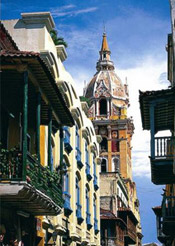 Having been lost to the litblogosphere for nearly two months (due to life changes and certain bizarre experiences that stem from my current situation as a nomadic educator), I now attempt to post something worth your while. I sadly could not contribute to Jeff and Trevor's marvelous Underrated Writers Project 2006, but I think there'll be some names from this post that will crop up in next year's list.
A. and I hopped the bus up to Cartagena this weekend for the Hay Festival, and were able to make it to five sessions. It was a glorious and complex experience. I hadn't been to Cartagena since I was 3, but the circle finally swung 'round and found us exhausted and happy, our heads buzzing with new authors, titles, and renewed longing to spend hours reading in quiet corners.
The weather was perfect--clear sky over a wide sea--and the walled colonial city held lovely sights around every corner: huge wooden gates with life-sized iron lizard knockers, balconies overflowing with flowers and ivy over narrow streets, and people from all over the world conversing about literature.
So this week I hope to post some notes from the many Moleskine pages I filled... (For each events' blurb, see the original program.) Although three of the writers I'd hoped the most to see were inexplicably absent at their respective sessions (Guillermo Arriaga, David Mitchell, and Chimamanda Adichie), my disappointment vanished as soon as the sessions began.
04 December 2006
One sip of an answer
The program for January's Hay Festival in Cartagena was finally posted on Friday of last week! I am going to do my best to make it up for at least one of the days over the weekend. It would be nothing short of amazing to see Wole Soyinka, David Mitchell, and Chimamanda Adichie here in Colombia. (Other speakers include Junot Díaz, Guillermo Arriaga, Christopher Hitchens, Mario Mendoza, Santiago Gamboa, Bob Geldof, David Starkey, and Guillermo Martínez.)
School is out, the apartment is emtpy and clean, and I am finally beginning to recover my sanity after one hell of a year. Hope to read the few books that are not packed away in storage before I head north for a month of family reunions, reading, and true winter. Interestingly, someone slipped me a copy of a local writer's novella for commentary, and I am contemplating a bilingual review. Also, there is Stendhal waiting--I'd done ok reading it online, but now that my internet access is intermittent, I'll have to stay silent until I can pick up my own copy next week (!). And so it goes...
There's a lovely little thread on literary allusions of a favorite band that brought a certain poem to my attention: Rumi's "Who Says Words With My Mouth?" translated by Coleman Barks (with thanks to Katherine):
All day I think about it, then at night I say it.
Where did I come from, and what am I supposed to be doing?
I have no idea.
My soul is from elsewhere, I'm sure of that,
and I intend to end up there.
This drunkenness began in some other tavern.
When I get back around to that place,
I'll be completely sober. Meanwhile,
I'm like a bird from another continent, sitting in this aviary.
The day is coming when I fly off,
but who is it now in my ear who hears my voice?
Who says words with my mouth?
Who looks out with my eyes? What is the soul?
I cannot stop asking.
If I could taste one sip of an answer,
I could break out of this prison for drunks.
I didn't come here of my own accord, and I can't leave that way.
Whoever brought me here will have to take me home.
This poetry, I never know what I'm going to say.
I don't plan it.
When I'm outside the saying of it,
I get very quiet and rarely speak at all.
School is out, the apartment is emtpy and clean, and I am finally beginning to recover my sanity after one hell of a year. Hope to read the few books that are not packed away in storage before I head north for a month of family reunions, reading, and true winter. Interestingly, someone slipped me a copy of a local writer's novella for commentary, and I am contemplating a bilingual review. Also, there is Stendhal waiting--I'd done ok reading it online, but now that my internet access is intermittent, I'll have to stay silent until I can pick up my own copy next week (!). And so it goes...
There's a lovely little thread on literary allusions of a favorite band that brought a certain poem to my attention: Rumi's "Who Says Words With My Mouth?" translated by Coleman Barks (with thanks to Katherine):
All day I think about it, then at night I say it.
Where did I come from, and what am I supposed to be doing?
I have no idea.
My soul is from elsewhere, I'm sure of that,
and I intend to end up there.
This drunkenness began in some other tavern.
When I get back around to that place,
I'll be completely sober. Meanwhile,
I'm like a bird from another continent, sitting in this aviary.
The day is coming when I fly off,
but who is it now in my ear who hears my voice?
Who says words with my mouth?
Who looks out with my eyes? What is the soul?
I cannot stop asking.
If I could taste one sip of an answer,
I could break out of this prison for drunks.
I didn't come here of my own accord, and I can't leave that way.
Whoever brought me here will have to take me home.
This poetry, I never know what I'm going to say.
I don't plan it.
When I'm outside the saying of it,
I get very quiet and rarely speak at all.
18 November 2006
Bears repeating
I've been taking time out from writing an exam (on Holes no less) to explore a few new (to me) litblogs, and loved reading these thoughts by Darby Dixon on "difficult" books and those who read them:
As Flannery O'Connor said,
Now--slight but personally important aside begins here--this isn't about being part of "the literary smart set." Rather, I think it's good practice for anyone who wants to talk shop about literature and the reading of it to engage with books from across, and sometimes off, their personal taste radars. Which, okay, maybe is about being part of the literary smart set. What I think I'm getting at is that I'm not comfortable with the sort of value judgment implied by a discussion of "the smart sets," in a sort of snoot-vs-snooty-antisnoot sense, or a hipper-than-thou-hipster sense. As if the "smart set" were a self-important, exclusionary organization, populated by nothing but smug bastards who scoff at those on the outside. I'm not so naive as to suggest it doesn't happen, consciously or not, but I'm also bold enough to suggest that people who are like that ought to be bopped on the nose, because thinking that way is a bunch of horsepucky. Reading literature and talking about it is as inclusive an activity as I can think of, asking of those who wish to take part in it only that they do it as much as they like, to whatever extent or end they like. I like to think (hope) that the "literary smart set"--and yes, you can read "litbloggers" there if you want--is by and large an encouraging group; that the discussion, debate, and disagreements are friendly in nature; and that I'm contributing to that in my own way. At least, I hope my professed love of and enthusiasm for big hard books--as well as for all books I like--is as evidently well-intentioned (an entertaining) as I desire it to be.(Emphasis mine.) I've said it before and I'll say it again: a lack of willingness to submit oneself to "difficulty" can be just as snobbish as the attitude of ivory-tower types who look down on "the masses." We are the ones who deny ourselves opportunities to grow beyond our personal boundaries.
In any case--literary or not--I do think it's healthy to stretch beyond yourself from time to time. In a literary sense, a book like Gravity's Rainbow becomes a portable education in close reading, forcing you--if you accept the challenge--into a deeper headspace that both shifts and intensifies your relationship with the words on the page.
As Flannery O'Connor said,
Art never responds to the wish to make it democratic; it is not for everybody; it is only for those who are willing to undergo the effort needed to understand it. We hear a great deal about humility being required to lower oneself, but it requires an equal humility and a real love of the truth to raise oneself and by hard labor to acquire higher standards.
17 November 2006
Winding down
Next week is our last full week of school, and although I won't be heading up north until the middle of December, I'm already making my reading list for the month I'll be away. The problem is that there are 20 titles on it already...
However, the LBC have posted this winter's nominations, and I'm fully determined to use this time to read them. They all look fascinating:
However, the LBC have posted this winter's nominations, and I'm fully determined to use this time to read them. They all look fascinating:
Scott McKenzie of Slushpile nominated Demon Theory by Stephen Graham Jones - MacAdam/CageI fly back on 15 January, just when they announce the selection. I'm happy about finally being able to participate--it feels like Christmas already.
Anne Fernald of Fernham nominated Seven Loves by Valerie Trueblood - Little Brown
CAAF of Tingle Alley nominated Wizard of the Crow by Ngugi Wa'Thiong'O - Pantheon
"For surely there will be an end...
...and thine expectation shall not be cut off."
MOSCOW: The wife of Nobel laureate Alexander Solzhenitsyn on Thursday presented the initial three volumes of the first full collection of his works to be published in Russia — a country still struggling with the legacy of the oppressive era he documented.(via TEV)
It was a cherished moment for the aging writer, who has been through prison camps and exile and, Natalya Solzhenitsyn said, feels the "draining of the life force" as his 88th birthday approaches. He was not at the presentation.
"Alexander Isayevich told me that the French have a saying: 'Nothing comes too late for he who is able to wait,'" Natalya Solzhenitsyn, who has nurtured her husband's work and protected his privacy, told a news conference, using his first name and patronymic.
With financial support from a state-owned bank, the 30-volume project marks the latest twist in what Solzhenitsyn's wife called the "very dramatic fate of Solzhenitsyn's books," which helped reveal the brutality of the Soviet system and dictator Josef Stalin's labor camps.
16 November 2006
A new vice
 I stumbled across this word-game site while creating a web quest for my class, and have become addicted to popword, which is basically Tetris with letters (made it to Level 10 in under a week!--yes, lots of "research" going on in my spare time). The storyman with classic novel titles was fun for a while, too.
 Also, there is a contest afoot for the 16 and under set, but the mad-lib style of this Beatrice letter is fun to play with in any case.
15 November 2006
You say crazy, I say sublime
Matthew Cheney on teaching Nabokov:
Inevitably, there were students who were convinced Nabokov was insane or a drug addict or both. This accusation comes up all the time when we read anyone who is not among the hardest of hardcore realists, because imagination is something that has come to be associated only with the stimulus of drugs or madness. That someone could think up a story like Invitation to a Beheading -- where a man is imprisoned for "gnostic turpitude" in a fortress of porous walls and fake windows and rules against improper dreams -- without being addicted to hallucinogens or lacking a couple of screws is at best inconceivable to many people, if not threatening. The people who issue these accusations would never think of such a story or such imagery themselves, and therefore they can't imagine how anyone else could, unless there was something wrong with their brains. I am sad to see this way of thinking in my students, because it means they are suspicious of one of the fundamental techniques of art, but at least in the classroom I am able to challenge and undermine those beliefs; the effect of such suspicion on the world at large is depressing to contemplate.Thank God there are teachers like this still out there. I've personally observed too much accomodation of the outside realm to suit students, rather than adequate preparation of students for the world beyond the classroom. This is where it all begins...but willingness to look beyond immediate perceptions is all too rare.
Magic carpet
Halfway through Speak, Memory and I am confronted with constant reminders as to why I love Nabokov.
I confess I do not believe in time. I like to fold my magic carpet, after use, in such a way as to superimpose one part of the pattern upon another. Let visitors trip. And the highest enjoyment of timelessness--in a landscape selected at random--is when I stand among rare butterflies and their food plants. This is ecstasy, and behind the ecstasy is something else, which is hard to explain. It is like a momentary vacuum into which rushes all that I love. A sense of oneness with sun and stone. A thrill of gratitude to whom it may concern--to the contrapuntal genius of human fate or to tender ghosts humoring a lucky mortal.(Someday...)
Of interest
- Literature Matters (e-zine of the British Council's literature department) enumerates their "Projects in Prospect," where I discover some extremely interesting news...
Hay Festival
UPDATE: Found the site for the new program, although the schedule has not yet been posted.
Where: Cartagena
When: Jan 2007
Three UK writers (tbc) invited to perform. - Some timely discussion of Helen Vendler at The Reading Experience
- The Complete Review analyzes Against the Day.
- Scott McLemee recalls his discovery of a letter by Thomas Pynchon.
- Maud draws attention to some troubling background information on the state of literature in translation; The Literary Saloon offers more. (Thank God for Words Without Borders!)
- A Curious Singularity has pressed on to Katherine Mansfield.
- We've embarked upon the next section of chapters in Reading... The Red and the Black. (Stendhal was a pretty funny guy--never expected to grin so much while reading this one!)
- Anne has begun collecting "mentions of, allusions to, and debts to Woolf in contemporary culture."
- Joanna Newsome's new album, Ys, has finally arrived! Largehearted Boy raves.
07 November 2006
Excellent question
Steve Mitchelmore catches a misuse of T.S. Eliot's words about how modern poetry "must be difficult":
That line of Eliot's comes from his long essay on Dante in which he admits to have been "passionately fond of certain French poetry long before I could have translated two verses of it correctly" and that obtaining "an immense amount of knowledge" about Dante before reading him "is positively undesirable". So Ford's contention that "Eliot and Stevens shivered with distaste at the idea of writing poetry that was intelligible to the masses" is a snotty misrepresentation of the meaning of difficulty. Their poetry might puzzle its explicators but it still gives me, a mere reader, immense reading pleasure. Maybe, I think now after reading the review, it's because their poetry contains (and uncontains) that "bursting unity of opposites". One has to read the words - leap aboard the roller coaster of language - to experience those complexities in all their reality. There are few poets who do this. So why are we being constantly warned off?The idea that something must be fully comprehended before it can be appreciated flies in the face of one of art's primary functions--to inspire wonder. I believe that anyone could pick up work by "Ezra Pound, Marianne Moore, Wallace Stevens, Hart Crane, William Carlos Williams, Gertrude Stein, and of Eliot himself" and get something out of it. The problem is that most are either too lazy or scared to try...or share this misapprehension of what "difficulty" means.
Tolling bells
From Jenny Davidson I learn that Ernestine Gilbreth Carey died on Saturday:
[Her father] Frank Bunker Gilbreth believed that the factory management principles he espoused to his clients could also be applied to his family of six girls and six boys, produced in 17 years; Lillian Moller Gilbreth, who had a Ph.D. from Brown University (earned around 1915, while she had several children at home), was an industrial psychologist and an engineering expert. Mr. Gilbreth died of a heart attack in 1924 at 55, the day after Mrs. Carey graduated from high school; his wife died in 1972 at 93.If you have no idea who I'm talking about, go pick up copies of Cheaper by the Dozen, Belles on Their Toes, and Time Out for Happiness *immediately*. A while ago I mentioned how much funnier a book can be when read aloud as opposed to read to oneself. The first two in this list definitely fit that category. Growing up in a family of seven, it was a joy and relief to read about the exploits of the pioneers of motion study. We owe the Gilbreths quite a lot--everything from the modern kitchen to flip-top garbage cans!
Mrs. Carey’s brother Frank Bunker Gilbreth Jr. received first billing as a co-author, and the book’s narrative voice is decidedly unified, never betraying who wrote what. Nevertheless, Mrs. Carey wrote other books (as did her brother, who died in 2001), including “Jumping Jupiter,” “Rings Around Us” and “Giddy Moment.”
01 November 2006
"Anything but bored"
Blackbird, the literary journal of Virginia Commonwealth University, has published the newly-discovered Sylvia Plath poem online:
(via Maud)
Anna Journey, Contributing Editor of Blackbird, discovered that this poem was unpublished, and brought it to the attention of our editorial staff, along with a number of additional reasons why it is a poem of interest. Her essay, “Dragon Goes to Bed with Princess: F. Scott Fitzgerald’s Influence on Sylvia Plath” (forthcoming in Notes on Contemporary Literature), explores in detail how “Ennui” germinated from Plath’s creative response to The Great Gatsby, as evidenced by her handwritten notes in her personal copy of that novel, as well as an essay she wrote on Fitzgerald’s Tender Is the Night. Fitzgerald’s lingering influence continued to produce echoes in Plath’s work, even in such a later poem as “Daddy,” whose last line may recall Dick Diver’s farewell to his dead father in Tender Is the Night. Plath’s broad range of allusions in “Ennui” also includes Don Quixote by Miguel de Cervantes, “The Lady or the Tiger?” by Frank R. Stockton, and “The Beast in the Jungle” by Henry James, as well as providing an indirect response to that “delicate monster,” Ennui, as it was famously described in “Au Lecteur” (“To the Reader”) by Charles Baudelaire, a poem whose sardonic tone matches Plath’s own.I find the combination of allusions to Stockton, James, and Cervantes especially intriguing. The juxtapositions open up many other possibilities...
(via Maud)
27 October 2006
Wonderful
Scott Esposito on Richard Powers:
But if in Powers we lose a sense of mystery, we gain a sense of wonder. One of the most striking aspects of a Powers novel is the sense of genuine amazement at the natural world that the reader is left with. This is no small achievement tn an era in which it is often remarked that space shuttle flights are no longer televised because they have become so commonplace, so banal. Powers reveals a very real, very necessary awe at science and nature. This is no preachy exercise, no citing of facts and figures; it is something that is communicated through the stories and metaphors, something that takes hold of you as you read without Powers needing to lay it out for you. It is humbling, which I believe is exactly Powers's point, to re-instill a needed sense of humility as humans gain truly God-like powers over their environment. This is something that neither Pynchon nor DeLillo does, something I think only a Richard Powers could do.Excellent observation. I think this is one of the reasons I enjoy his novels so much--I come away with a very Chestertonian sense of wonder.
26 October 2006
Of lightning and lightning bugs
As Mark Twain famously quipped, "The difference between the almost right word and the right word is really a large matter--’tis the difference between the lightning-bug and the lightning."
Margaret Jull Costa (translator of books by José Saramago, Arturo Pérez-Reverte, Luis Fernando Verissimo, Javier Marías, Ramón del Valle-Inclán, and Fernando Pessoa) offers a fascinating translation exercise, based on one of my favorite passages of Pessoa's:
After a brief discussion on the points raised, she offers some final thoughts:
Margaret Jull Costa (translator of books by José Saramago, Arturo Pérez-Reverte, Luis Fernando Verissimo, Javier Marías, Ramón del Valle-Inclán, and Fernando Pessoa) offers a fascinating translation exercise, based on one of my favorite passages of Pessoa's:
Pasmo sempre quando acabo qualquer coisa. Pasmo e desolo-me. O meu instinto de perfeição deveria inhibir-me de acabar; deveria inhibir-me de dar começo. Mas distraio-me e faço. O que consigo é um produto, em mim, não de uma aplicação da vontade, mas de uma cedência dela. Começo porque não tenho força para pensar; acabo porque não tenho alma oara suspender. Este livro é a minha cobardia.She offers a literal translation (for those of us who don't speak Portuguese), with multiple word-choice options, and asks:
How will you translate 'alma' - 'soul' 'heart', 'courage', 'guts'? What should you do with the last sentence?What can you come up with?
Read your finished version of the whole text out loud. Does the language flow, does it have the right cadence and rhythm?
Are there any awkward juxtapositions of sounds or unnecessary repetitions of words?
After a brief discussion on the points raised, she offers some final thoughts:
What I hope this workshop has made clear is that while there is no single correct translation or version of a text, that certainly does not mean that any translation will do. Translation is always a balancing act between faithfulness to letter and faithfulness to spirit. You have to understand what the author means not only at the level of denotation, but also of connotation. You have to be aware of the sound of words and their register, as well as the rhythm and sound of the sentence in the translated version, so that the finished product is as cogent, fluent and convincing in the new language as it is in the original.
24 October 2006
When fidelity is treasonous
Don Paterson's brief piece on translating Rilke explains,
Meanwhile, Bud comments on this other excellent article and explains how "even reading in your own language is a translation":
And last--but far from least!--Jeff announces that The Unbearable Lightness of Being is finally (!!) being released in the Czech Republic. (I somehow think that a retranslation into English is now called-for...although that might take another ten years!)
(The two articles came via The Literary Saloon and were posted on my birthday. I'll take that as a nod that I'm heading in the right direction...)
The one thing a poet must avoid, however, is pretending that both the meaning and the music of the original poem can be carried into the new language. Because a poem works on the heretical principle that sound and sense are the same thing, a poem is locked for ever in its original form. The poem's effect, which is all there is of it, can no more be "translated" than can a piece of music.As frightening a prospect as this sounds, it does make a lot of sense. I'm willing to admit that my predisposition has always been to the more "literal" side, but perhaps I owe this to a somewhat Romantic notion of authorial inspiration? That is, the closer something sticks to the literal meaning, the closer we are to authorial intent. But is this merely an almost mystical trust in the efficacy of words? (Especially as Paterson himself admits that Rilke's Sonnets to Orpheus "appear to have been less composed than dictated to the German poet - as if they had been sitting around elsewhere, waiting for someone to channel them into speech. In an earlier time, we would have had no trouble in describing the Sonnets - in their oracularity and their visionary power - as a prophetic work.") On the other hand, I'm beginning to see such an attitude as exhibiting a lack of trust: authorial intent is far from the only issue that must be examined when analyzing a work of literature.
Yet we are compelled to seek some new incarnation for foreign poems in our own language. The two main strategies are the "translation" and the "version". In the translation, you work on accurately representing the words and their systems of relations; here, the integrity of the means (your skill and qualifications as a translator, say) justify the end. In the version, you work on representing the poem's idea and "spirit"; here, the integrity of the end (your inner conviction that this somehow "captures the vibe" of the original) justifies the means. A translation mirrors the original and stands alongside it; but a version tries to be a new, free-standing poem in its own right. In order to achieve that level of semantic and musical integration, it has, at some point, to forget the original and complete the course on its own.
Meanwhile, Bud comments on this other excellent article and explains how "even reading in your own language is a translation":
What is translation if not an interpretation? Once we think in those terms, we've opened the door for the sometimes less than literal result of different translations over time. [...]Angel Gurria-Quintana (in the article Bud quotes) points out the interesting dichotomy between "clarity" and "precision," ultimately deciding that
If I read a book in English (the only language I can read in) and I look up a word, aren't I then imposing Mr. Webster's and my own meaning on that word and therefore the author's intent? [...]
The best analogy comes from music - a performance of a symphony is a translation of a composer's music (often with the help of notes, either latin notation or annotations). At one level each conductor's music may sound the same - ta ta ta ta ta ta ta ta ta ta ta ta ta ta ta (can't you tell, that's Ode to Joy), but listening more closely, changes in timing or tone (not to mention possible reinstrumentation) can make the music sound quite different.
In the best literature, form is substance. Similarly with translations. Puritans may take issue, but it is undoubtedly a translation’s beauty - rather than its careful imitation of an original - that finally nudges it across the language barrier and enhances the pleasure it provides. Even if translation is treason, it is a necessary form of treachery on which readers of world literature depend.Interestingly, it's my father (a native Spanish-speaker) who has opened up my mind to the reason clarity *must* supercede precision in a translation. Communication doesn't always have to indicate a loss of fidelity. Literalism (whether it be whimsical or heavy-handed) is ultimately more about not offending the author than it is about fully serving the work. And if fidelity means putting the essence (or meaning) of a work in second place, who or what is actually being betrayed?
And last--but far from least!--Jeff announces that The Unbearable Lightness of Being is finally (!!) being released in the Czech Republic. (I somehow think that a retranslation into English is now called-for...although that might take another ten years!)
(The two articles came via The Literary Saloon and were posted on my birthday. I'll take that as a nod that I'm heading in the right direction...)
16 October 2006
Green
My last post was about Jealousy, but this one is about envy.
Today marks the beginning of the Echo Maker Roundtable #1 over at Ed's. Looks like it's going to turn out to be an incredible discussion, with Powers himself joining in on Friday.
Also, the Litblog Co-op has chosen their Autumn selection (which looks fascinating, as ever).
I'm going to do my best to bury myself in what I still have to read here rather than complaining about what I'm missing... At least I'll have a chance to read these when I fly north for a visit in December!
Today marks the beginning of the Echo Maker Roundtable #1 over at Ed's. Looks like it's going to turn out to be an incredible discussion, with Powers himself joining in on Friday.
Also, the Litblog Co-op has chosen their Autumn selection (which looks fascinating, as ever).
I'm going to do my best to bury myself in what I still have to read here rather than complaining about what I'm missing... At least I'll have a chance to read these when I fly north for a visit in December!
Trapped in text
Between reading Richard Powers, Virginia Woolf, Stephen Hawking, and Alain Robbe-Grillet, my mind is buzzing with thoughts on space/time/perspective/the nature of reality and the way in which we attempt to apprehend it with words. All of these texts inform each other in one way or another--I'm sure someone in some grad school somewhere has probably written a thesis that encapsulates these works, linking a private human understanding of "truth" with books that plumb the depths of reality's features in one way or another. I have always found books that tinker with space and time to be fascinating experiments where words are the tools that scratch at the skin of truth.
I've just finished Jealousy (Maud piqued my curiosity), and although I have no experience in talking about this sort of writing at all, here are some preliminary neophyte thoughts...
The first-person narrator (who never says "I") meticulously describes everything he sees and hears, while the reader becomes rapidly aware that he suspects his wife of having an affair with a neighbor from the next plantation. Certain events are described over and over again in the narrative (with slight differences each time) and I felt like I was witnessing an endless memory-loop in an obsessive mind. The narrator's almost clinical detachment becomes increasingly creepy as the excuses he makes for the other two ("It was only a piece of bad luck, without consequences, an incident of no seriousness, one of the minor inconveniences of colonial life.") slowly give way to descriptive fixations that become slightly more obscure and chaotic the more his selective memory jumps around. The coldly "objective" observations undermine themselves as linear time is confused for absolute space. (Precise location and situation are the only things that can be known through his gaze--there is even a diagram mapping out the house and the locations repeatedly mentioned in the novel. Time becomes hazy and one has to read carefully to distinguish between 6.30am and 6.30pm.)
With each paragraph, I had to reorient myself to the narrator's switched subjects and erratic descriptions--my only immediate point of reference for this was The Waves (and, basically, Virginia Woolf's writing in general). The reader has to be constantly alert to subtle cues and shifts in the observations, because the shocks are sudden and come without much warning. I went into the novel with the understanding that a murder takes place. After finishing it, I can't even tell you if that's true or if one or even two people are murdered. But I love this sort of thing--when an author demands to be read carefully, creating close readers of us all. I know that if I'd paid closer attention, compared each page of "action" (or nonaction, as the case may be) with the diagram, counted the number of times that smashed centipede was mentioned (and the single mention of its removal), and noted the discrepancies among the narrator's own versions of events, a much more defined story would've emerged.
In his essay "Objective Literature: Alain Robbe-Grillet," Roland Barthes declares:
Here is a 2003 interview with Robbe-Grillet (via This Space).
I've just finished Jealousy (Maud piqued my curiosity), and although I have no experience in talking about this sort of writing at all, here are some preliminary neophyte thoughts...
The first-person narrator (who never says "I") meticulously describes everything he sees and hears, while the reader becomes rapidly aware that he suspects his wife of having an affair with a neighbor from the next plantation. Certain events are described over and over again in the narrative (with slight differences each time) and I felt like I was witnessing an endless memory-loop in an obsessive mind. The narrator's almost clinical detachment becomes increasingly creepy as the excuses he makes for the other two ("It was only a piece of bad luck, without consequences, an incident of no seriousness, one of the minor inconveniences of colonial life.") slowly give way to descriptive fixations that become slightly more obscure and chaotic the more his selective memory jumps around. The coldly "objective" observations undermine themselves as linear time is confused for absolute space. (Precise location and situation are the only things that can be known through his gaze--there is even a diagram mapping out the house and the locations repeatedly mentioned in the novel. Time becomes hazy and one has to read carefully to distinguish between 6.30am and 6.30pm.)
With each paragraph, I had to reorient myself to the narrator's switched subjects and erratic descriptions--my only immediate point of reference for this was The Waves (and, basically, Virginia Woolf's writing in general). The reader has to be constantly alert to subtle cues and shifts in the observations, because the shocks are sudden and come without much warning. I went into the novel with the understanding that a murder takes place. After finishing it, I can't even tell you if that's true or if one or even two people are murdered. But I love this sort of thing--when an author demands to be read carefully, creating close readers of us all. I know that if I'd paid closer attention, compared each page of "action" (or nonaction, as the case may be) with the diagram, counted the number of times that smashed centipede was mentioned (and the single mention of its removal), and noted the discrepancies among the narrator's own versions of events, a much more defined story would've emerged.
In his essay "Objective Literature: Alain Robbe-Grillet," Roland Barthes declares:
For Robbe-Grillet, the function of language is not a raid on the absolute, a violation of the abyss, but a progression of names over a surface, a patient unfolding that will gradually "paint" the object, caress it, and along its whole extent deposit a patina of tentative identifications, no single term of which could stand by itself for the presented object. [...]Meanwhile, the internal is externalized to the extent that all supposed "subjectivity" is banished to nearly scientific precision of visual description. It's uncanny to read, but a remarkable glimpse into yet another way of viewing the world.
Robbe-Grillet is important because he has attacked the last bastion of the traditional art of writing: the organization of literary space.
Here is a 2003 interview with Robbe-Grillet (via This Space).
13 October 2006
Old laughter
This might wind up sounding like one of those "you-had-to-be-there" things, but I think some would agree that when you read something aloud it can seem much funnier than if you were simply reading it to yourself. Such was the case with L.M. Montgomery's The Golden Road (sequel to The Story Girl, which is also excellent). The children write and edit their own magazine, contributing anything from essays on "My Most Exciting Adventure" to local gossip and fashion notes. Years ago, I would spend hours reading Montgomery's stories to my younger sisters...and for some reason, I still can't read this one with a straight face:
ESSAY ON SHAKESPEARE
Shakespeare's full name was William Shakespeare. He did not always spell it the same way. He lived in the reign of Queen Elizabeth and wrote a great many plays. His plays are written in dialogue form. Some people think they were not written by Shakespeare but by another man of the same name. I have read some of them because our school teacher says everybody ought to read them, but I did not care much for them. There are some things in them I cannot understand. I like the stories of Valeria H. Montague in the Family Guide ever so much better. They are more exciting and truer to life. Romeo and Juliet was one of the plays I read. It was very sad. Juliet dies and I don't like stories where people die. I like it better when they all get married especially to dukes and earls. Shakespeare himself was married to Anne Hatheway. They are both dead now. They have been dead a good while. He was a very famous man.
FELICITY KING.
(PETER, MODESTLY: "I don't know much about Shakespeare myself but I've got a book of his plays that belonged to my Aunt Jane, and I guess I'll have to tackle him as soon as I finish with the Bible.")
12 October 2006
Description over object?
More from Plowing the Dark on programming and language:
Software is the final victory of description over thing.
He held her declaration in midair, turning it over. With software, the thing and its description are one and the same. Any item that you can learn how to say, you can make, pretty much out of raw syntax.
Saying and making...
...are one another's night jobs.
Wonder and disgust vied for control of her voice. So that's why we want to do everything over again in software. Why we all want to move there.
Well, it's no worse than words, really.
What are you talking about? It's a lot worse than words. It's words on steroids. Words are safe exactly because they're so fuzzy. Deniable near-misses. Give them teeth, and every teenaged thing that you ever regretted saying is out there drunk behind the wheel of the Chevy.
11 October 2006
Woolf discussion
Devoted to discussing one short story a month, A Curious Singularity has chosen Virginia Woolf's "Kew Gardens" for October. The discussion got started yesterday... Anyone is free to chime in.
Here is the rest of their tentative schedule:
Here is the rest of their tentative schedule:
Virginia Woolf, “Kew Gardens” (1919)
Katherine Mansfield, "At the Bay" (1922)
Franz Kafka, “A Hunger Artist” (1924)
Ernest Hemingway, "Hills Like White Elephants" (1927)
Delmore Schwartz, "In Dreams Begin Responsibilities" (1937)
Kay Boyle, "Winter Night" (1946)
Jean Stafford, "In the Zoo" (1953)
Isaac Bashevis Singer, “Gimpel the Fool” (1953)
Isak Dinesen, “The Blank Page” (1957)
James Baldwin, "Sonny's Blues" (1957)
Flannery O'Connor, "Everything That Rises Must Converge" (1961)
Frank O'Connor, "My Oedipus Complex" (1963)
John Cheever, "The Swimmer" (1964)
Patrick White, “Dead Roses” (1964)
Grace Paley, "A Conversation with My Father" (1974)
Alice Munro, "How I Met My Husband" (1974)
Jean Rhys, "Sleep it Off Lady" (1976)
Raymond Carver, "Where I'm Calling From" (1983)
10 October 2006
Wandering
 It seems there are endless directions one could take in a life. The inevitable "burden of freedom"--our terrible curse and secret joy. You make the usual pro and con lists, weigh the balance, map out possibilities and the potential latent within each one. You try using differing criteria: What if X wasn't a limitation? What would I want then? You take your time, rid yourself of emotion, attempt to be as objective as possible, all so that you have nothing to regret. That the promise certain professors supposedly saw in you will be justified somehow. The days pass, the weeks, the months...and you know something will have to be done. But what? And where? The novelty of intention fades with the waning light of each old sky and you wonder if certainty will ever step beyond myth and into your seaside room.
Never say never.
09 October 2006
The "one book" meme
Bud tossed this in my direction and I'm torn between delight and chagrin. I've always hated making lists like this--how in the world am I to pick only ONE? But I'll take it to mean "one of many" and so I'll give it a shot and will try to post it as quickly as possible to keep me from changing my mind a billion times and spending five hours on it...
1. One book that changed your life?
Annie Dillard's An American Childhood. First read it when I was 18--had I read it a couple of years previous to this, I would've been spared a lot of heartache. I have yet to read a more accurate account of what it's like to perceive the world as a child and an adolescent. Pure magic. It rescued me from a suffocating private isolation and articulated all the things I never thought I'd find words for. Brilliant. (Honorable mention: Salinger's Franny and Zooey.)
2. One book that you have read more than once?
Charlotte Bronte's Jane Eyre. This was the first candidate for the question above, but since I've read it eight times, here she is. I was 13 when I first picked this one up--and have carried it with me ever since.
3. One book you would want on a desert island?
T.S. Eliot's Four Quartets. I could spend years getting to the bottom of this thing...and love every minute.
4. One book that made you cry?
Dostoevsky's novella, "A Gentle Creature" (which can be found in here). Part of his genius lies in communicating a deep compassion for humanity even while portraying the inhuman things we do to each other.
5. One book that made you laugh?
The inevitable: John Kennedy Toole's A Confederacy of Dunces. Many times I was sure I'd pass out from lack of oxygen...
6. One book you wish had been written?
Bud already said what I would've (and for the same reasons), so I'll go with Dickens' The Mystery of Edwin Drood. Charles aping his pal Wilkie? Who knows? Even better is reading what exists of this unfinished novel in the context of The D. Case: Or the Truth About the Mystery of Edwin Drood. Imagine Father Brown, Poirot, Holmes, Petrovich, Marlowe, and other detectives going straight from the page to a conference in Rome where they have to collectively pool their little grey cells to figure out how Dickens would've ended it if he'd lived long enough... The result is far from perfect, but highly intriguing nonetheless.
7. One book you wish had never been written?
Ok, I'll say it: The Da Vinci Code. The dumbing-down of culture continues... (And did United Statesians really need yet one more reason to look like idiots while traveling Europe?)
8. One book you are reading currently?
Richard Powers' Plowing the Dark. It's only the second novel of his I've read, but I adore this writing. I'm trying to not get too jealous of those who live in the same country as The Echo Maker...
9. One book you have been meaning to read?
José Saramago's La caverna. I have yet to read Saramago (the shock! the horror!), but I miraculously found a used copy here in town and thought it'd be good to try him in Spanish first (plus he seems to be quite popular 'round here). We shall see.
10. Pass it on:
Anne at Fernham (Missed you while you were away!)
(And thank you dear Anon. for the added nudge to nip the procrastination disease in the bud.)
1. One book that changed your life?
Annie Dillard's An American Childhood. First read it when I was 18--had I read it a couple of years previous to this, I would've been spared a lot of heartache. I have yet to read a more accurate account of what it's like to perceive the world as a child and an adolescent. Pure magic. It rescued me from a suffocating private isolation and articulated all the things I never thought I'd find words for. Brilliant. (Honorable mention: Salinger's Franny and Zooey.)
2. One book that you have read more than once?
Charlotte Bronte's Jane Eyre. This was the first candidate for the question above, but since I've read it eight times, here she is. I was 13 when I first picked this one up--and have carried it with me ever since.
3. One book you would want on a desert island?
T.S. Eliot's Four Quartets. I could spend years getting to the bottom of this thing...and love every minute.
4. One book that made you cry?
Dostoevsky's novella, "A Gentle Creature" (which can be found in here). Part of his genius lies in communicating a deep compassion for humanity even while portraying the inhuman things we do to each other.
5. One book that made you laugh?
The inevitable: John Kennedy Toole's A Confederacy of Dunces. Many times I was sure I'd pass out from lack of oxygen...
6. One book you wish had been written?
Bud already said what I would've (and for the same reasons), so I'll go with Dickens' The Mystery of Edwin Drood. Charles aping his pal Wilkie? Who knows? Even better is reading what exists of this unfinished novel in the context of The D. Case: Or the Truth About the Mystery of Edwin Drood. Imagine Father Brown, Poirot, Holmes, Petrovich, Marlowe, and other detectives going straight from the page to a conference in Rome where they have to collectively pool their little grey cells to figure out how Dickens would've ended it if he'd lived long enough... The result is far from perfect, but highly intriguing nonetheless.
7. One book you wish had never been written?
Ok, I'll say it: The Da Vinci Code. The dumbing-down of culture continues... (And did United Statesians really need yet one more reason to look like idiots while traveling Europe?)
8. One book you are reading currently?
Richard Powers' Plowing the Dark. It's only the second novel of his I've read, but I adore this writing. I'm trying to not get too jealous of those who live in the same country as The Echo Maker...
9. One book you have been meaning to read?
José Saramago's La caverna. I have yet to read Saramago (the shock! the horror!), but I miraculously found a used copy here in town and thought it'd be good to try him in Spanish first (plus he seems to be quite popular 'round here). We shall see.
10. Pass it on:
Anne at Fernham (Missed you while you were away!)
(And thank you dear Anon. for the added nudge to nip the procrastination disease in the bud.)
08 October 2006
Word made flesh?
Fellow blogger Robert wonders about the similarities between poetry and programming languages:
Both require precision, and poetry usually also involves some degree of linguistic compactness. Also, just as software executes within the context of an operating system, poetry likewise "executes" within the psyche of the reader. A few lines in either form can have a profound impact, sending memory pointers in myriad directions.This immediately jumped out at me because today I read a conversation between Steve and Adie in Powers' Plowing the Dark that went something like this:
I'm telling you, writing my first subroutine was...like causing huge chunks of unravished bride to rise up, just by singing to her. A good, polished program was everything I thought poetry was supposed to be.Although I agree with Adie (and sestinas were never meant to offer "reality check"s), I admit that it's an interesting idea...albeit a potentially dangerous one.
Stevie. You must have had a very peculiar idea of what poetry was supposed to be.
No different than any person who ever wrote it. I was going to get inside of reality and extract its essence, write down on paper the magic metrical words that, read aloud, would do their open sesame.
She looked at the screen, ready to deny everything. But she nodded. The vital formula. Sympathetic spells. Life's nail clippings. The impression of a body in bed.
He raced on, not hearing her. There was this kid poet, and he wrote and wrote. He rubbed the magic lamp until the poetic self-abuse police threatened to come impound him. And still nothing happened. The incantation seemed to be defective. Then they put the kid in front of this terminal and initiated him into the secret syntax. A few simple rules, combined in a few elegant ways, and blamm-o. The thing works. It runs. The world does move. The rules churn. The descriptions step their way through their own internal logic. The lines of code set more switches, change more states. Commands produce results.
The word made flesh.
Spiegel flinched. Don't mock me.
I'm not mocking.
Because that's exactly what it is. It doesn't matter if you're only talking about a formula for compound interest plugged into a general ledger program. Change any variable and the executing universe alters. Move it to the left, increment it by a quarter precent, and the new result gets spit out whole. It gives one a tremendous feeling of--
Power?
Perfectibility. Coding possessed a kind of reality check that sestinas never had. A program either worked or it didn't, and if it didn't work, it was wrong. Period. Something magnificent to that.
I made a lot of wrong paintings in my life. Believe me. And I didn't need any machine to tell me they were wrong.
But you never knew, completely, when you made a right one.
Adie wrapped her self-indicting silence around her like a shawl.
It's...funny, Spiegel went on. Art made all this happen, you know. The whole digital age. Music did it. Hollerith got his idea for the punched data card from the player piano. From the Jacquard tapestry loom. [...] The rules, the operators? They're completely open-ended. Extensible. Whatever you can imagine, they can build. Think of it: the universal behavior machine, able to build any gadget that crossed the human mind. Not a tool. The ultimate medium.
07 October 2006
Bix
Before closing down shop in August, Brendan Wolfe of The Beiderbecke Affair was unable to find an English translation of a Cortázar story and had to resort to the whimsically imprecise Babelfish. It's taken me a while to get my act together, but with all my best wishes, here's the first paragraph of that story (hopefully a legible alternative):
I am Panamanian and have lived with Bix for a while.(Here's the complete piece in its original Spanish.)
I write it and go on to the next line; no one will believe it, if they did, they would be like me and I don’t know anyone like me. Not exactly me, but at least like me. At best, it’s an advantage because I can write it without it mattering if they read it or not, that in the end I’ll burn this with the last match of the last cigarette. Or I’ll leave it abandoned in the street, or I’ll give it to someone to do what he likes with it; everything will be behind, so far behind Bix and I. I write because I have nothing else to do and because it’s true or it would appear to be true to someone like me. These people exist, I’ve brushed past them in life nearby or at a distance, not everyone lives bound to what they’ve been taught. Look, Rimbaud said that he’d fallen in love with a pig, and professors think he was a great poet. They probably think so without believing it because they must in order to not appear wrong. But I know that he was a great poet and Bix also knew it, although he’d never read a line of French and I had to translate Rimbaud to him and he’d hold his head in his hands and sit thinking, or he’d go to the piano and would begin to play that thing that they now call In a Mist and it was his way of saying that he understood French poetry because it arrived via Debussy and because everything almost always arrived through music and that was his only way of understanding things that he didn’t understand when they came to him through other means--life for example, the order of what I myself called reality and which he only understood in C major or F sharp, sweetly blowing into his coronet or going to the piano and allowing Lost in a Fog to be born, burning his lips on the cigarette forgotten by the spider hands that spun and spun on the keyboard until everything ended in a curse and a leap, I always had a tube of cream nearby to cure his lips, afterwards we laughingly kissed and he went back to cursing because it hurt and because the coronet would hurt him even more in the evening when he had to play in the Blue Room for eighty dollars a night.
06 October 2006
Changes for "La Casa"
Colombian government to reconstruct García Márquez's birthplace:
El Ministerio de Cultura destinará 200 millones de pesos para la primera etapa de las obras a través de una licitación pública que abrirá a partir del próximo 17 de octubre.This week I was able to pick up a copy of El olor de la guayaba (which was translated into English as The Fragrance of Guava) at our one (tiny!) local bookstore. It's a marvelous little collection of conversations between Plinio Apuley Mendoza and Gabriel García Márquez (with photos), discussing the latter's life and work. In it, he says he attempted to write One Hundred Years of Solitude when he was 18, under the title of La Casa (but for many reasons, it didn't come out right).
La casa paterna del autor de novelas como 'Cien años de soledad' se encuentra ubicada en la población de Aracataca, departamento de Magdalena, en la costa Caribe.
El escritor colombiano, que obtuvo el galardón en 1982, actualmente vive entre la ciudad de México y la colonial ciudad de Cartagena, capital del caribeño departamento de Bolívar.
PAM: What was your purpose when you sat down to write One Hundred Years of Solitude?(This quick translation is mine.)
GGM: To give an integrated, literary outlet to all of the experiences that had in some way affected me during my childhood.
PAM: Many critics see in the book a parable or allegory of the history of humanity.
GGM: No, I only wanted to give a poetic consistancy to the world of my childhood, which as you know, occurred in a very large, sad house with a sister that ate dirt and a grandmother that saw the future, and many relatives with the same names who could never tell much difference between happiness and dementia.
PAM: The critics always find more complex intentions.
GGM: If they exist, they're unconscious. But it could also be that critics, as oppossed to novelists, don't discover in books what they can find, but what they want to see.
04 October 2006
Belated wishes
[cross-posted at 400 Windmills]
Last Friday was Cervantes' 459th birthday, but it's taken me this long to do something about it. Better late than never!
"Sueña Alonso Quijano"
El hombre se despierta de un incierto
sueño de alfanjes y de campo llano
y se toca la barba con la mano
y se pregunta si está herido o muerto.
¿No lo perseguirán los hechiceros
que han jurado su mal bajo la luna?
Nada. Apenas el frío. Apenas una
dolencia de sus años postrímeros.
El hidalgo fue un sueño de Cervantes
y don Quijote un sueño del hidalgo.
El doble sueño los confunde y algo
está pasando que pasó mucho antes.
Quijano duerme y sueña. Una batalla:
los mares de Lepanto y la metralla.
~ Jorge Luis Borges, Cervantes y el Quijote
["Alonso Quijano Dreams"
The man awakes in an uncertain
dream of sabers and flat fields
and he strokes his beard with his hand
and he asks whether he's wounded or dead.
Don't the sorcerers pursue him
that have sworn to his ill under the moon?
Nothing. Barely the cold. Barely an
illness of his recent years.
The hidalgo was a dream of Cervantes'
and Don Quixote a dream of the hidalgo.
The double dream confuses them and something
is happening that happened a long time ago.
Quijano sleeps and dreams. A battle:
the seas of Lepanto and the shrapnel.]
Last Friday was Cervantes' 459th birthday, but it's taken me this long to do something about it. Better late than never!
"Sueña Alonso Quijano"
El hombre se despierta de un incierto
sueño de alfanjes y de campo llano
y se toca la barba con la mano
y se pregunta si está herido o muerto.
¿No lo perseguirán los hechiceros
que han jurado su mal bajo la luna?
Nada. Apenas el frío. Apenas una
dolencia de sus años postrímeros.
El hidalgo fue un sueño de Cervantes
y don Quijote un sueño del hidalgo.
El doble sueño los confunde y algo
está pasando que pasó mucho antes.
Quijano duerme y sueña. Una batalla:
los mares de Lepanto y la metralla.
~ Jorge Luis Borges, Cervantes y el Quijote
["Alonso Quijano Dreams"
The man awakes in an uncertain
dream of sabers and flat fields
and he strokes his beard with his hand
and he asks whether he's wounded or dead.
Don't the sorcerers pursue him
that have sworn to his ill under the moon?
Nothing. Barely the cold. Barely an
illness of his recent years.
The hidalgo was a dream of Cervantes'
and Don Quixote a dream of the hidalgo.
The double dream confuses them and something
is happening that happened a long time ago.
Quijano sleeps and dreams. A battle:
the seas of Lepanto and the shrapnel.]
03 October 2006
Kids' recommendations
Last week, Bogotá's Biblioteca Luis Ángel Arango unveiled Los libros que leo, a site devoted to 1200 book recommendations and illustrations received by the children of Colombia (organized by region). Topping the list of the ten favorites? Antoine de Saint-Exupéry's The Little Prince. (Even if you don't read Spanish, the illustrations alone are worth the click.)
Back to life
Amid the flurry of visits of the past month, my sister brought books (!), including the one I hated to leave behind, Plowing the Dark. After what feels like years, I was able to do nothing but sit in a café tonight and lose myself in words...
"You see? You see? If we can make these...scratch lines come to life, then life is not just some outside thing that happens to us. It's something we come into and make."(Read about Powers' recent novel in Bookforum.)
Dalkey Archive Press moves...
...to the University of Rochester:
UPDATE 14 November...Scratch that. Not happening.
The Dalkey Archive Press, a prestigious independent publisher specializing in international literature and translations, will move to the University of Rochester in January 2007. A nonprofit publisher currently located in Normal, Ill., Dalkey releases 30 titles a year that are carried in 2,000 bookstores and libraries in the United States and Canada.(via Inside Higher Ed)
"We are delighted that Dalkey Archive Press, the premier press in literary translation, has chosen to join us at the University of Rochester," said Peter Lennie, the Robert L. and Mary L. Sproull Dean of the Faculty of Arts, Sciences, and Engineering. "Its presence on campus will help energize exciting new programs and will offer rich opportunities—particularly those focused on literary translation—to connect scholarship and professional experience."
UPDATE 14 November...Scratch that. Not happening.
02 October 2006
Medellín's poetry
According to the Poetry International Network,
The Medellín International Poetry Festival shares this year's Swedish Right Livelihood Award with Indian rights activist, Ruth Manorama and Daniel Ellsberg, the former US Defence Department official who leaked secret Pentagon documents during the Vietnam war.The latest edition of Prometeo, the journal of the Medellín festival, includes work by over 60 poets from five different regions of the world.
The prize committee cited the "The Festival Internacional de Poesía de Medellín" for promoting peace in what it called one of the most violent cities in the world. The Right Livelihood Award for justice, peace and truth-building, often referred to as "the alternative Nobel Prize", was founded in 1980 to honour work ignored by the prestigious Nobel prizes.
18 September 2006
Coffee Break
Like Stuart Murdoch of Belle and Sebastian, Patti Smith has started an online diary (although the entries don't appear to be archived). Free verse poetry to go with your morning brew.
12 September 2006
My thoughts exactly
Once again, Dan Green nails it:
In my opinion, to value fiction (or film) primarily for its ability to "make sense" through story is to move it even farther away from poetry (itself the fountainhead of all literature) and to align it with--even make it subservient to--all those other areas of inquiry where "understanding" reigns, however intuitive or partial such understanding might be where literature is concerned.This makes me want to get back to my James Longenbach reading... (And all my other reading for that matter!)
07 September 2006
Ever been had?
Libby Purves explains why the Betjeman hoax is such a good thing for "the whole trade of popular literary biography":
Sometimes it seems from the book pages that modern British readers are far keener to read clever-dick analysis and Hello!-style gossip about great writers than we are to approach their actual works, laying ourselves innocently and humbly open to what they have to say to us. It is good for publishers’ profits but less good for our souls. I was lucky enough years ago to study literature under tutors who demanded that we acquire only the most basic historical context and sketchy personal information about the masters, but who insisted that we knew each text and judged it by its intended meaning, its truth and the skill of its execution.(via Bookninja)
However good a biography, you still get closer to a writer’s heart and spirit by going back to the works themselves. It really is not necessary to know whether Jane Austen was a virgin, or which of T. S. Eliot’s wives it was who slept with Bertrand Russell. Interesting, but not essential. In youth I learnt much formative wisdom from Howards End before I ever found out that E. M. Forster was gay, or indeed a bloke at all; I read Evelyn Waugh at 12 in an equal state of uncertainty about the author’s gender, and nonetheless revelled in the acid beauty of the prose.
Later, in long university months of studying Paradise Lost, I dutifully checked up on the politics and religion of the time but felt only a passing interest in the fact that the blind poet dictated it to his daughters (and that interest was mainly because my tutorial partner and I had a theory that the damn thing was meant to be six times as long, only the duty daughter sometimes got bored and sneaked out of the room for a nap leaving Milton orating to the cat).
01 September 2006
Sound advice
Wislawa Szymborska counsels would-be poets:
(via The Page)
- “Your existential pains come a trifle too easily. We’ve had enough despair and gloomy depths. ‘Deep thoughts,’ dear Thomas says (Mann, of course, who else), ‘should make us smile.’ Reading your own poem ‘Ocean,’ we found ourselves floundering in a shallow pond. You should think of your life as a remarkable adventure that’s happened to you. That is our only advice at present.”
- “We have a principle that all poems about spring are automatically disqualified. This topic no longer exists in poetry. It continues to thrive in life itself, of course. But these are two separate matters.”
- “Rilke warned young poets against large sweeping topics, since those are the most difficult and demand great artistic maturity. He counseled them to write about what they see around them, how they live each day, what’s been lost, what’s been found. He encouraged them to bring the things that surround us into their art, images from dreams, remembered objects. ‘If daily life seems impoverished to you,’ he wrote, ‘don’t blame life. You yourself are to blame. You’re just not enough of a poet to perceive its wealth.’ This advice may seem mundane and dim-witted to you. This is why we called to our defense one of the most esoteric poets in world literature—and just see how he praised so-called ordinary things!”
- “A definition of poetry in one sentence--well. We know at least five hundred definitions, but none of them strikes us as both precise and capacious enough. Each expresses the taste of its own age. Inborn skepticism keeps us from trying our hand at our own. But we remember Carl Sandburg’s lovely aphorism: ‘Poetry is a diary kept by a sea creature who lives on land and wishes he could fly.’ Maybe he’ll actually make it one of these days?”
- “In school no time is spent, alas, on the aesthetic analysis of literary works. Central themes are stressed along with their historical context. Such knowledge is of course crucial, but it will not suffice for anyone wishing to become a good, independent reader, let alone for someone with creative ambitions. Our young correspondents are often shocked that their poem about rebuilding postwar Warsaw or the tragedy of Vietnam might not be good. They’re convinced that honorable intentions preempt form. But if you want to become a decent cobbler, it’s not enough to enthuse over human feet. You have to know your leather, your tools, pick the right pattern, and so forth. . . . It holds true for artistic creation too.”
- “Perhaps you could learn to love in prose.”
More on the state of things
Frank Kermode on English studies:
Looking back over the field he has dominated for half a century, Kermode's words are unminced. Universities, he says, "are being driven by madmen". And education in general "is being run by lunatics".(via The Page)
The recent A-level and GCSE statistics, I point out, would indicate that at one level, at least, his subject is increasingly popular. "Well," he replies, "I don't know what they call 'English' now. I can understand the attractiveness of it. But I don't hold the view that reading English is a soft option, or at least it shouldn't be. It should be a severe option, restricted to those people who are qualified to do it. I've been out of touch with student life for a long time. But I don't believe that many people nowadays get many visible benefits from studying English. It doesn't do them any harm, of course."
Is he suggesting that English should be re-engineered to be more in line with currently unpopular "hard" subjects - like physics? "Yes. I discovered just today, for example, that it's no longer compulsory at GCSE to take a foreign language. This seems to me to be a monstrous decision." [...]
"Looking back at the study of English in universities over the years the first thing that occurs to me is how very important the subject once seemed. In America the New Criticism - a school led by Cleanth Brooks and Robert Penn Warren - argued that the close study of poetry was a supremely valuable thing. This was a view that was then accepted generally. And the leading academic literary critics were, in those days, very famous people.
"Think, for example, of Northrop Frye. Frye's is now a name that you never hear mentioned but which was then everywhere. CS Lewis, who is now famous for fairy stories, was then famous for being a scholar. Tolkien too was famous for being a scholar, not for elves and so on. There is no prestige associated any longer with being a good critic. There are people writing now who seem to me likely to be as good as those critics I've been mentioning but they won't be as famous nor as influential. There's some very good scholarship in the subject still going on. There's also an immense amount of rubbish."
Subscribe to:
Posts (Atom)


